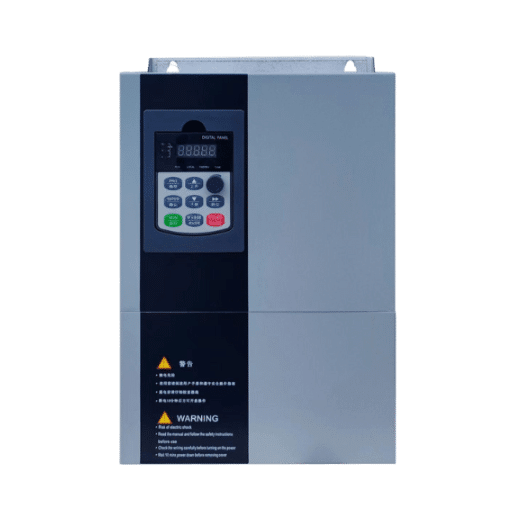
Ready to Get Your VFD Solution?
Whether you need a single drive or a complete system, we have the VFD products and engineering support to ensure your project's success.


The main disadvantages of a VFD are higher upfront cost, harmonic distortion, EMI interference, motor insulation stress, bearing currents, heat generation, partial-load efficiency losses, and added maintenance complexity. Every one of them is manageable with correct specification, but ignoring them turns a good investment into an expensive failure.
Here is a number worth remembering. Bearings rated for 100,000 hours of service have failed in under 720 hours on VFD-driven motors with no shaft grounding protection. That is not a defect in the drive. It is what happens when a drive is installed without accounting for the side effects that come with pulse-width modulated power.
We build variable frequency drives for a living, and we still tell some customers not to buy one. This guide covers the eight real disadvantages of variable frequency drive technology, quantified with field data, and pairs each one with the mitigation that neutralizes it. The goal is not to scare you away from drives. It is to make sure yours is specified correctly the first time. If you want the other side of the ledger first, our companion guide to the advantages of VFD lays out the energy, control, and protection benefits that make these drawbacks worth managing.
Key Takeaways
- The 8 core disadvantages of a VFD: cost, harmonics, EMI, insulation stress, bearing currents, heat, partial-load losses, and maintenance burden.
- A 6-pulse VFD can produce current distortion (THDi) up to ~95% without reactors or filters, threatening transformers and capacitor banks.
- Unprotected shaft currents can destroy motor bearings in 1-3 months; a $100 grounding ring prevents it.
- At 100% speed, a VFD uses 1-3% more energy than direct-on-line starting. Constant-speed loads should not have drives.
- Mitigation hardware adds 15-30% to project cost. Budget for it upfront or your payback math will be wrong.

The main disadvantages of a VFD are: higher purchase and installation cost, harmonic distortion on the supply, electromagnetic interference, voltage spikes that stress motor insulation, shaft currents that damage bearings, heat that demands enclosure cooling, efficiency losses at full speed or very light load, and the commissioning and maintenance skills power electronics require.
In summary form:
The table below maps each disadvantage to the applications it hits hardest and its primary fix. The sections that follow explain the mechanisms and the numbers.
| Disadvantage | Why It Happens | Most Affected Applications | Primary Mitigation |
|---|---|---|---|
| Upfront cost | Power electronics plus accessories | Small motors, fixed-speed loads | Correct application selection |
| Harmonics | 6-pulse rectifier draws non-sinusoidal current | Weak supplies, capacitor banks, generators | Line reactors, filters, AFE drives |
| EMI/RFI | Fast PWM switching radiates noise | Plants with sensors, instrumentation | Shielded cable, grounding, separation |
| Insulation stress | Reflected-wave voltage spikes on long cables | Long cable runs, old motors | dV/dt or sine wave filters, inverter-duty motors |
| Bearing currents | Common-mode voltage induces shaft current | Motors 75 HP+, long runs, high carrier frequency | Shaft grounding ring, insulated bearings |
| Heat | 2-5% of throughput becomes enclosure heat | Hot climates, sealed panels | Ventilation, derating, heatsink cleaning |
| Partial-load losses | Drive efficiency collapses below ~20% load | Oversized drives | Right-sizing, bypass for full-speed duty |
| Complexity | Parameters, tuning, consumable parts | Sites without electrical staff | Commissioning support, PM schedule |
Not sure whether these drawbacks apply to your application? Send your motor nameplate and cable run length to our engineering team and we will flag the risks before you spend anything.
A VFD typically costs two to three times more than a soft starter of the same rating, and roughly the same as the motor it drives. That is only the beginning of the bill. Shielded motor cable, input line reactors, harmonic filters, dV/dt filters, enclosures, and commissioning labor routinely add 15-30% on top of the drive price.
Raj, a project engineer at a beverage plant, initially budgeted $18,000 for four 25-horsepower (HP) pump drives based on catalog prices. However, after factoring in line reactors, shielded cables, and three days of commissioning costs, the actual installation expense reached $23,400—a 30% overrun that had to be covered by the contingency fund. Although the project ultimately paid for itself within 14 months, Raj included the costs of these essential ancillary hardware components in the budget from the outset when submitting proposals for subsequent projects.
The fix is not to avoid VFDs. It is to buy them only where speed control pays, and to price the complete system. Our guide to the VFD payback period shows how to build that business case with full installed cost, and why catalog pricing understates it by 30-50%.
A standard 6-pulse VFD rectifier draws current in short pulses rather than a smooth sine wave. Research on VFD harmonic generation and mitigation puts unmitigated current distortion (THDi) as high as 80-95%, dominated by the 5th, 7th, 11th, and 13th harmonics.
Those harmonics do real damage upstream. They overheat transformers and neutral conductors, resonate with power factor correction capacitors until the capacitors fail, and cause nuisance breaker trips. Harmonics also add 1-2% in motor losses. Facilities subject to IEEE 519 limits can find themselves out of compliance after a large drive installation.
Mitigation is well established. A 3-5% line reactor cuts THDi roughly in half. Passive harmonic filters bring it below 8%. Twelve-pulse, 18-pulse, and active front end drives address it at the source. The right choice depends on how much drive load your supply carries; the fix costs money, which is why it belongs in the project budget from day one.
The same fast switching that makes a VFD efficient also makes it a radio noise source. IGBTs switching thousands of times per second radiate electromagnetic interference that couples into nearby signal wiring. Symptoms include drifting 4-20 mA sensor readings, corrupted encoder feedback, and fieldbus communication errors.
This is one of the most preventable VFD drawbacks. Shielded VFD cable with the shield bonded at both ends, a low-impedance grounding system, and physical separation between power and control wiring eliminate most EMI problems at installation. Skip them, and you will spend weeks chasing “ghost” instrumentation faults.

A VFD’s output is not a sine wave; it is a train of steep voltage pulses. On long cable runs, those pulses reflect at the motor terminals and can momentarily double in amplitude, a phenomenon called reflected wave. Voltage spikes the motor was never designed to see then hammer the winding insulation thousands of times per second.
The consequences are cumulative. Insulation failure probability rises with switching frequency, and a standard motor on a long cable run can see its service life cut in half compared to direct-on-line operation. Motor-side voltage distortion approaching 70% has been measured in poorly designed installations.
Three mitigations cover nearly every case. Specify inverter-duty motors with reinforced insulation for new installations. Add a dV/dt filter or load reactor when cable runs exceed about 30 meters, and a sine wave filter beyond 100 meters. Keep cable runs as short as the installation allows. Our VFD programming guide also covers carrier frequency settings, since lower switching frequencies reduce spike energy at the cost of more audible motor noise.
VFD bearing currents are the disadvantage that catches even experienced maintenance teams off guard. A VFD’s high-frequency common-mode voltage capacitively couples onto the motor shaft. When shaft voltage exceeds the breakdown threshold of the bearing grease film, it discharges through the bearing. Each discharge is a tiny arc that pits the race, a process called electrical discharge machining.
Over time the pitting forms washboard ridges known as fluting, accompanied by grease degradation and a distinctive whining noise. Specialists in VFD-driven motor repair document bearings failing within one to three months of commissioning, and cases where bearings designed for 100,000 hours survived less than 720. Bearing protection research identifies shaft currents as a leading cause of premature bearing failure on driven motors.Because this single mechanism can undo years of expected service, our guide to protecting VFD motor life explains how shaft grounding, insulated bearings, and correct carrier settings keep a driven motor running for its full rated lifespan.
Paul, a maintenance supervisor at a Midwest grain facility, replaced the drive-end bearing on the same 100 HP fan motor three times in eleven months. Each failure showed identical frosting on the race. A shaft grounding ring costing under $150 ended the failure cycle immediately; the motor has now run four years on one set of bearings. The ring, or an insulated non-drive-end bearing on larger motors, is cheap insurance that should be specified with the drive, not after the third failure.
A VFD is 95-98% efficient at rated load, which means 2-5% of everything it processes becomes heat inside your panel. On a 100 kW drive, that is up to 5 kW of continuous heat, roughly two domestic space heaters sealed in an enclosure.
Heat is the primary killer of drive electronics. Electrolytic DC bus capacitors follow the Arrhenius rule of thumb: every 10°C above rated temperature roughly halves their service life. Nuisance overtemperature trips in summer are usually a ventilation problem, not a drive fault.
Mitigation is straightforward but must be designed in: size panel ventilation or air conditioning for the drive’s heat dissipation figure, derate the drive for high ambient temperatures, and clean heatsinks and filters on a schedule. An enclosed drive in a 45°C compressor room is a drive that will trip in July.
Of all the disadvantages of VFD drives, this one is the least understood. A VFD consumes 1-3% of throughput power in its own conversion losses. If the motor runs at 100% speed continuously, the drive saves nothing and costs that 1-3% forever. The energy math goes negative.
At the other extreme, drive efficiency collapses at very light load. Below about 20% of rated output, efficiency can fall to 20-70%, so an oversized drive loafing along on a small motor wastes a surprising share of the power it draws.
The fixes are application discipline and right-sizing. Reserve VFDs for loads that genuinely vary. Size the drive to the motor, not to some hypothetical future motor. For full-speed duty with only a starting problem, a soft starter at one-third the cost is correct engineering, as our comparison of VFD vs soft starter differences explains in detail.

A soft starter has almost nothing to configure and almost nothing to wear out. A VFD has dozens of parameters that must match the motor and load, plus consumable components on a replacement schedule: cooling fans every 3-5 years, DC bus capacitors every 7-10 years.
Misconfiguration is its own failure mode. Wrong motor data, an aggressive deceleration ramp, or a skipped protection setting can trip the drive repeatedly or damage the driven equipment. Troubleshooting power electronics also demands skills a general maintenance crew may not have.
None of this is a reason to avoid drives; it is a reason to plan for them. Commission against a checklist, back up the final parameter set, keep one spare drive for critical lines, and put fans and capacitors on the PM schedule. For most general industrial motors below 690V, our low voltage VFD systems ship with commissioning support and documented parameter sets to shorten that learning curve.
Honest guidance has to name the cases where the disadvantages outweigh every benefit. Skip the VFD when:
Choosing the simpler starter in these cases is not cutting corners. It is correct specification. Our decision guide on when to use a VFD walks through the full framework, including the positive cases where a drive pays back in months.
We apply the same standard to our own quotes. Last year a distribution center asked us to price drives for two 5.5 kW exhaust fans that run 45 minutes per shift at full speed. Every benefit of the VFD was irrelevant to that duty cycle, so we recommended standard starters at one-fifth the cost. The customer came back six months later for drives on their air handling units, an application where the math actually worked.

Five questions tell you whether the disadvantages are manageable line items or deal-breakers for your installation:
Four or five yes answers means these VFD problems and solutions are manageable line items with standard mitigation. Two or fewer means the honest answer is probably a soft starter. When the answer is yes, specification quality determines whether you get the savings or the failure stories. Our engineering team reviews load profiles, cable runs, and supply conditions before quoting, because the mitigation hardware is part of the drive system, not an optional extra.
Not when correctly specified. VFDs can damage motors through two mechanisms: dv/dt voltage spikes that erode winding insulation, and shaft currents that flute bearings. Both are prevented with inverter-duty motors, output filters on long cable runs, and shaft grounding rings. An unprotected standard motor on a long cable run is where the damage stories come from.
On variable-torque loads like pumps and fans running 4,000+ hours per year, yes: typical payback is 6-18 months even after full installed cost. On constant-speed or low-hour loads, no. The value question is always application-specific, never a property of the drive itself.
Most VFD harmonics problems start with the 6-pulse rectifier, so start the fix with a 3-5% line reactor, which cuts current distortion roughly in half and costs little. For stricter limits, add a passive harmonic filter (THDi below 8%) or specify a 12-pulse, 18-pulse, or active front end drive. Measure THDi at the point of common coupling after installation to verify compliance.
A quality industrial VFD delivers 10+ years of service. Cooling fans need replacement every 3-5 years and DC bus capacitors every 7-10 years as preventive maintenance. Ambient temperature is the biggest variable: every 10°C above rating roughly halves capacitor life.
Yes, with precautions. Short cable runs (under 30 meters), a moderate carrier frequency, and a shaft grounding ring on larger motors make standard motors acceptable in many applications. For new installations, long cables, or motors above 75 HP, an inverter-duty motor with reinforced insulation is the safer specification.
The eight disadvantages of a VFD are real: higher cost, harmonics, EMI, insulation stress, bearing currents, heat, partial-load losses, and maintenance burden. Every one of them has a proven engineering mitigation, and every mitigation is cheaper than the failure it prevents. The plants that get burned are the ones that priced the drive and skipped the system around it.
The honest summary is this: on the right load, with filters, grounding, and cooling designed in, a VFD remains the single best energy investment in most industrial facilities. On the wrong load, or installed without mitigation, it becomes an expensive lesson.
Want the risks flagged before you buy? Contact our engineering team with your motor data and cable run lengths for an application review, or browse our VFD product range to see drives and mitigation accessories specified together. The right system costs less than the wrong drive.