Ready to Get Your VFD Solution?
Whether you need a single drive or a complete system, we have the VFD products and engineering support to ensure your project's success.

A Variable Frequency Drive (VFD) is a crucial component in modern industrial applications, offering precise control over the speed and torque of AC motors. By adjusting the frequency and voltage supplied to the motor, VFDs enable operators to optimize performance for various tasks, such as plastics and rubber extrusion. This technology not only enhances energy efficiency but also contributes to the smooth operation and longevity of the equipment.
In plastic and rubber extrusion, VFDs play a vital role in ensuring the optimal functioning of extrusion systems. By allowing operators to control the speed and torque of extruder motors, VFDs help achieve the desired plastic output in terms of quality and consistency. The ability to fine-tune motor speeds reduces energy consumption, lowers maintenance costs, and enhances the overall reliability of the extrusion process.

When selecting a VFD for your extruder, it’s crucial to consider several factors to ensure optimal performance and compatibility.
Verifying motor compatibility is the most critical first step. You must ensure the VFD’s voltage, phase, and horsepower (or kW) ratings align with your motor’s nameplate data. More importantly, because extruders are constant torque applications that demand high power even at low speeds, the VFD must have a “Heavy-Duty” or “Constant Torque” amperage rating that meets or exceeds the motor’s Full Load Amp (FLA) rating. Using a “Normal Duty” drive designed for fans or pumps will lead to tripping and failure. For optimal performance and motor life, it is also highly recommended to use an inverter-duty rated motor.
For extrusion, the VFD’s control features are paramount for ensuring product quality and system reliability. Standard V/F control is insufficient; you must select a drive with high-performance Sensorless Vector or Flux Vector Control. These advanced modes provide the precise torque and stable speed regulation necessary to maintain consistent screw speed, even as material viscosity changes. Look for a drive that can deliver high starting torque (typically 150% or more at low frequencies) to turn a loaded screw, and ensure it has the necessary analog and digital I/O or communication protocols (like EtherNet/IP or Modbus) to integrate seamlessly with your primary control system.
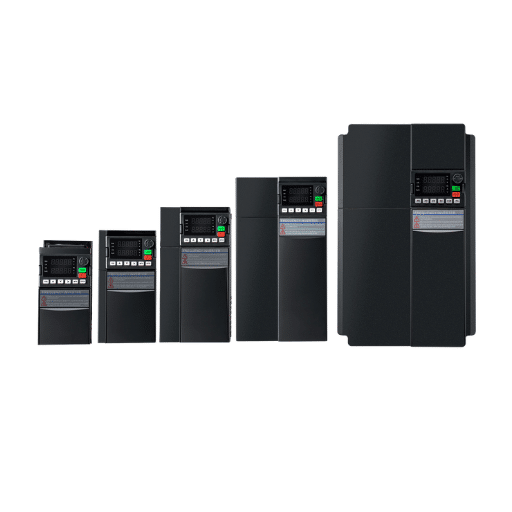
A compact, high-performance vector drive providing flexible customization and precise, energy-saving control for a wide array of extruder applications.
Technical features
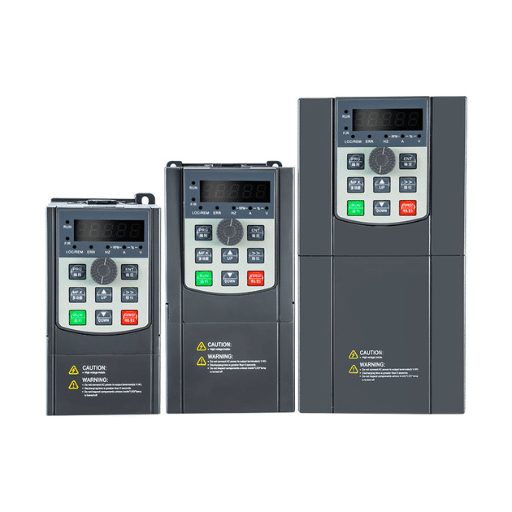
This universal VFD features a modern, compact design and superior heat dissipation, making it an adaptable solution for numerous systems.
Technical features

A heavy-duty vector VFD delivering high-torque output at low speeds, designed for the most demanding industrial extruder applications.
Technical features
As technology advances, the future of VFDs in industrial applications looks promising. Innovations in VFD design focus on enhanced automation, improved energy efficiency, and integration with smart manufacturing systems. Additionally, advancements in digital technology will enable more precise control and monitoring of motor speeds and torque, paving the way for even greater optimization in plastic extrusion and other industrial processes.
Fine-tune motor RPM to maintain exact melt flow and pressure, ensuring consistent product dimensions and quality from start to finish.
Our VFDs deliver stable, full torque even at very low speeds, which is critical for starting up with a full barrel and processing high-viscosity materials without motor strain.
:A VFD-powered extruder consumes energy proportional to its workload. This can reduce electricity consumption by up to 30% compared to older DC drives or hydraulic systems.
This table summarizes the critical parameters and specifications users consider when selecting a VFD for an extrusion application.
| Parameter | Specification / Requirement |
|---|---|
| Control Mode | Sensorless Vector (SVC) or Flux Vector (FVC) |
| Application Duty Rating | Constant Torque (CT) or Heavy Duty (HD) |
| Starting Torque | 150% - 200% of rated torque at <1 Hz |
| Speed Regulation | ≤ 0.5% (SVC) |
| Overload Capacity | 150% for 60 seconds (minimum) |
| Output Amperage (FLA) | Must be ≥ Motor FLA (at CT/HD rating) |
| Input Voltage | 3-Phase 380-480V (most common) |
| Dynamic Braking | Transistor included (Braking resistor may be external) |
| Communication | EtherNet/IP, Modbus TCP/IP, Profinet |
| Enclosure Rating | NEMA 1 (IP20) for cabinets, NEMA 12 (IP54) for dusty areas |
Selecting the optimal VFD requires careful consideration of your motor specifications, application requirements, environmental conditions, and performance objectives. Our technical team provides comprehensive support throughout the selection and implementation process.
We assist with:



A VFD provides superior screw speed control because it maintains a set speed with extreme accuracy, regardless of changes in load or material viscosity. Unlike older DC drives, which can suffer from speed drift and require frequent adjustments, a modern extruder VFD uses advanced algorithms to hold the motor’s RPM steady. This results in more consistent melt pressure, tighter dimensional tolerances, and higher product quality.
The energy savings are significant. A VFD ensures the motor only uses the energy required for the specific speed and load, which can reduce electricity consumption by up to 30% compared to older DC drives or inefficient hydraulic systems. This efficiency is especially noticeable in applications that don’t always run at 100% speed, leading to a substantial reduction in operational costs.
No, it requires significantly less maintenance. The AC induction motors used with VFDs are brushless, which eliminates the need for regular inspection and replacement of motor brushes—a common maintenance task for DC motors. This reduction in maintenance leads to less downtime and lower long-term ownership costs.
“High torque at low speed” refers to the VFD’s ability to deliver maximum turning force even when the screw is rotating very slowly. This is critical during a “cold start” when the barrel is full of solid polymer. A high-torque plastics drive can overcome this initial resistance without overloading the motor, preventing costly downtime and potential equipment damage. It is also essential for processing high-viscosity materials that require more force.
The primary advantage is consistency. Precise screw speed control directly translates to a stable melt flow and uniform pressure within the extruder barrel. This consistency is key to eliminating variations in product dimensions (like wall thickness or diameter), reducing surface defects, and ensuring uniform material properties throughout the production run, thereby minimizing scrap rates.
The precise control offered by a VFD allows you to create specific “recipes” for different polymers. You can fine-tune the screw speed to match the unique melt characteristics of various materials, from low-viscosity resins to highly-filled compounds. This flexibility enables you to optimize the extrusion process for each specific job, ensuring better performance and quality across a wider range of products.