Ready to Get Your VFD Solution?
Whether you need a single drive or a complete system, we have the VFD products and engineering support to ensure your project's success.

A Variable Frequency Drive (VFD) is an essential component in modern machine control systems, particularly in CNC machine tools. By utilizing a frequency inverter, VFDs adjust the frequency of the power supplied to the motor, allowing for precise control of motor speed and torque. This adjustment is critical in achieving optimal machine performance and energy efficiency.
In the realm of industrial automation, the use of VFDs is indispensable. They provide a sophisticated means of controlling the speed and torque of motors, which is vital for the seamless operation of CNC machines. With VFDs, manufacturers can achieve high-performance levels, reduce mechanical stress, and extend the lifespan of equipment by optimizing motor speed and torque for specific tasks.

Discover how VFD technology solves the most common machine shop problems and transforms operational efficiency
Most high-performance machine tools require three-phase power, but your shop only has single-phase service. Installing three-phase lines costs $5,000-$15,000 or more.
✔ The VFD Solution:
VFD systems convert your existing single-phase 220V power directly into clean three-phase output, eliminating the need for expensive phase converters or utility upgrades. Install in hours, not weeks.
Traditional machine tools require stopping the machine, opening covers, manually repositioning belts or changing pulleys every time you need a different speed. This wastes time and reduces productivity.
✔ The VFD Solution:
Electronic variable speed control allows instant adjustment from 0-5000 RPM while the machine is running. Simply turn a dial or press a button. No more downtime, no more frustration.
Standard motors run at full speed constantly, wasting enormous amounts of energy even during light loads or idle time. Energy costs can account for 60% of industrial electricity consumption.
✔ The VFD Solution:
VFDs match motor speed precisely to the actual load requirement, reducing energy consumption by 30-50%. Most installations achieve ROI within 6-18 months through energy savings alone.
Direct-on-line motor starting creates massive mechanical shock – up to 7x normal running current – that damages bearings, couplings, gears, and belts. This leads to frequent repairs and shortened equipment life.
✔ The VFD Solution:
By reducing the motor speed during periods of low demand, a VFD dramatically lowers the operational noise of the HVAC equipment. This creates a quieter and more pleasant indoor environment.
Belt-driven machines suffer from speed variations due to belt slip, wear, and temperature changes. This causes visible chatter marks, poor surface finish, and dimensional inconsistencies.
✔ The VFD Solution:
Crystal-accurate digital speed control maintains ±0.5% speed stability regardless of load variations. Achieve mirror-finish surfaces and repeatable precision on every part.
Running incorrect speeds for different materials dramatically shortens tool life. Too fast causes excessive heat and tool wear; too slow reduces productivity and can cause chip loading issues.
✔ The VFD Solution:
VFDs provide real-time data on motor performance (current, voltage, speed) and log fault codes. This predictive capability allows maintenance teams to identify issues early, reducing downtime and simplifying troubleshooting.

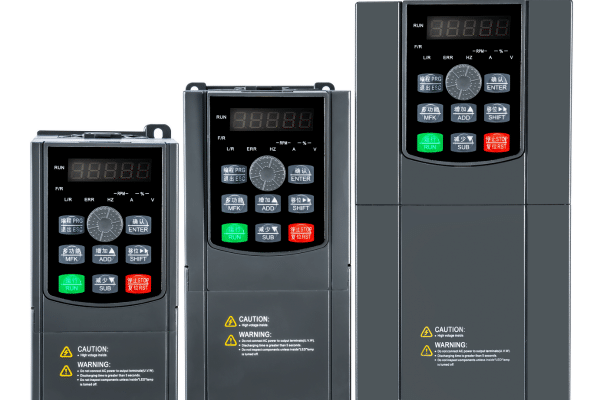
A compact, high-performance vector drive offering flexible customization and precise, energy-saving control for various machine tool operations.
Technical features

This universal VFD features a modern, compact design and superior heat dissipation, making it an adaptable solution for numerous systems.
Technical features

A heavy-duty vector drive providing high-torque output at low speeds, ensuring robust and precise control for demanding industrial tasks.
Technical features
Professional-grade VFD systems engineered for demanding machine tool applications
When selecting a Variable Frequency Drive (VFD) for your CNC machine tool, several critical factors must be considered. First, the power and voltage requirements of your motor and drive system are paramount. A VFD must match the motor’s ratings to ensure efficient performance and prevent mechanical stress. Additionally, the type of control system you plan to integrate, such as a programmable logic controller (PLC), can influence your choice of VFD, as compatibility with existing systems is essential. Another consideration is the desired level of torque control, which impacts precision in machining operations. Finally, assessing the environment where the VFD will operate is crucial, as factors like temperature and humidity can affect the device’s lifespan and reliability.
Various VFD models offer diverse features that can significantly impact CNC machine tool performance. Key features to compare include vector control capabilities, which enhance torque and motor speed management, and the ability to support high-performance servo drives. Some VFDs offer advanced speed control options, allowing for precise adjustments to the motor’s speed and torque to match specific operational needs. It is also important to examine the inverter technology employed, as a frequency inverter or frequency converter can provide different benefits in terms of energy efficiency and control precision. Understanding these features enables informed decisions that align with both performance goals and budget constraints.
Optimizing motor control with VFDs involves fine-tuning several parameters to achieve desired outcomes. By adjusting motor speed and torque, VFDs can improve CNC machine efficiency significantly. Implementation of a robust control system, possibly through the integration of motor controllers and PLCs, ensures real-time monitoring and adjustments. Utilizing advanced vector control and programmable settings, operators can tailor the VFD’s performance to specific machining tasks, enhancing both precision and energy efficiency. Regular maintenance and updates to the VFD’s firmware also contribute to sustained optimal performance, ensuring the CNC machine operates at peak efficiency with minimal downtime.
Industrial-grade performance for demanding machine tool applications
| Feature | Specification |
|---|---|
| Input Voltage Range | 200V - 690V (Low Voltage) |
| Output Frequency | 0.1Hz - 400Hz |
| Power Range | 0.4kW - 500kW |
| Control Method | V/F Control, Vector Control, Torque Control |
| Overload Capacity | 150% for 60 seconds, 180% for 10 seconds |
| Efficiency | ≥98% |
| Startup Torque | 200% at 0.5Hz |
| Communication Protocol | Modbus, Profibus, CANopen, Ethernet |
| Protection Level | IP20, IP54, or IP65 for industrial environments |
| Operating Temperature | -10°C to +50°C |
| Cooling Method | Forced air cooling |
| Display | LED/LCD display for real-time monitoring |
| Safety Features | Overvoltage, undervoltage, overload, short circuit, and overheat protection |
| Harmonic Control | Built-in DC reactor and optional harmonic filter |
| Noise Level | Low noise operation with optimized PWM control |
| Applications | Lathes, milling machines, grinders, CNC machines, and other precision tools |
| Frequency Resolution | 0.01Hz |
| Power Supply Options | AC220V, AC380V, or DC24V |
Selecting the optimal VFD requires careful consideration of your motor specifications, application requirements, environmental conditions, and performance objectives. Our technical team provides comprehensive support throughout the selection and implementation process.
We assist with:


Choosing the right VFD for a CNC machine tool involves considering factors such as the motor’s power requirements, the type of application, and specific features like acceleration and deceleration rates. It’s essential to match the VFD’s specifications with the motor’s needs to ensure optimal performance and efficiency while minimizing maintenance costs.
Utilizing a VFD in CNC milling machines provides numerous advantages, including improved machining quality, cost savings, and the ability to achieve superior surface finishes. VFDs allow for a wide speed range, enabling operators to adjust the speed according to the material and machining requirements, thus enhancing productivity.
A VFD improves control over machine components by allowing precise adjustments to the motor speed and torque. This capability leads to better management of acceleration and deceleration times, reducing mechanical stress on motors and extending their lifespan. It also enhances the control solution for various CNC machine applications.
A VFD inverter plays a critical role in machine tool applications by converting fixed-frequency AC power into variable frequency and voltage output. This transformation enables the motor to operate at different speeds, providing the flexibility needed for diverse machining tasks and improving overall machine performance.
Yes, implementing a VFD can significantly reduce maintenance costs for CNC machines. By enabling smoother start and stop operations and allowing for gradual acceleration and deceleration, VFDs minimize wear and tear on motors and other components, leading to fewer breakdowns and lower maintenance requirements.
VFDs are primarily compatible with AC motors, including induction motors and synchronous motors. They can effectively control single-phase and three-phase motors, making them suitable for various CNC machines and other machine tools. This versatility allows for tailored solutions based on specific application needs.