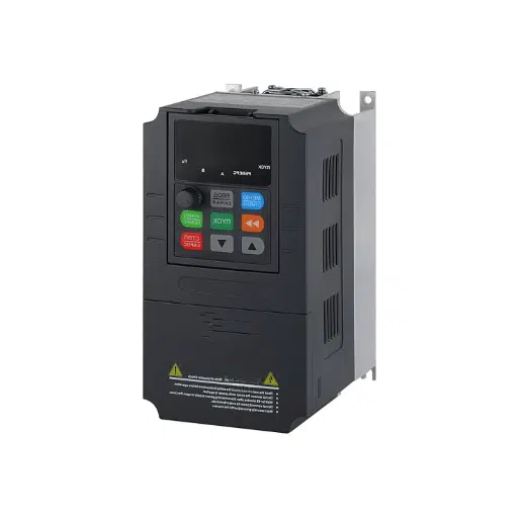
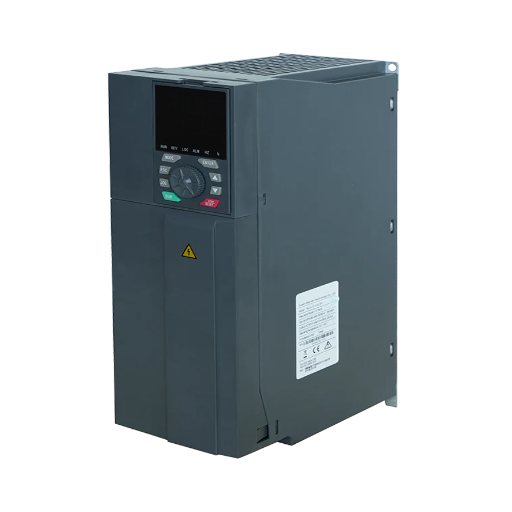
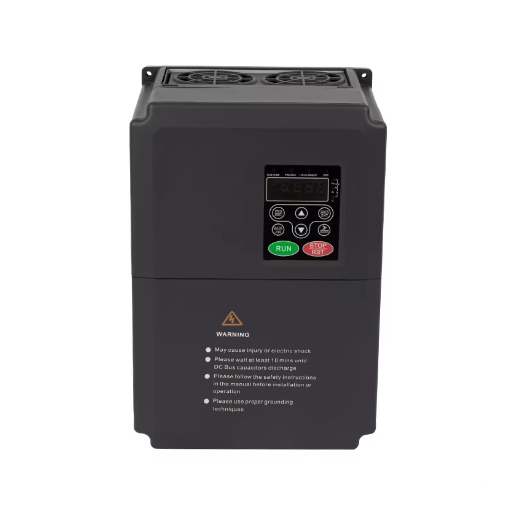
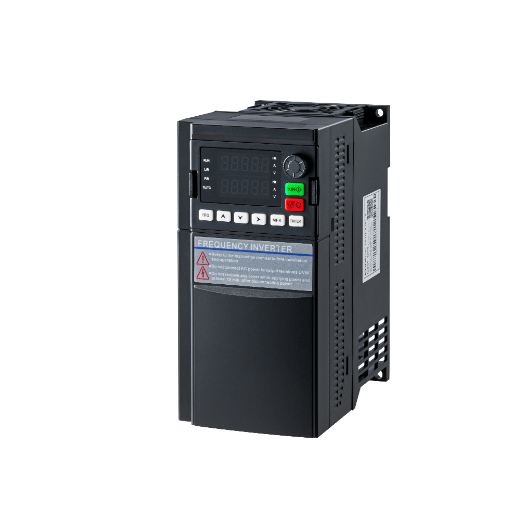
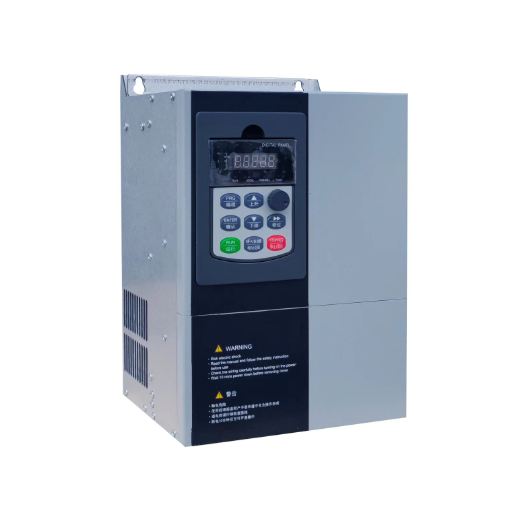
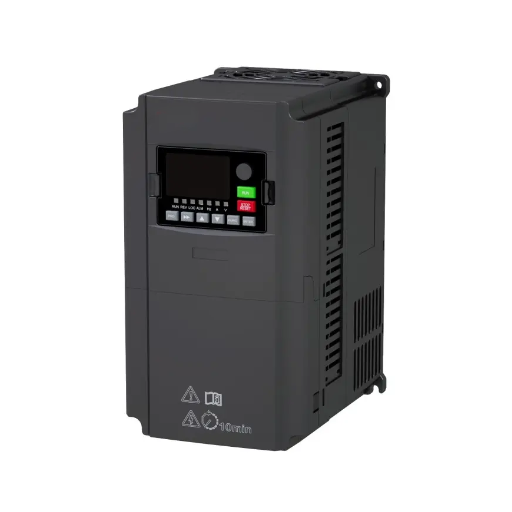
Ready to Get Your VFD Solution?
Whether you need a single drive or a complete system, we have the VFD products and engineering support to ensure your project's success.

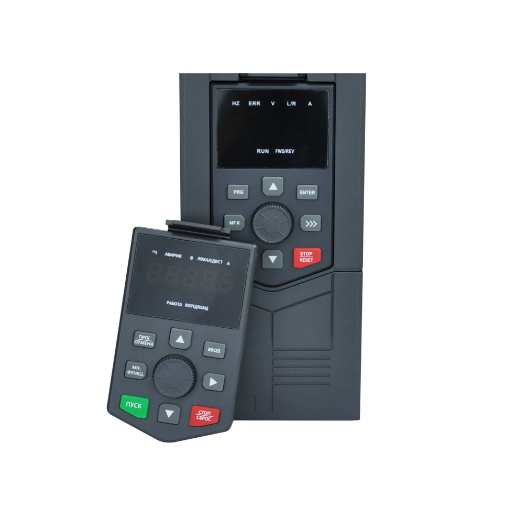
AC drives for HVAC are selected by duty rating, ambient, harmonics, and BAS protocol, not by kW alone. Use this datasheet checklist before you specify.
AC drives for HVAC are variable frequency drives rated for variable-torque fan and pump duty. The right unit is selected from the motor’s full-load current and the site conditions, not from the kW rating alone.
Consider a 45 kW cooling tower fan. Motor and drive are both 45 kW, and the plant room reaches 46 °C in August. The drive’s datasheet rates full output only to 40 °C and derates above it.
It trips on over-temperature in its first week. The fix is ventilation, relocation, or a larger frame.
Matching kW feels safe because it’s on both nameplates. But kW hides the lines that decide survival: overload rating, ambient derating, and protocol list. This guide gives you a five-line screen, a nameplate table, and a fire sequence independent of the building network.
If you have a motor nameplate and a plant room, send the details to our engineers and we will check the frame before you order.
Key Takeaways
- AC drives for HVAC share the power stage with general-purpose drives; the duty rating, firmware, and presets differ.
- ABB and Yaskawa publish 110% for 60 seconds in variable-torque duty; a 150% drive cannot be compared by kW alone.
- A drive rated at 40 °C without derating can trip in a hotter plant room; apply ambient and altitude derating first.
- IEEE 519 limits harmonic current at the point of common coupling, not the drive terminals.
- Fire override must be triggered from the fire alarm panel, not the BAS, and the fault response must be specified.
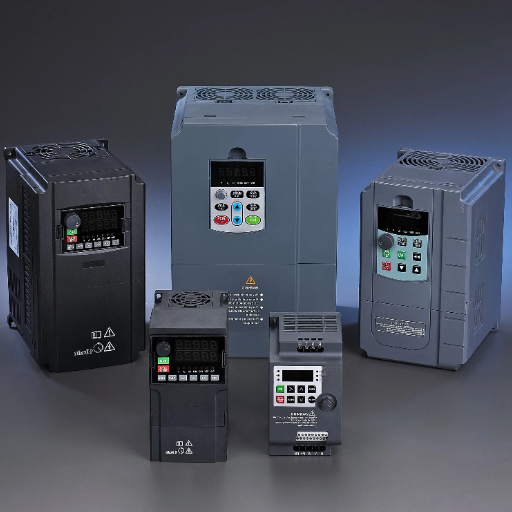
An AC drive is another name for a variable frequency drive. Its rectifier, DC link, and inverter are the same hardware whether the label says HVAC or general purpose.
What changes is the software and the published duty. HVAC drives ship with presets for fans and pumps: PID loops for static pressure or temperature, sleep and wake, damper control, flying start, and building automation protocols. A general-purpose drive can do the same work after configuration, but it may not ship with the presets, the protocol, or the same variable-torque rating.
Most HVAC loads are variable torque. A centrifugal fan or pump needs torque that rises with the square of speed, so the drive can be rated for less breakaway torque than a conveyor. That is why the same motor can often sit behind a smaller HVAC drive.
The energy case for VFDs in HVAC systems follows the fan law. At a fixed impeller diameter, fan power varies with the cube of speed. A 10% speed reduction leaves about 73% of the power, a 27% saving. A 20% reduction leaves about 51%, a 49% saving.
Background video: how the rectifier, DC link, and inverter stages work. The selection rules below are independent of any brand.
Not every HVAC fan needs an AC drive. An EC plug fan has a brushless DC motor and integrated speed control, so it accepts a 0-10 V or Modbus signal directly. ebm-papst reports that EC fans are often 30-50% better at part load, but the gap narrows at full speed.
If the AHU is new with EC plug fans, the drive may be redundant; for an existing AC motor, a drive or direct-on-line starter can be the better choice.
The fastest way to compare AC drives for HVAC with a general-purpose drive is the overload table, not the kW column.
ABB publishes 110% for 1 minute every 10 minutes and a 135% peak for 2 seconds on the ACH580 in variable-torque duty (ABB ACH580 catalog). Yaskawa publishes 110% for 60 seconds, 140% for 2 seconds, and 175% instantaneous on the HV600 (Yaskawa HV600 catalog).
A general-purpose drive such as the Shandong Electric YC-5000 publishes 150% for 60 seconds and 180% for 10 seconds. That is a constant-torque rating; it doesn’t make the drive interchangeable with an HVAC drive at the same kW.
The drive’s continuous current is set at the intended overload. A 30 kW general-purpose drive and a 30 kW HVAC drive can differ in variable-torque duty. Compare output current at the overload you will use, then compare price.
A constant-torque load on an HVAC drive usually needs one frame size larger. For a conveyor, crane, or positive-displacement pump, start with a constant-torque drive or upsize the HVAC unit.
The motor nameplate gives five values that decide the drive frame.
| Nameplate field | What it decides |
|---|---|
| Voltage and phase | Drive voltage class and input wiring |
| Full-load current (FLA) | Continuous drive current, the first selection number |
| Frequency and base speed | Motor pole count and maximum speed setting |
| Service factor | Whether the motor can run above nameplate current |
| Motor type and duty | V/F, sensorless vector, or closed-loop control; inverter-duty check |
Start with FLA. A 30 kW, 400 V, 4-pole motor at 0.86 power factor and 0.93 efficiency draws about 54 A: 30,000 divided by 1.732 times 400 times 0.86 times 0.93. The same motor at 480 V draws about 45 A. If the drive’s continuous output current is below the motor FLA at the site voltage, the drive is too small regardless of its kW label.
Don’t add a 15% service factor on top automatically. Service factor is a motor capability, not a drive requirement. Confirm the running current and the drive’s continuous rating at the plant room ambient. An oversized drive costs more, takes more panel space, and can run at light load with a poorer power factor (Fuji Electric).
For a chiller compressor, confirm start torque and overload with the equipment supplier.
Once the current is known, five lines decide whether the drive fits.
Look for the variable-torque line. ABB’s ACH580 publishes 110% for 1 minute every 10 minutes; Yaskawa’s HV600 publishes 110% for 60 seconds. A general-purpose drive may publish 150% for 60 seconds. The higher number signals a different load.
ABB rates the ACH580 from -15 °C to +50 °C, derates output above +40 °C, and derates above 1,000 m altitude. Yaskawa rates the HV600 at 40 °C for IP20 and IP55, 50 °C for a protected chassis, and up to 60 °C with derating. A 46 °C plant room is outside the un-derated range for both.
Record the maximum summer ambient at the drive, not the average, and add its heat release to the room load.
UL Type 1 suits clean indoor rooms. Type 12 adds dust and dripping-liquid protection; IP21 and IP55 are the IEC equivalents. A plenum rating matters when the drive sits in an air path. A sealed IP55 unit dissipates heat through its surface, so clearance matters more than on an open Type 1 unit.
ABB declares the ACH580 to EMC category C2. Yaskawa builds an EMC filter into the HV600 and declares IEC 61800-3 compliance for restricted distribution.
The filter is half the answer. Cable length and switching frequency interact, and some drives restrict the highest switching frequencies above a stated cable length. Check the cable table before mounting. Our guide to motor cable length limits covers the layout.
A six-pulse drive draws non-sinusoidal current. ABB fits an optimized DC link choke to the ACH580-01; its ultra-low-harmonic ACH580-31 publishes 3% or less THDi with unity power factor. Yaskawa fits a 5% split choke.
IEEE 519 applies at the point of common coupling, to the aggregate load. For a weak supply with a short-circuit ratio below 20, the TDD limit is 5.0% (IEEE 519-2022 Table 2 summary). A single drive at its terminals will exceed that number; that isn’t a violation.
Decide the method before you buy: choke, line reactor, passive filter, 12-pulse, or active front end.
| Datasheet line | Published example | What to write in the schedule |
|---|---|---|
| Overload | 110% for 60 s, variable torque | “110%/60 s VT minimum; state the continuous current at 40 °C” |
| Ambient | 40 °C without derating | “Rated current at 46 °C after derating; heat release stated” |
| Enclosure | UL Type 1/12, IP21/IP55, plenum | “Type 12 for washdown areas; plenum rated where in air path” |
| EMC and cable | C2 filter, cable table | “C2 filter; maximum motor cable length stated with switching frequency” |
| Harmonics | DC choke, 3% THDi AFE option | “Method and expected TDD at the PCC; IEEE 519 study if required” |
The Shandong Electric YC-5000 page lists 200-690 V, 0.4-500 kW, a built-in DC reactor, IP20/IP54, and -10 °C to +50 °C. Confirm these on the model datasheet; our low voltage VFD systems page shows the ranges.
Have a datasheet open? Send the model and site conditions, and we will check the overload, ambient, and harmonic lines.
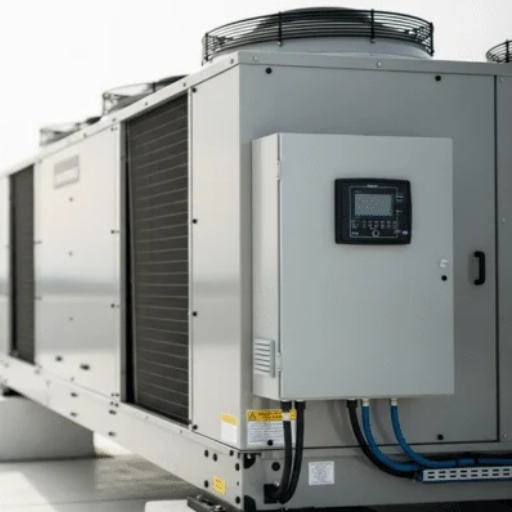
A drive that runs the fan but can’t talk to the BAS is a commissioning problem.
An AHU VFD holds duct static pressure. A chilled-water pump holds differential pressure. A cooling tower fan may hold condenser water temperature.
All three need a PID loop with feedback, a setpoint, and a usable range. PID control in a VFD covers tuning.
Sleep and wake stop the drive at low demand and restart when feedback drifts. Flying start catches a spinning fan after a power interruption. Damper control opens the damper before the drive runs. These are standard HVAC expectations, but not every general-purpose drive ships with them.
ABB embeds BACnet MS/TP, Modbus RTU, and Johnson Controls N2 in every ACH580; BACnet/IP and LonWorks are optional. Yaskawa embeds BACnet (BTL certified), Siemens APOGEE FLN, N2, and Modbus, with LonWorks and EtherNet/IP as options.
The Shandong Electric YC-5000 lists Modbus, Profibus, CANopen, and Ethernet, but not native BACnet. If the schedule says BACnet MS/TP, confirm the gateway or option card before you order. A gateway isn’t always a problem, but it changes the point count, wiring, and commissioning time.
Keep the safety and status points hardwired even when the drive has a network card. Specify:
Fuji Electric makes the same point for critical cooling systems: keep hardwired enable, run-status, and critical-alarm signals so key functions do not depend solely on the network. A BAS that is offline should not be able to stop a fan the fire service needs.
A school retrofit specified drives with Modbus while the BAS used BACnet MS/TP. The integrator added gateways and the electrician pulled separate status wiring for the smoke control fans. The project lost a week to a detail on page one of the datasheet.
The drive is the part with the manual, but the motor is the part that fails in the ceiling void.
A drive output is a switched waveform, not a sine wave. Long motor cables increase reflected-wave voltage at the motor terminals, and fast switching edges stress the winding insulation. The manual gives a maximum cable length and a switching-frequency limit. Stay inside both.
If the fan is farther from the drive than the recommended cable length, an output reactor or a dV/dt filter may be needed. The motor cable length guide explains the options. Don’t solve a long-cable problem by raising the switching frequency; that usually makes it worse.
Common-mode voltage from the drive can create shaft voltage and bearing currents, especially on larger motors. The risk rises with motor size, cable length, and switching frequency. Insulated bearings, a grounding ring, or a common-mode choke are the usual countermeasures. Above roughly 30 kW, ask the motor supplier about bearing protection.
A single drive can run several fan motors in parallel, but only within limits. Use V/f control, size the drive current for the sum of the motor currents, and give each motor its own overload protection.
An encoder can’t be used for closed-loop control on more than one motor from a single drive. If the fans need independent speed or precise static pressure, separate drives are cleaner. Our HVAC VFD systems page covers the product side; the VFD in HVAC systems guide covers the application side.
A “fire mode” checkbox isn’t a specification. ABB states that no general safety standard governs override implementation in drives; consultants must examine the details (ABB override guide).
In ABB’s implementation, override is triggered by a single digital input from the fire alarm relay or the firefighter’s station. The drive ignores other analog, digital, communication, and keypad commands and cannot exit until the fire signal is reset. Low-priority faults are ignored; overcurrent, earth leakage, and short circuit can still trip, with a programmable number of restarts.
Write the sequence into the specification:
A packaged bypass adds contactors that run the motor directly if the drive fails. ABB’s E-Clipse bypass includes a bypass starter, a disconnect, and electronic overload protection; Yaskawa’s includes a 3-contactor bypass and a smoke purge override. Bypass helps life-safety fans, but it doesn’t replace the override sequence. It must still receive the fire signal and protect the motor.
Consider a hospital test where the override signal was routed through the BAS. The BAS was offline for a network upgrade, so the drive never entered override.
The circuit was rewired to the fire panel, and the test passed. The drive was fine. The signal path was wrong.
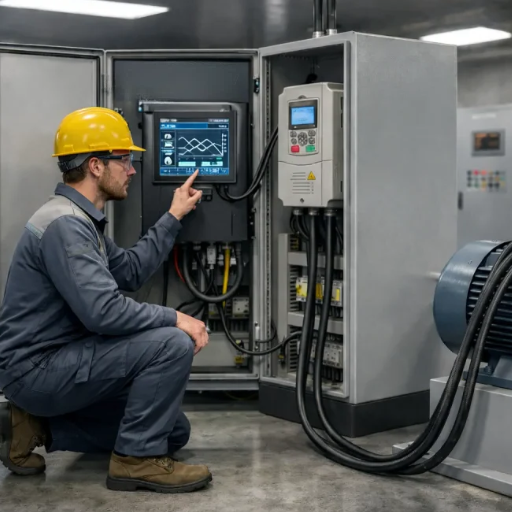
A specification error usually shows up in the first hour. Check five points:
Our HVAC VFD commissioning guide covers parameter and tuning steps. For a larger retrofit, the VFD for HVAC systems guide covers the project sequence and energy calculation.
An AC drive for HVAC is a variable frequency drive configured for fan and pump duty. It holds static pressure, differential pressure, or temperature, and ships with presets such as PID, sleep/wake, damper control, and BAS protocols.
The power stage is the same. The differences are the variable-torque overload, the firmware presets, and the embedded protocols. ABB and Yaskawa rate their HVAC drives at 110% for 60 seconds; a general-purpose drive may publish 150%. Compare output current at the intended overload, not kW.
Yes, in V/f mode only. Size the drive current for the sum of the motor currents, give each motor its own overload relay, and do not use encoder feedback for more than one motor. Use separate drives if the fans need independent control.
It needs whatever protocol the BAS uses. BACnet MS/TP is common, and ABB and Yaskawa embed it. Modbus RTU is also common. If the drive doesn’t list the protocol natively, confirm a gateway or option card, and keep the critical status points hardwired.
Price is set by frame size, enclosure, harmonic method, bypass, and protocol card, not kW. A 30 kW drive with an active front end and bypass can cost more than a 45 kW basic unit. Ask for a like-for-like quote.
AC drives for HVAC are not chosen by matching kW on two nameplates. They are chosen by motor FLA, the variable-torque overload, the ambient, the enclosure, the harmonic method, and the BAS protocol. The five-line screen catches the errors that commissioning would otherwise find.
Start with the nameplate, write the values into the schedule, and test the fire sequence with the BAS offline. That is the difference between a drive that runs and a drive that passes the witness test.
Send your motor nameplate, supply details, maximum ambient, and BAS protocol to our engineers for a compatibility check before you release the order.