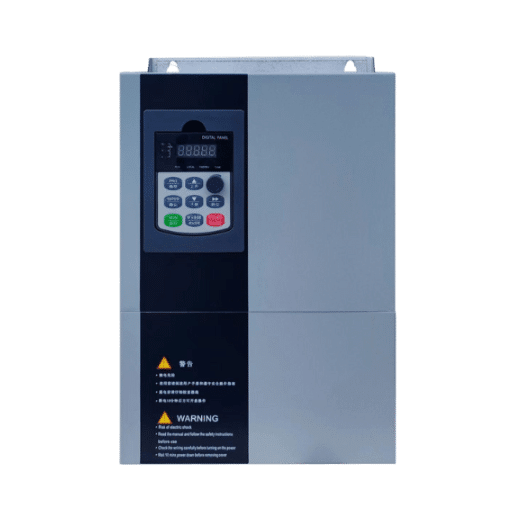
Ready to Get Your VFD Solution?
Whether you need a single drive or a complete system, we have the VFD products and engineering support to ensure your project's success.


A low-voltage VFD is a motor control device that depends on altering frequency and voltage to control speed and torque and typically functions at or below 690 Volts. It is the most common kind of VFD based on a unit basis, used in HVAC, water treatment, manufacturing, and food industries.
On Tuesday Marcus Chen found himself in the mechanical room of his 200,000-square-foot distribution centre and for the first time in months did what he was reluctant to do. He picked up the maintenance log for the four 50 HP cooling tower fans and calculated their yearly electricity bill: $32,000. A big number from four fans, when every one of them was in overdrive, basically running twenty-four-seven, even in 60-degree-plus weather. Such waste!
Marcus is not alone. Factory managers, facilities engineers, and procurement teams across every industrial sector face the same problem: they have motors running at a fixed speed and burning the energy they need not have consumed. The low voltage variable frequency drive offers a technically mature solution, one that is very financially attractive and much simpler to install than most buyers think.
By the end of this guide, you will know exactly which low voltage VFD you need for your application, how much it will save you, and how to install it, including harmonics and compliance issues. We will explore what they are; how you can make your selection; where they deliver the highest returns; and the required certifications you will need for your market.
Key Takeaways
- Low voltage VFDs (220V-690V) control 80% or more of the global VFD market by unit volume.
- Modern LV drives achieve 96-98% efficiency, with vector control now standard even on compact units.
- HVAC fan retrofits typically pay back in 12-24 months; water treatment pumps in 18-36 months.
- Selection requires matching control mode to load type: V/f for fans, vector for conveyors and positioning.
- Global compliance (UL, CE, CCC) is non-negotiable for export; plan certification into your procurement timeline.

A low voltage variable frequency drive (LV-VFD) forms an important type of frequency or voltage adjustable motor speed controller, which can transform input power through fixed frequency and fixed voltage into output speed, or frequency, voltage adjustable as required. In industry terms, the low range for VFDs is anything from 220V-690V AC input. This so largely covers about all industrial and commercial motor applications worldwide.
When it comes to volume, LV drives represent more than 80% of the total VFDs sold worldwide, just because they cater to an 80-horsepower level and even below. Yet something critical to admit is that power infrastructure has been most generally installed at 230V, 400V, 480V, or 575V. A low voltage VFD fits right into the power infrastructure. No step-down transformers needed. No special switchgear.
The low-voltage range in drives extends from fractional-horsepower brands for minor equipment up to 1000kW (1350HP) spread at the upper end while becoming economically non-profitable. Beyond that volume, medium-voltage drives come around.
Every low voltage VFD, regardless of brand or size, follows the same three-stage topology.
Rectifier stage: After the incoming AC voltage passes through a diode or IGBT bridge, it gets changed into DC voltage. Modern drives adopt active front ends (AFEs) incorporating IGBTs designed to minimize harmonics and enable regenerative braking. However, passive diode bridges are still widely used in the lower-end models.
DC bus stages: Capacitors and sometimes inductors do the smooth operation of DC voltage after its rectification. The DC bus acts as an energy bank, disconnecting the power at the next input stage, creating a clean, variable-frequency waveform.
Inverter stage: IGBTs or silicon carbide (SiC) MOSFETs control whether the DC bus voltage is on or off in a pulse-width modulated (PWM) pattern. By varying the pulse-width and the order in which they are switched, the inverter recreates a three-phase AC waveform of the desired frequency and voltage. The motor sees a smooth sine wave which dictates how fast it needs to go.
Modern drives using IGBT or SiC technology achieve 96-98% efficiency at rated load. That means for every 100 kW of mechanical power delivered to the motor, only 2-4 kW is lost as heat inside the drive. Advances in semiconductor switching, covered in detail by Control Engineering, continue to push these efficiency figures higher while reducing drive size and cost.
The boundary between low voltage and medium voltage drives is not arbitrary. IEC standards define low voltage as up to 1,000V AC, but the practical industry dividing line for VFDs sits at 690V input. Above 690V, drives require different semiconductor technology, larger clearances, and more sophisticated cooling systems.
For buyers, the choice between LV and medium voltage (MV) comes down to motor power and infrastructure. LV drives feed motors up to about 1,000 kW directly. Beyond that, cable sizing becomes impractical, and MV drives at 3.3 kV, 6 kV, or 10 kV become the economical choice. If your application is below 500 HP and your facility has standard 480V or 400V distribution, a low voltage VFD is almost certainly the right choice.
Want to see the full comparison? Our upcoming guide on low voltage vs high voltage VFD selection breaks down cost tables, infrastructure requirements, and the exact power thresholds where each technology wins.
For a deeper technical breakdown of the performance comparison, application scenarios and selection logic between low voltage and high voltage drives, see our Low Voltage Drive vs High Voltage Drive guide.

Selecting the right low voltage VFD is not about buying the most expensive unit with the longest feature list. It is about matching the drive to your motor, your load, and your environment. Follow this five-step framework.
Start with your motor nameplate. Record the rated voltage, full-load amperage (FLA), and power in kW or HP. Your VFD must match or exceed the motor voltage. The VFD current rating should be at least equal to the motor FLA, and ideally 10-15% higher to account for harmonic heating and temperature derating.
If you are running the drive in ambient temperatures above 40 degrees C (104 F), apply a derating factor. Most manufacturers publish derating curves. A drive rated for 50 A at 40 C may only deliver 40 A at 50 C. Account for this upfront, or the drive will trip on overload during summer months.
Control mode determines how the drive commands torque and speed. For 70% of fan and pump applications, simple V/f control is sufficient and costs 20-30% less than vector-capable drives. V/f maintains a fixed voltage-to-frequency ratio. It is simple, robust, and energy-efficient for variable-torque loads.
Sensorless vector control estimates motor flux and torque without an encoder. It provides better speed regulation (typically 0.5% vs 2-3% for V/f) and higher starting torque. This is the sweet spot for most conveyor, mixer, and general machinery applications.
Encoder-based vector control (also called flux vector or closed-loop vector) uses a physical encoder on the motor shaft. It delivers precise speed control down to 0.01% and full torque at zero speed. Reserve this for positioning applications, winders, and hoists where accuracy matters.
Direct torque control (DTC) is available on premium drives from ABB and a few others. It calculates torque and flux directly rather than through current control loops, giving extremely fast dynamic response. Unless you are running high-performance servos, DTC is overkill.
Loads that impose a torque contingent on speed, power demands now become bigger to the speed-square. These stands easiest corners for VSDs, basically because the energy conservations are unlike. Each 20% decrease in speed will decrease power consumption by near 50 percent.
Loads of constant torque (conveyors, mixers, extruders) are very difficult for VSDs but, are big energy-saving areas which is usually about 15-25; alongside these savings, the major advantage in their favor is that a very high level of process control is acquired with less mechanical wear.
High-impact or cyclic loads (cranes, presses, centrifuges) require drives with high overload capacity. Look for 150% overload for 60 seconds as a minimum. If your load cycles rapidly, also verify the braking resistors of the drive or even consider if an offer of regenerative units is needed.
The kind of enclosure will apply loads on the drive’s electronics. IP20 means clean electrical rooms. If it is going to be close to a dust source, a mixing tank, or outdoor applications, very good enclosure interference may be IP54 or NEMA 12. For use in washed environments, IP66 or NEMA 4X is the requirement.
Altitude also plays its part in cooling. Air density decreases above 1,000 meters (3,300 feet), reducing the capacity for heat dissipation. Derate the drive by 1% approximately with every 100 meters above 1,000; otherwise, choose a high-altitude-specific drive system.
Modern low voltage VFDs are not standalone devices. They are nodes on your automation network. At minimum, ensure the drive supports Modbus RTU over RS-485. For tighter integration, look for Modbus TCP, PROFINET, EtherNet/IP, or BACnet for building automation.
Also check the onboard I/O. Basic drives offer a few digital inputs and one analog output. If you need multiple speed presets, external fault inputs, or analog feedback, count the I/O points before you buy. It is cheaper to specify the right drive than to add external relay modules later.
Need help matching a drive to your motor? Our VFD sizing guide for motor selection walks through FLA matching, derating calculations, and load-type selection with a printable worksheet.
Not every application has room for a wall-mounted drive cabinet. Control panels, MCC buckets, and skid-mounted packages demand smaller footprints. Compact low voltage VFDs and compact VFD systems address this without sacrificing capability.
For applications involving a VFD for small motors, compact drives offer an ideal form factor. Fractional horsepower to 5 HP motors pair naturally with these smaller units, minimizing panel space and installation cost.
For a deeper technical breakdown of small motor VFD application timing, operation methods and key precautions, see our VFD for Small Motors guide.
Compact VFDs typically range from 0.1 kW to 22 kW (0.125 HP to 30 HP) and measure 100 mm to 200 mm in width for the smaller units. At the 5.5 kW (7.5 HP) level, a compact drive like the Delta MS300 or Siemens SINAMICS V20 occupies roughly 40% less panel space than a standard bookshelf drive.
The trade-off is usually thermal management and I/O count. Compact drives run hotter per unit volume and may omit isolated analog inputs or relay outputs found on larger chassis. For simple fan or pump duty, this rarely matters. For complex machinery with multiple feedback signals, verify the I/O map carefully.
Many compact drives support zero-clearance side-by-side mounting, meaning you can pack them shoulder-to-shoulder without the 50 mm air gap standard units require. This can cut panel depth by 30% or more. Check the manufacturer’s derating rules for side-by-side installation, typically a 5-10% current reduction.
DIN rail mounting is standard on drives below 2.2 kW (3 HP). It simplifies installation and replacement. Above that power level, bolt-on mounting becomes necessary due to weight and vibration.
Most compact low voltage VFDs are programmed for standard induction (asynchronous) motors. If you are driving a permanent magnet synchronous motor (PMSM) or a brushless DC motor, verify that the drive supports PM motor control. This requires different flux estimation algorithms. Running a PM motor on an induction-motor V/f profile will produce poor torque and potentially damage the motor.
If you are working with tight panel space and wondering how control mode choice interacts with drive size, our compact VFD selection guide covers physical sizing alongside performance.

Most buyers overspend on vector control they do not need. Understanding when each control mode is appropriate saves money and prevents performance disappointments. This section covers vector control low voltage drive selection from V/f through encoder-based systems.
For control-mode-specific commissioning, see our vector control commissioning walkthrough.
V/f control is the original VFD algorithm. It maintains a constant ratio of voltage to frequency. The motor’s magnetic flux stays stable. For centrifugal pumps, HVAC fans, and simple conveyors, V/f delivers perfectly acceptable performance at the lowest cost.
The limitations show up when you need precise speed holding under load variation. They also appear when you need high starting torque for heavy loads, or operation at very low speeds. V/f drives typically slip 2-3% at rated load. A commanded 1,500 RPM becomes 1,455-1,470 RPM actual. For a cooling tower fan, this is irrelevant. For a conveyor feeding a packaging line, it can cause product jams.
Sensorless vector control (SVC) uses a mathematical model of the motor to estimate rotor flux and position without a physical encoder. It delivers 150% starting torque, 0.5% speed accuracy, and stable operation down to roughly 5 Hz. For the majority of industrial machinery, this is more than adequate.
When Sarah Patel, operations engineer at a municipal water treatment plant, replaced the fixed-speed drives on her four lift station pumps with sensorless vector units, she gained two benefits. First, the VFDs matched pump speed to inflow, cutting energy use by 34%. Second, the torque control eliminated water hammer on start-up, extending pipe fitting life by reducing pressure spikes from 85 psi to 42 psi.
SVC is now standard on most mid-range low voltage VFDs above 2.2 kW. The price premium over V/f is typically 10-15%, not the 50% it was a decade ago.
Encoder-based (closed-loop) vector control requires a rotary encoder mounted on the motor shaft. The encoder feeds position feedback to the drive. This enables 0.01% speed accuracy, full torque at zero speed, and precise position holding.
Use encoder feedback for winders where tension must stay constant regardless of roll diameter. Use it for hoists that must hold a load at standstill without a mechanical brake. Use it for positioning tables where repeatability is measured in millimeters. The encoder adds cost, typically $200-600, plus wiring complexity. Do not specify it unless your application genuinely requires it.
| Load Type | Recommended Control | Why |
|---|---|---|
| Centrifugal pumps, fans, cooling towers | V/f | Lowest cost, adequate performance |
| General conveyors, mixers, agitators | Sensorless vector | Better speed holding, higher starting torque |
| Positioning, winders, hoists, elevators | Encoder-based vector | Precision speed and torque at all speeds |
| High-dynamic servos, flying shears | DTC or servo drive | Fastest torque response |
Low voltage VFDs are the workhorse of industrial motor control because they fit the power range where most motors actually operate. Here are the industries where they deliver the strongest returns.
Heating, ventilation, and air conditioning represents one of the largest addressable markets for low voltage VFDs and VFD for HVAC systems. AHU supply fans, return fans, chilled water pumps, and cooling tower fans all run on motors that are historically oversized and fixed-speed.
The economics are compelling. A 10-ton rooftop unit (RTU) supply fan running with a VFD saves approximately 610peryearat610peryearat0.10 per kWh. Cooling tower fans see 30-50% energy reductions. Payback periods run 12-24 months. The savings come from the affinity laws. Fan power varies with the cube of speed. Running at 80% speed cuts power to 51% of full-load.
Modern building automation systems (BAS) integrate low voltage VFDs via BACnet or Modbus, enabling demand-controlled ventilation. CO2 sensors modulate fan speed based on occupancy rather than running at design maximum all day.
For a deeper explore HVAC-specific selection and retrofit planning, see our guide on VFD for HVAC systems.
Water and wastewater treatment is energy-intensive. Pumping alone can represent 80% of a treatment plant’s electrical consumption. Low voltage VFDs on lift station pumps, filtration backwash pumps, and distribution booster pumps match flow to demand. No throttling with valves.
The standard lift station example illustrates the point. A 40 HP submersible pump running 6,000 hours per year at full speed consumes roughly 179,000 kWh. At 0.12perkWh,thatis0.12perkWh,thatis21,480 annually. Installing a low voltage VFD and matching speed to inflow reduces average power to 65% of full load. The savings are 62,650 kWh and $7,518 per year. Payback on the VFD and installation is typically 18 months.
Filtration systems benefit from precise flow control. Too fast, and media filters bypass; too slow, and throughput suffers. A VFD maintains optimal flow rates across varying filter head loss, extending media life and improving water quality consistency.
For water treatment pump VFD selection, see our application-specific guide.
Manufacturing applications exploit both the energy savings and the process control capabilities of low voltage VFDs. Conveyor lines use VFDs to coordinate speed between stations. The result: no product pile-up and no gaps.
When David Torres, production supervisor at a Midwest packaging facility, retrofitted his bottling line with vector-controlled VFDs, product spacing variation dropped from plus or minus 8 inches to plus or minus 1.5 inches. Labeling accuracy improved. Downstream jam frequency fell by 70%.
Machine tools benefit from smooth spindle acceleration. Rather than across-the-line starting that shocks gears and bearings, a VFD ramps the spindle to speed over two to five seconds. This extends mechanical life and allows optimal cutting speeds for different materials.
Air compressors with VFD inlet modulation maintain stable discharge pressure while unloading partially during low-demand periods. A fixed-speed compressor loads and unloads repeatedly, wasting energy during blow-down and reload. VFD-controlled rotary screw compressors reduce energy use by 25-35% in variable-air-demand environments.
Food processing demands both performance and cleanliness. Washdown-rated low voltage VFDs in IP66 or NEMA 4X enclosures withstand high-pressure cleaning and chemical sanitizers. Stainless steel housings prevent rust in wet environments.
Mixers and blenders use VFDs to maintain consistent product texture across batch sizes. A 100-gallon mixer and a 500-gallon mixer may use the same recipe but need different agitator speeds. The VFD stores multiple speed presets and ramps profiles for each product line.
Packaging machinery uses VFDs for precise film feeding, sealing bar positioning, and conveyor pacing. Vector control eliminates the speed drift that causes film registration errors and wasted material.
For energy savings calculations by application, see our energy savings guide.

Energy efficiency is no longer optional. It is a competitive advantage. Low voltage VFDs and energy saving VFD systems deliver measurable savings that finance departments can verify on utility bills.
Industry research from VFDs.com confirms that well-applied drives routinely cut pump and fan energy use by 30-50% in commercial and industrial settings.
The affinity laws govern centrifugal pumps and fans. They state that:
This cubic relationship is why VFDs create such dramatic savings. A 10% reduction in fan speed reduces power by 27%. A 20% reduction cuts power by 49%. A 30% reduction cuts power by 66%.
The math is simple. Speed cubed equals power. In practical terms, a 50 HP cooling tower fan running at full speed 24/7 wastes approximately 8,000peryearinelectricity.Dialitto708,000peryearinelectricity.Dialitto702,700. The VFD pays for itself in 14 months. The fan runs quieter, too.
| Application | Typical Energy Savings | Annual Savings (50 HP, $0.12/kWh) | Payback Period |
|---|---|---|---|
| HVAC supply fan | 30-50% | $3,800-6,300 | 12-18 months |
| Cooling tower fan | 30-50% | $3,800-6,300 | 12-24 months |
| Chilled water pump | 20-35% | $2,500-4,400 | 18-30 months |
| Water treatment pump | 20-40% | $2,500-5,000 | 18-36 months |
| Manufacturing conveyor | 15-25% | $1,900-3,200 | 24-36 months |
| Air compressor | 25-35% | $3,200-4,400 | 18-30 months |
These figures assume continuous operation. Intermittent-duty applications see longer payback but still benefit from reduced mechanical wear and improved process control.
To calculate payback for your specific application, use this formula:
Simple payback (years) = Total installed cost / Annual energy savings
Total installed cost includes the VFD, line reactor or filter, bypass contactor (if required), installation labor, and commissioning. For a 50 HP drive in a commercial building, installed cost typically runs $4,000-8,000 depending on enclosure type and harmonic mitigation requirements.
Utility rebate programs can cut payback by 30-50%. Many North American utilities offer prescriptive rebates of 50−200perHPforVFDretrofitsonfansandpumps.Someprogramscover5050−200perHPforVFDretrofitsonfansandpumps.Someprogramscover5050,000 for industrial facilities. Check with your utility before procurement; rebate pre-approval is usually required.
Rebate programs typically require pre- and post-installation verification. You will need baseline energy measurements from the existing fixed-speed system, usually one month of kWh data or short-term power logging. After installation, most programs require a follow-up inspection or submittal of commissioning reports.
ASHRAE 90.1 and IECC building codes now mandate VFDs on fan systems above certain horsepower thresholds in new construction and major renovations. Even if you are not pursuing rebates, code compliance may require VFD installation. Verify local amendments before design.
A VFD is only as reliable as its installation. Poor wiring, inadequate grounding, or skipped commissioning steps cause more field failures than defective drives.
Use stranded copper conductors rated for 75 C minimum. The NEC and IEC both require separate conduits for input power, output power to the motor, and control wiring. Never run motor cables in the same conduit as analog signal wires; the PWM switching creates electrical noise that can disturb 4-20 mA or 0-10 V signals.
Motor cable length matters. Standard drives can typically feed motors up to 50 meters (150 feet) without additional filtering. Beyond that, reflected wave phenomena create voltage spikes at the motor terminals. Those spikes damage insulation.
For cable runs over 50 meters, specify a dV/dt filter or a sinusoidal output filter. For runs over 150 meters (500 feet), a load reactor or sine-wave filter is mandatory.
Ground the VFD chassis to a dedicated earth ground using the shortest possible path. Do not daisy-chain ground connections from one drive to the next. Star grounding, where each drive’s ground wire returns independently to a central ground bus, minimizes ground loops and electromagnetic interference (EMI).
Shield motor cables at both ends. The shield acts as a Faraday cage, containing the high-frequency switching noise. Ground the shield at the drive end through a clamp or pigtail, and at the motor end through the motor junction box ground screw. Do not use the shield as a ground conductor for safety grounding.
VFDs draw non-sinusoidal current, creating harmonic distortion on the supply. IEEE 519 and IEC 61000-3-6 set limits on voltage total harmonic distortion (THD) at the point of common coupling.
For small installations with a single drive, a 3% line reactor on the input side typically reduces current THD from 80-100% down to 30-40%. This is usually sufficient for compliance.
For larger installations or sites with multiple drives, passive harmonic filters or active front end (AFE) drives may be required. AFE drives use IGBTs on the input side to draw near-sinusoidal current, achieving THD below 5%. They cost 30-50% more than standard drives but eliminate the need for external filters and reactors.
Before applying power:
At first power-up:
During load testing:
For detailed wiring and panel-layout guidance, refer to our low voltage VFD installation and wiring guide.

Exporting VFDs or installing them in multinational facilities requires understanding regional certification requirements. Non-compliant equipment gets held at customs, rejected by inspectors, or excluded from project bids.
Underwriters Laboratories (UL) listing is required for VFDs sold in the United States and Canada. UL 61800-5-1 covers adjustable speed electrical power drive systems. A UL-listed drive has been tested for fire, electric shock, and mechanical hazards under North American installation practices.
Look for the UL mark on the drive nameplate. CE marking alone does not satisfy NEC or CEC requirements. If you are sourcing drives from overseas for a US project, verify UL listing before shipment. Retrofitting non-UL drives into an installation can void insurance coverage and violate local electrical codes.
CE marking under the Low Voltage Directive (2014/35/EU) and EMC Directive (2014/30/EU) is mandatory for VFDs placed on the European market. The drive must carry a CE mark. It must also have a Declaration of Conformity from the manufacturer.
EMC compliance is particularly important. The drive must neither emit excessive electromagnetic interference nor be unduly susceptible to it. CE-marked drives include internal EMC filters. They specify shielded motor cable requirements. Installers must follow the manufacturer’s EMC installation notes precisely. Otherwise, the CE compliance claim is invalidated.
The China Compulsory Certification (CCC) mark is required for low voltage electrical equipment sold or used in China. VFDs fall under category CNCA-C03-02. A CCC-certified drive has passed testing by a Chinese-accredited laboratory.
For manufacturers exporting to China, CCC certification typically takes 3-6 months and requires factory audits. If your project specifies Chinese-market drives, build this lead time into your procurement schedule.
IEC 61800 is the foundational international standard for adjustable speed electrical power drive systems. It is divided into multiple parts:
Many countries use the IEC standards, while some take the national deviations. The AS/NZS 61800 series is adopted in Australia and New Zealand. JIS C 6010 is used by Japan; its content is largely harmonized with IEC with additional earthquake resistance testing for certain applications. India makes a requirement of BIS certification for imported electrical equipment by referencing IS 12615 and IS 9000 series standards.
It’s always a good idea to verify the specific certification requirements for your destination country before going ahead and specifying or procuring any drives. A drive that may be just the one for a German project may be totally out of compliance with an Indian installation.
VFDs typically operate in the 220V AC voltage range up to 690V AC, which includes the global standard commercial power distribution voltages, such as 230V, 400V, 480V, and 575V. By IEC standards, low voltage extends to 1,000V, but within the VFD industry, 690V represents the upper practical limit for low-voltage drive topology.
Yes, usually. For the most part, the standard induction motors produced after 1990 tend to be compatible with the VFD. though older motors with Class B insulation might require an output filter or reactor to protect the winding insulation from the PWM voltage spikes. If the motor was manufactured prior to 1990 or has been rewound using lower-grade insulation materials, either consult the motor manufacturer or perform an insulation resistance test on the motor before connecting a VFD.
A more typical low voltage VFD can last 10-15 years with proper installation and environmental conditions less than 40 C. It most commonly sees failure in the cooling fans, of a life of around 5 to 7 years, and DC bus capacitors, with a life of around 7-10 years, either of which can be replaced. Dust, heat, or corrosive atmospheres drastically shorten their life.
VFD creates non-sinusoidal current, therefore further causes the electrical supply with non-linear distortion. So, by being just one tiny drive, they never cause any problems. Multiple drives or drives, which are huge when compared to transformer capacity, might push voltage THD to loom up beyond IEEE 519 or IEC limits. Install line reactors, harmonic filters, or active front end drives as mitigation.
Undervoltage trips occur when the DC bus voltage falls below the drive’s minimum threshold, typically due to low incoming line voltage, voltage sags from utility events, or insufficient transformer capacity. Check input voltage under load. If sags are brief, some drives offer ride-through settings that maintain operation for 1-3 seconds during voltage dips.
Standard TEFC (totally enclosed fan-cooled) motors rely on an internal fan attached to the shaft. Below approximately 20-30% of base speed, airflow drops enough that the motor may overheat at full load torque. For continuous operation below 30% speed at high torque, specify a motor with independent forced ventilation (separate cooling fan) or derate the motor by 20-30%.
V/f Control system works on the principle of maintaining a fixed V/f ratio and inherently controlling speed in an open loop configuration. It is simple, cost-effective, and fairly adequate for pump and fan applications. Vector control either estimates or directly measures motor flux and torque and, thus, attains very precise regulation of motor speed, high starting torque, and stable operation at low speeds. For applications where speed accuracy is of utmost importance, the vector control shall be used for conveyors, mixers, etc.
Yes, but the savings are smaller than on variable-torque loads. A constant-torque load like a conveyor running at 80% speed still draws roughly 80% of full-load power, whereas a fan at 80% speed draws only 51%. The primary benefits on constant-torque loads are process control, reduced mechanical wear from soft starting, and the ability to match production rate to demand.
Annual maintenance should include: checking and tightening power terminals, inspecting cooling fans for dust buildup and bearing noise, verifying DC bus capacitor health through capacitance testing, cleaning heat sinks and air filters, and backing up parameter sets. In dusty environments, increase inspection frequency to quarterly.
Compact VFDs are a great choice when the panel space is bound to freedom, the application is relatively simple (few I/O points, no complex networking) and the power level is below 22 kW (30 HP). In case you need more I/O, advanced communication options, better thermal margins, or power levels exceeding 22 kW, a standard chassis or enclosed drive should be preferred. Compact drives are not inferior but simply optimized for space-constrained, lower-complexity applications.
Low voltage VFDs are the workhorse of industrial motor control for good reason: they integrate with the existing power infrastructure; power ranges fit most motors in operation as well as drives. The criteria of the suitability of this equipment are easy to measure in savings and, more importantly, from a speedy return on investment. Whether you are retro-fitting a cooling tower fan, sizing a drive for a new conveyor line, or specifying equipment for export, the principles as laid out in this guide provide a clear framework.
Start with notice of one application. Establish the energy baseline. Size the drive through these five steps. Use a return on investment (ROI) assessment to confirm savings. After you see the saving on your utility bill, rolling out to other systems becomes a simple decision.
If you need application-specific guidance or want to compare specifications across our low voltage VFD product range, our engineering team is available to review your motor nameplates, load profiles, and environmental conditions. We also invite you to browse our complete VFD product line to see the full range of voltages, power ratings, and control options we offer for global industrial markets.
For a deeper technical breakdown of industrial automation VFD PLC docking, fieldbus application and safety mechanism design, see our Industrial Automation VFD guide.