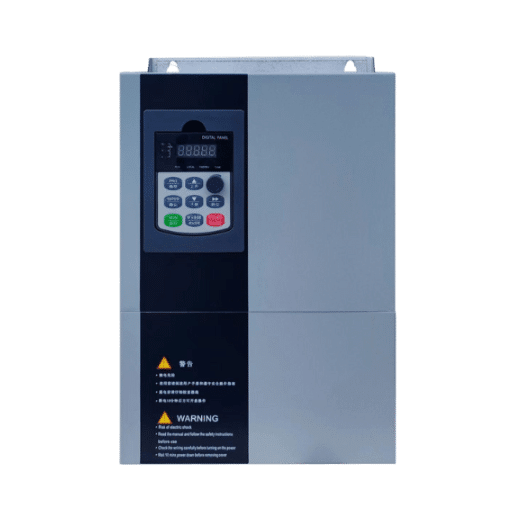
Ready to Get Your VFD Solution?
Whether you need a single drive or a complete system, we have the VFD products and engineering support to ensure your project's success.


A low voltage drive (220V to 690V) is the right choice for motors up to approximately 500 kW in most industrial applications, while a high voltage or medium voltage drive (3 kV to 10 kV) becomes economical above 1 MW or when cable runs exceed 500 meters. Between 500 kW and 1 MW, the decision depends on plant infrastructure, redundancy needs, and total installed cost including cables, transformers, and switchgear. Low voltage drives offer lower unit cost, simpler maintenance, and wider supplier choice. High voltage drives reduce cable copper, eliminate step-up transformers, and improve efficiency in very large motors.
A cement plant in Vietnam needed to drive a 1,200 kW raw mill fan. The engineering contractor proposed a single 6.6 kV medium voltage drive, quoting 180,000forthedriveplus180,000forthedriveplus45,000 for installation. The plant owner’s electrical manager questioned whether two 600 kW low voltage drives in a master-follower arrangement might be cheaper. Our team ran the numbers: two LV drives at 28,000each,plusa28,000each,plusa15,000 step-up transformer, plus 300 meters of 3 kV cable at 12,000,plustwomotorcontrolcentersat12,000,plustwomotorcontrolcentersat8,000 each. Total: 99,000installed.TheLVsolutionsaved99,000installed.TheLVsolutionsaved81,000 upfront. But the MV drive had 2% better overall efficiency at full load, saving $3,600 per year in electricity. The payback on the MV premium was 22 years. The plant chose the LV dual-drive arrangement. Two years later, when one drive needed a fan unit replacement, the mill kept running at 50% capacity. The single MV drive would have shut the entire line down for three days.
That story is the core thesis of this guide. A low voltage drive vs high voltage drive decision is never about motor kilowatts alone. It is about total installed cost, redundancy, maintenance capability, and plant infrastructure. This article walks through the voltage thresholds, cost comparisons, efficiency trade-offs, and application fit rules that determine which drive class wins for your specific project.
Key Takeaways
- A low voltage drive vs high voltage drive decision depends on total installed cost, not just the drive unit price. LV often wins below 1 MW even with transformers and cables included.
- IEC defines low voltage as up to 1,000V and medium voltage as 1 kV to 35 kV; NEMA defines low voltage as up to 600V.
- LV drives cost roughly 50−150perkW;MVdrivescost50−150perkW;MVdrivescost200-400 per kW, but MV eliminates transformer and cable losses over long runs.
- Multiple LV drives provide N+1 redundancy that a single MV drive cannot match, often making LV the better choice for critical processes.
- MV drives need specialized technicians for maintenance; LV drives can be serviced by in-house electricians with widely available spare parts.

For a broader view of the low voltage VFD landscape, see our complete selection guide. This article serves as a practical VFD voltage selection guide for specifying engineers. For our low voltage VFD systems, browse the product range.
The first step in any low voltage drive vs high voltage drive decision is understanding what the voltage classes actually mean. IEC 60038 defines low voltage as up to 1,000V AC and medium voltage as 1 kV to 35 kV. NEMA MG1 uses a lower threshold, defining low voltage as up to 600V. A low voltage vs high voltage VFD comparison starts with understanding the practical ranges. In practice, industrial VFDs cluster into two main camps. Low voltage drives cover 220V to 690V input, with output matching the motor voltage. Medium voltage drives cover 2.3 kV to 10 kV, with 3.3 kV, 4.16 kV, and 6.6 kV being the most common ratings. High voltage above 35 kV is rarely used in industrial VFD applications.
Low voltage drives span fractional kilowatts to roughly 2,000 kW when using parallel units, multi-pulse rectifiers, or master-follower configurations. Medium voltage drives typically start around 200 kW and extend to 30 MW or more. The overlap zone, roughly 200 kW to 2 MW, is where engineers spend most of their time debating the low voltage drive vs high voltage drive question. Below 200 kW, LV is almost always the answer. VFD below 690V applications cover the vast majority of industrial motors. Above 2 MW, MV is almost always the answer. In between, the decision requires a detailed analysis.
Low voltage drives cost roughly 50to50to150 per kW depending on features, brand, and control mode. A 500 kW LV drive might cost 35,000to35,000to55,000. Medium voltage drives cost roughly 200to200to400 per kW because they use series-stacked IGBTs or IGCTs, multi-level topologies, and extensive isolation systems. A 1,000 kW MV drive might cost 200,000to200,000to350,000. The unit cost gap is large, but it is only part of the story.
Low voltage systems need large motor cables because current is high. A 1 MW motor at 400V draws roughly 1,700A, requiring multiple parallel 240 mm2 cables or bus duct. Over a 300-meter run, LV cable cost can exceed 15,000.Iftheplantdistributionis400Vandthemotorisrated3.3kV,astep−uptransformeradds15,000.Iftheplantdistributionis400Vandthemotorisrated3.3kV,astep−uptransformeradds12,000 to $25,000 plus 1% to 2% continuous losses. Medium voltage systems use smaller cables because current is lower. A 1 MW motor at 6.6 kV draws roughly 110A, fitting easily in a single 70 mm2 cable. The MV drive connects directly to the MV bus, eliminating the transformer entirely.
Consider a worked example for a 1 MW motor with a 200-meter cable run. The LV path: drive (55,000)+step−uptransformer(55,000)+step−uptransformer(18,000) + cables (12,000)+MCC(12,000)+MCC(8,000) = 93,000.TheMVpath:drive(93,000.TheMVpath:drive(280,000) + cables (3,000)+switchgear(3,000)+switchgear(25,000) = 308,000.TheLVsystemcostsroughlyone−thirdoftheMVsystem.Butifthecablerunis800meters,LVcablecostjumpsto308,000.TheLVsystemcostsroughlyone−thirdoftheMVsystem.Butifthecablerunis800meters,LVcablecostjumpsto45,000 and the gap narrows. If the plant already has an MV bus, the MV switchgear cost drops and MV becomes more competitive.
Low voltage drives are serviced by in-house electricians. Control cards are hot-swappable. Power modules for common frame sizes are available from multiple suppliers with 24-hour delivery in most regions. Hourly labor rates for LV maintenance are standard industrial rates. Medium voltage drives require technicians trained on HV safety procedures. Power module replacement typically requires a plant shutdown. Spare parts have longer lead times and are sourced from the original manufacturer. Annual maintenance contracts for MV drives can cost 3% to 5% of drive price versus 1% to 2% for LV drives.
Need help comparing LV and MV costs for your project? Contact our application engineers for a total installed cost analysis including cables, transformers, and switchgear.

Modern LV VFDs achieve 96% to 98% efficiency at full load and 94% to 96% at 50% load. Modern MV VFDs with multi-level topologies achieve 97% to 98.5% at full load and 95% to 97% at 50% load. The gap is 1% to 2% in favor of MV, which is meaningful at very high power but modest in absolute terms. For energy savings by voltage class, see our detailed guide covering pumps, fans, and conveyors.
Drive efficiency is only one component of total system efficiency. LV cable losses follow the I-squared-R relationship. At 1,700A over 300 meters, copper losses can exceed 3% to 5% of motor power. A step-up transformer adds another 1% to 2% in continuous no-load and load losses. Medium voltage eliminates the transformer and cuts cable losses to under 0.5% because current is 15 times lower. The result: MV often wins on total system efficiency when cable runs exceed 400 meters, but LV can win when cables are short and the transformer is already in place.
Low voltage motor drive applications are the clear winner for motors under 500 kW in standard industrial plants. They also win when redundancy matters. A process line with four 250 kW pumps can run at 75% capacity if one LV drive fails. With a single 1,000 kW MV drive, a failure shuts the entire line down. LV is also preferred in plants with existing 400V or 480V distribution, where adding an MV bus would require major electrical infrastructure upgrades. For compact VFD systems for sub-200 kW motors, see our compact drive selection guide. For vector control in the low voltage range, see our commissioning walkthrough.
The main high voltage drive advantages appear for motors above 1 MW, especially when the plant already has an MV distribution bus. When to use high voltage VFD systems also includes long cable runs over 500 meters, where LV cable cost becomes prohibitive. Mining, marine, and oil and gas installations often have existing HV infrastructure and certified HV technicians, making MV the natural choice. Applications requiring direct-on-line bypass with an HV motor also favor MV because the bypass contactor is simpler at high voltage.
This is where the low voltage drive vs high voltage drive debate is most intense. The decision matrix includes four factors. First, does the plant have an MV bus? If not, LV is strongly favored. Second, is redundancy required? If yes, multiple LV drives beat a single MV drive. Third, what is the total installed cost including cables and switchgear? Run the numbers for both options. Fourth, does the plant have MV-trained maintenance staff? If not, LV is the safer long-term choice. For water treatment pump VFD selection, see our application-specific guide.
Standard 6-pulse LV drives produce total harmonic distortion (THD) of 30% to 80% on the input current, depending on impedance. This is the cheapest option but often requires external mitigation. A 12-pulse configuration uses a phase-shift transformer to cancel certain harmonics, reducing THD to 10% to 15%. An active front end (AFE) uses IGBTs on the input side to achieve THD under 5%, but adds 30% to 50% to drive cost. External active filters can be added to any configuration but cost 5,000to5,000to15,000 depending on power rating.
Medium voltage drives use multi-level topologies: neutral-point clamped (NPC), active NPC (ANPC), or cascaded H-bridge. These designs inherently produce cleaner output waveforms with lower dV/dt stress on motor insulation. The input rectifier stages are often 12-pulse or 18-pulse by design, achieving THD of 5% to 10% without additional filters. Many MV drives meet IEEE 519 compliance out of the box, while LV drives often need add-on mitigation to reach the same standard.
For a 1 MW system, a standard 6-pulse LV drive with line reactor achieves roughly 35% THD. Adding an active filter brings it to 5% at a total cost of 65,000(drive+filter).Amulti−levelMVdriveachieves865,000(drive+filter).Amulti−levelMVdriveachieves8280,000 (drive only). If IEEE 519 compliance is mandatory, the LV+filter combination is cheaper. If the plant has generous source impedance and THD is not a binding constraint, the MV drive’s inherent cleanliness is a bonus, not a deciding factor.

Low voltage drives have a smaller footprint. A 500 kW LV drive fits in a cabinet roughly 600 mm wide by 2,000 mm tall. Units can be wall-mounted or floor-standing and mounted side-by-side with minimal clearance. Medium voltage drives need significantly more space. A 1 MW MV drive cabinet is typically 2,400 mm wide by 2,200 mm tall, with mandatory front and rear access clearances for HV safety. Room ventilation requirements are also stricter because MV drives generate more heat per unit volume. For installation requirements for low voltage drives, see our complete installation guide.
Low voltage systems use standard molded-case circuit breakers (MCCB) or air circuit breakers (ACB), familiar to every industrial electrician. Medium voltage systems need vacuum circuit breakers, surge arresters, and specialized protection relays with lockout and arc-flash detection. Arc flash energy at 6.6 kV is orders of magnitude higher than at 400V, requiring greater working clearances, higher personal protective equipment (PPE) ratings, and stricter access controls. The switchgear room for an MV installation can cost 2 to 3 times more than the equivalent LV room.
A 1 MW LV installation at 400V requires either multiple parallel 240 mm2 cables per phase or bus duct. Cable trays are large, bending radii are generous, and raceways consume significant building space. A 1 MW MV installation at 6.6 kV uses a single 70 mm2 cable per phase. The cables are smaller and easier to route, but the terminations are specialized. HV terminations require skilled technicians, precise stress cone installation, and partial discharge testing after commissioning. A faulty MV termination can fail catastrophically, while a faulty LV termination typically just overheats and trips a breaker.
Reliability is where the low voltage drive vs high voltage drive calculation often flips in favor of LV. A single MV drive is a single point of failure. If the drive fails, the motor stops. A dual-LV configuration with two 500 kW drives feeding a 1 MW load provides N+1 redundancy. If one drive fails, the process continues at 50% capacity while repairs are scheduled. For critical processes where even a brief stop is expensive, this redundancy advantage can be worth more than the efficiency gain of a single MV unit.
Consider a worked scenario: a water treatment plant needs 1,000 kW of pump capacity. Option A is one 1,000 kW MV drive with MTBF of 120,000 hours and MTTR of 72 hours (specialized technician, factory parts). Option B is two 500 kW LV drives with MTBF of 100,000 hours each and MTTR of 8 hours (in-house electrician, local spares). The availability of Option A is 99.94%. The availability of Option B with one drive carrying the full load is 99.84% per drive, but with both drives running at 50% the system availability jumps to 99.999% because one drive can fail without interrupting service.
Low voltage drives use modular designs with hot-swappable control cards. Power modules for frame sizes up to 500 kW can often be replaced in under an hour by a qualified electrician. Spare parts are stocked by distributors worldwide. Medium voltage drives use custom power modules that are not interchangeable between manufacturers. Replacement requires a shutdown, specialized HV safety procedures, and often factory-trained personnel. The mean time to repair (MTTR) for an MV drive is typically 24 to 72 hours versus 2 to 8 hours for an LV drive.
Both modern LV and MV drives can achieve MTBF ratings of 100,000+ hours when properly maintained. MV drives have a slight theoretical advantage because lower current stress on semiconductors reduces thermal cycling degradation. However, in practice, environmental factors matter more than voltage class. Dust, temperature, vibration, and power quality issues cause more failures than the intrinsic voltage rating of the drive. A well-maintained LV drive in a clean electrical room will outlast a poorly maintained MV drive in a dusty mining environment.
Evaluating a dual-drive LV configuration vs a single MV drive? Our application team can model availability, total cost of ownership, and redundancy scenarios for your specific process requirements.
Individual low voltage VFDs are commonly available up to 1,000 kW at 400V or 690V. Above that, engineers use parallel drive configurations, multi-pulse rectifiers, or master-follower arrangements to reach 2,000 kW or more. The practical limit for a single LV drive cabinet is roughly 1,500 kW, though this varies by manufacturer and cooling method.
Medium voltage VFDs are 1% to 2% more efficient at the drive level due to multi-level topologies and lower switching losses. However, total system efficiency depends on cable and transformer losses. For short cable runs under 300 meters, LV plus a step-up transformer can match or exceed MV system efficiency. For long cable runs over 500 meters, MV almost always wins on total system efficiency.
Yes. Multiple LV drives in a master-follower or load-sharing configuration are a common alternative to a single MV drive. This approach typically costs 50% to 70% less upfront, provides redundancy, and allows in-house maintenance. The trade-off is slightly lower system efficiency and more control complexity. For motors between 500 kW and 1.5 MW, multiple LV drives are often the better choice.
IEC 60038 defines low voltage as up to 1,000V AC. NEMA MG1 defines low voltage as up to 600V. In industrial VFD practice, low voltage drives cover 220V to 690V. Medium voltage drives cover 2.3 kV to 10 kV. High voltage above 35 kV is rarely used in industrial motor control.
No. High voltage drives do not need less maintenance. In fact, they often need more specialized maintenance because HV components require certified technicians, factory-specific spare parts, and longer repair cycles. Low voltage drives can be maintained by standard industrial electricians with widely available parts. The MTTR for MV drives is typically 3 to 10 times longer than for LV drives.
Step up to medium voltage when the motor exceeds 1 MW, when cable runs exceed 500 meters, when the plant already has an MV distribution bus, or when the application requires direct-on-line bypass at high voltage. Between 500 kW and 1 MW, run a total installed cost comparison including cables, transformers, switchgear, and maintenance capability before deciding.
A low voltage drive vs high voltage drive decision is a system-level engineering choice, not a simple motor sizing exercise. The three rules are straightforward. First, match the voltage class to the motor size and plant infrastructure: LV below 500 kW, MV above 1 MW, and a detailed comparison in between. Second, compare total installed cost, not just drive price: cables, transformers, switchgear, and room space can flip the economics. Third, factor in maintenance capability and redundancy needs: multiple LV drives provide N+1 redundancy that a single MV drive cannot match.
If you are specifying a VFD system for a motor between 200 kW and 2 MW and want a neutral second opinion on LV vs MV total cost, contact our application engineers for voltage class selection support. We work across ABB, Siemens, Yaskawa, Schneider, and our own Shandong Electric LV and HV drive lines.