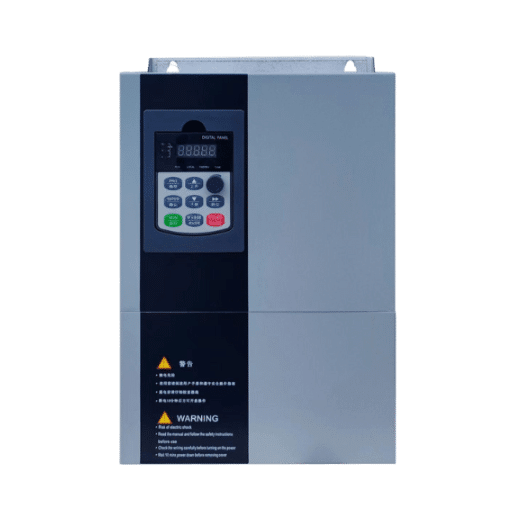
Ready to Get Your VFD Solution?
Whether you need a single drive or a complete system, we have the VFD products and engineering support to ensure your project's success.

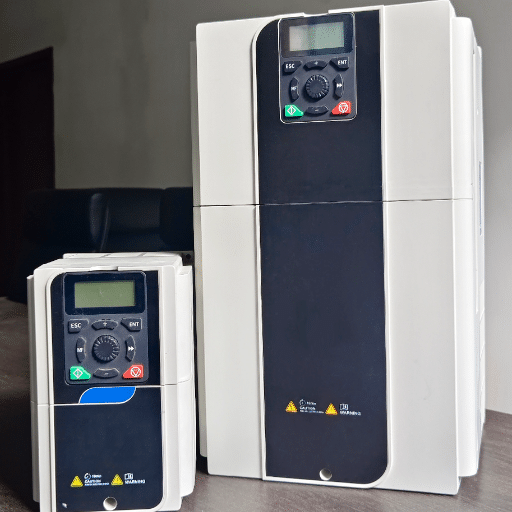
A variable frequency drive is basically an electronic motor controller that changes the frequency and voltage of the power sent to an AC motor, so you get sharper speed control while still using less energy—around 20 to 50 percent in pump and fan setups. It takes incoming fixed-frequency AC power and turns it into variable-frequency output using a sort of three step flow. first there is rectification, then DC bus filtering,and finally an inverter based pulse width modulation stage.
In a textile mill in Bangladesh, 47 motors were run at fixed speed all day and night. The monthly electricity bill was 48,000. After they installed variable frequency drives on just the 12 biggest loads, fans,pumps and air compressors the bill stayed 48,000. Then, after the rest of that same idea was fully applied on those 12 largest loads—fans,pumps,and air compressors— the bill went down to 31,000. That 35 percent cut covered the complete retrofit in about 14 months. The plant manager only real regret? not doing it sooner.
Stories like this are not exceptions. Electric motors consume approximately 60 to 70 percent of global industrial electricity. Most of them run at full speed even when the process only needs partial output. A variable frequency drive fixes this mismatch. It matches motor speed to actual demand, which cuts energy waste, reduces mechanical stress, and improves process control all at once.
By the end of this guide, you will understand pretty much exactly how a variable frequency drive works, how it fits in with a whole motor control system, and how to pick the proper one for your voltage class, load type , and surroundings. Whether you are a plant manager judging an energy retrofit, a procurement team sourcing drives for a new project , or an engineer building a control system, this guide gives you the technical baseline and an actual selection framework you need.
Key Takeaways
- A variable frequency drive controls AC motor speed by varying power frequency and voltage, which directly controls energy consumption.
- Modern VFDs operate at 96 to 98 percent efficiency and can cut pump and fan energy use by 20 to 50 percent through affinity law savings.
- Selection depends on six factors: voltage class, power rating, load type, control mode, environment, and communication protocol.
- VFDs differ from soft starters, VSDs, and AC drives in both function and application fit — choosing the wrong technology costs money and performance.
- A complete motor control system includes input protection, the drive, output filtering, and integration with PLC or SCADA networks.

If you’re new to the topic, our dedicated page on what is a variable frequency drive covers the fundamentals in full detail. A Variable Frequency Drive (VFD) is an electronic setup that steers the speed and torque of an AC electric motor, by shifting the frequency and voltage of the incoming power. Really the core idea is fairly plain: the motor speed ends up tracking the frequency of that electrical supply.
There’s a standard expression for it: N = 120 x f / p, where N means motor speed in RPM, f is frequency in hertz, and p is the count of motor poles. Take a 4-pole motor, fed by 60 Hz power, and you get a synchronous speed around 1,800 RPM. If you dial the frequency down to 30 Hz, the speed falls to 900 RPM. The VFD does that change with high precision, pretty much on its own, automatically.
This is important because industrial operations usually don’t ask for the full motor rate all day long. Like a cooling tower fan on a mild day, it doesn’t need to spin at 100 percent. And a water distribution pump at 2 a.m. , does not need the same flow as it does at 8 a.m. Keeping these motors running at peak speed and then “handling” the output with dampers or valves is a huge energy loss. With a variable frequency drive, the motor can slow when the demand drops, so power consumption drops too—following that rough cube trend tied to speed reduction.
You’ll also hear VFDs called different things depending on where you are and what people are talking about. In North America, “variable frequency drive” and “VFD” are the usual terms. In Europe and parts of Asia, people more often say “AC drive” or “frequency inverter”. “Variable speed drive” (VSD) is actually a wider category, since it can include mechanical speed steering like fluid couplings and eddy current drives, even if many folks mix up the meanings and use VSD and VFD like they are the same. Then there’s “adjustable speed drive” (ASD), which shows up in some technical writing now and then.
For clarity, this guide uses “variable frequency drive” and “VFD” consistently. For a deeper breakdown of how these terms differ and when each applies, see our guide on AC drive vs VFD terminology.
A VFD kind of turns fixed speed AC power into variable frequency AC power through three big stages, yes. Getting what happens in each of those stages is useful to troubleshoot issues, pick the right support equipment, and talk clearly with suppliers and integrators too .
The rectifier i s kinda the input stage. It pulls in that fixed AC power from your electrical supply, usually 220V to 690V, running at 50 or 60 Hz and then it turns it into DC power. Most everyday general-purpose VFDs end up using a six-diode bridge rectifier, because it is cost-effective and also fairly dependable. But bigger drives, or setups with hard harmonic limits, can go for a twelve-pulse or eighteen-pulse rectifier. Some systems even use an active front end (AFE) that basically pushes energy back toward the grid, like a regeneration thing. The specific rectifier setup changes the level of harmonic distortion, so this is why IEEE 519 and various local utility rules set caps on total harmonic distortion (THD) at the point of common coupling, or P C C.
The DC bus sits, sort of, between the rectifier and the inverter. It uses large electrolytic capacitors and sometimes DC chokes, to smooth out the rectified direct current into something like a steady voltage reservoir. This part is a bit of the lynchpin for ride-through ability— meaning the ability to keep output going during short voltage dips or micro outages. Also, the DC bus gives the energy storage that allows the inverter to switch quickly and, in a very exact way. Capacitor lifetime is a major maintenance thought; most makers rate these capacitors for 5 to 7 years, assuming normal operating temperatures.
The inverter is where the real magic happens. It uses fast-switching power electronic devices — almost exclusively IGBTs (Insulated-Gate Bipolar Transistors) in modern drives — to chop the DC voltage into precisely timed pulses. By modulating the width and timing of these pulses, the inverter reconstructs a variable-frequency, variable-voltage AC waveform that mimics a sine wave. This technique is called Pulse Width Modulation (PWM).
The carrier frequency — how fast the IGBTs switch — typically ranges from 2 kHz to 16 kHz. Higher carrier frequencies produce smoother motor current and quieter motor operation, but they increase switching losses and heat in the drive. Lower carrier frequencies reduce drive heating but increase motor noise and current ripple. Most applications settle in the 4 to 8 kHz range as a practical balance.
For a deeper technical dive into PWM theory, IGBT switching characteristics, and harmonic analysis, see our detailed article on VFD working principle.
If you have shopped for motor control equipment, you have probably seen all of these terms used interchangeably. They are not the same thing, and the differences matter when you are writing specifications or comparing quotes.
| Term | Full Name | What It Actually Means | Typical Usage |
|---|---|---|---|
| VFD | Variable Frequency Drive | Electronic device that varies frequency and voltage to control AC motor speed | North America, industrial contexts |
| VSD | Variable Speed Drive | Any system that controls motor speed, including mechanical methods | Broader term; Europe, general industry |
| AC Drive | AC Motor Drive | Same as VFD; emphasizes AC motor control | Europe, Asia, OEM specifications |
| Inverter | Frequency Inverter | Same as VFD; common in Asian markets | China, India, Southeast Asia |
| Servo Drive | Servo Motor Drive | High-precision position and torque control with feedback | CNC, robotics, packaging |
The practical distinction is this: every VFD is a VSD, but not every VSD is a VFD . A fluid coupling or an eddy current clutch is a VSD, because it steers speed in some manner, but it is not a VFD, since it does not change electrical frequency , you know. Servo drives are kinda a separate category all together— they manage position and torque with millisecond level accuracy using encoders or resolvers, and yeah they are overkill for plain pump or fan speed management .
Regional preferences also create confusion. A procurement team in Germany will likely specify an “AC drive” or “Frequenzumrichter.” A maintenance technician in Texas will ask for a “VFD.” A factory manager in Mumbai might call it an “inverter.” When sourcing equipment, clarify that you need an electronic variable frequency drive for AC motor speed control, and specify voltage, power, and control requirements in writing.
Not all VFDs use the same power topology. The type you need depends on your power rating, voltage class, and application requirements.
Voltage Source Inverter (VSI) drives dominate the market, accounting for over 95 percent of installed units. In a VSI drive, the DC bus maintains a stable voltage, and the inverter switches that voltage to the motor. VSI drives work with almost any AC induction motor and are available from fractional horsepower to multi-megawatt ratings. If you are specifying a VFD for a standard industrial application, you are almost certainly looking at a VSI topology.
Current Source Inverter (CSI) drives use a different approach. The DC link maintains a stable current rather than a stable voltage. CSI drives are inherently regenerative — they can return braking energy to the power grid without additional hardware. They are also more tolerant of motor cable length. However, they require specifically designed motors and are generally limited to high-power applications above 500 kW. You will encounter CSI drives in large compressors, extruders, and test stands.
PWM drives are a subset of VSI drives that use pulse width modulation as the switching strategy. This is the standard for general-purpose applications and is what most people mean when they say “VFD.”
Multi-level topologies — including neutral-point clamped (NPC) and cascaded H-bridge designs — are used in medium voltage drives (3 kV to 11 kV). These topologies reduce voltage stress on individual semiconductor devices and produce cleaner output waveforms with lower harmonic content. Multi-level drives are common in mining, power generation, and heavy process industries where motors exceed 1,000 kW.
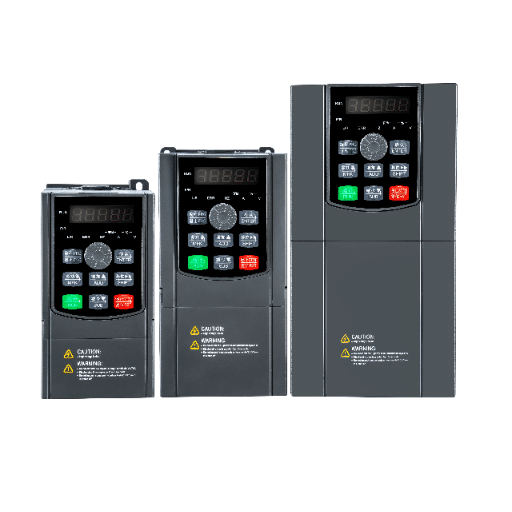
The control mode determines how the VFD manages the relationship between voltage, frequency, and motor torque. Choosing the wrong mode leads to poor performance, excessive heat, or unstable operation.
V/f control is the simplest and most common mode. The drive maintains a constant ratio between voltage and frequency to keep the motor magnetized across the speed range. At 60 Hz and 460V, the ratio is 7.67 V/Hz. At 30 Hz, the drive outputs 230V to maintain the same ratio. This works well for variable torque loads like centrifugal pumps and fans, where torque requirement drops with the square of speed. V/f control is inexpensive, easy to set up, and sufficient for perhaps 70 percent of all VFD applications.
The limitation is accuracy. V/f control does not measure actual motor current or compensate for load changes dynamically. At very low speeds — below 10 Hz — the motor can lose torque and overheat because the drive cannot distinguish between magnetizing current and torque-producing current.
Sensorless vector control (also called open-loop vector or SVC) solves the low-speed torque problem without requiring an encoder. The drive uses a mathematical model of the motor to estimate rotor position and flux in real time. This allows precise torque control even at zero speed, which is essential for conveyors, hoists, and machine tools that need high starting torque or precise speed holding under load.
Most modern sensorless vector drives can deliver something like 150 to 200 percent starting torque , and then keep the speed accuracy pretty steady, around 0.5 percent of the setpoint, even when no feedback is used . The downside though is that the setup feels more complex, because you usually have to type in the motor nameplate details and also run an auto tuning routine , so the drive can form its internal motor model .
Closed-loop vector control adds a physical encoder or resolver on the motor shaft to provide direct position feedback. This enables the highest level of precision: speed accuracy within 0.01 percent, torque response in milliseconds, and full torque at zero speed. It is the standard for positioning applications, winders, and high-performance servo-like tasks.
The downside is cost and complexity. Encoders add hardware, wiring, and maintenance points. The cable between motor and drive must be shielded and routed carefully to avoid noise. For most pump and fan applications, closed-loop control is unnecessary overkill.
Direct Torque Control, pioneered by ABB, takes a different approach. Instead of modulating voltage and frequency separately, DTC directly controls motor flux and torque using a switching table. The result is extremely fast torque response — typically under 2 milliseconds — without requiring an encoder. DTC excels in applications with rapid load changes, such as cranes, crushers, and test stands.
The selection guidance is straightforward: Use V/f control for centrifugal pumps, fans, and simple conveyors. Use sensorless vector for machine tools, material handling, and any application needing high starting torque or precise speed holding. Use closed-loop vector for positioning, winding, and servo-like tasks. Use DTC for applications with rapid torque transients or regeneration requirements.
To see how these control modes apply within a broader motor control architecture, our article on VFD for motor control covers practical integration in depth.
Variable frequency drives are used across virtually every industry that runs AC motors. The global VFD market, projected to reach $35 to 40 billion by 2030, reflects how universal this technology has become.
Pumps and fans represent the largest VFD application segment. In HVAC systems, VFDs control chilled water pumps, cooling tower fans, and air handling units to match building load. In water treatment, they regulate lift station pumps, filtration pumps, and distribution booster systems. In irrigation, they maintain constant pressure across varying numbers of active sprinklers. The affinity laws make these applications exceptionally profitable: a 20 percent speed reduction cuts power consumption by roughly 49 percent.
For application-specific guidance, see our articles on VFD for HVAC systems and VFD for water treatment.
In manufacturing, warehousing, and mining conveyors really need an adjustable speed so they can align with those production rates , stop a product pile-up, and also make starting smoother even when the load is already there. Sensorless vector control is usually the go-to option, since it gives strong initial torque and controlled speed behavior without having to add encoder wiring. For example, a food processing plant packaging line might move at about 30 meters per minute for normal output, then drop to around 5 meters per minute during changeover , or when they do the cleaning cycle.
Air compressors, refrigeration compressors, and process gas compressors they all get a big benefit from VFD control. Rather than load and unload the compressor in a purely mechanical way, which is kinda wasteful energy wise during unloaded time periods, a VFD matches the compressor speed to the real air or refrigerant demand. In bigger compressed air setups, this approach can even remove the need for multiple compressors turning on and off in sequence, which makes maintenance feel more straightforward and usually boosts dependability too.
CNC machines, printing presses, and metalworking equipment often rely on VFDs for how fast a spindle turns , for changing the feed rate and also for synchronized multi axis travel. In practice, these setups usually need either sensorless closed-loop vector control, so torque stays more exact. The VFD also gives you soft starting, which helps cut down mechanical jolt on gears , belts and bearings when you first power up and begin moving.
Cranes and hoists require precise torque control for smooth acceleration, controlled lowering, and load holding. A VFD with sensorless vector or DTC control eliminates the mechanical shock of contactor-based starting and provides regenerative braking that reduces brake wear. In overhead cranes, this translates directly to lower maintenance costs and longer component life.
For a broader survey of how these use cases play out across sectors, see our complete guide to VFD applications in industry.
The energy savings potential of a variable frequency drive is not marketing hype. It is physics. The relationship between speed and power consumption for centrifugal loads follows the affinity laws:
This cubic relationship is what makes VFDs so effective. A fan running at 80 percent speed consumes only 51.2 percent of full-speed power (0.8 cubed = 0.512). A pump at 70 percent speed uses only 34.3 percent of full-speed power (0.7 cubed = 0.343).
Worked example: Consider a 75 kW cooling tower fan in a manufacturing facility. At full speed, it draws approximately 78 kW including motor and drive losses. If the facility runs the fan at 80 percent speed for 6,000 hours per year — which is typical for seasonal HVAC load — the annual energy consumption drops from 468,000 kWh to 239,760 kWh. At 0.10perkWh,thatisasavingsof0.10perkWh,thatisasavingsof22,824 per year. A 75 kW VFD and installation might cost 18,000to18,000to25,000, giving a payback of 10 to 13 months.
Here is how savings vary by load type:
| Application | Typical Speed Reduction | Power Reduction | Annual Savings (100 kW motor, 6,000 hrs) |
|---|---|---|---|
| Centrifugal fan | 20% | ~49% | $29,400 |
| Centrifugal pump | 20% | ~49% | $29,400 |
| Compressor | 15% | ~39% | $23,400 |
| Conveyor | 10% | ~27% | $16,200 |
However, honesty about limitations builds authority. VFDs do not save energy on positive-displacement pumps, constant-torque loads running at full speed, or applications with minimal speed variation. A Thailand water district learned this the hard way: they installed VFDs on three lift station pumps expecting 30 percent savings, but two of the pumps fed positive-displacement sludge pumps that do not follow the affinity laws. The actual savings came in at 8 percent. The third pump, a centrifugal raw water pump, delivered the expected 28 percent reduction.
For detailed energy savings calculations, payback analysis, and real-world case studies, see our guide on VFD benefits energy saving.

A VFD does not operate in isolation. It sits within a larger motor control system that includes input protection, output filtering, braking components, and communication interfaces. Understanding this architecture helps you specify the complete system, not just the drive.
Upstream of the VFD, you need a circuit breaker or fuses for short-circuit protection. A contactor or disconnect switch allows safe isolation for maintenance. A line reactor or DC choke reduces harmonic current drawn from the supply and protects the rectifier from voltage transients. For drives above 50 kW or installations with strict harmonic limits, consider an active front end or passive harmonic filter. The IEEE 519 standard provides guidance on acceptable harmonic distortion levels.
The VFD has all the rectifier, DC bus, inverter, and the control electronics in one enclosure, kind of all together like that. Some important key specs beyond just voltage and power include the enclosure rating (NEMA 1 , NEMA 12, NEMA 4X, or IP ratings) and also the cooling approach (forced air, or liquid cooling) and the ambient temperature rating as well. Most of the usual drives are set up for 40 degrees C ambient , so if it runs above that, or if you’re above 1,000 meters in altitude, then derating is required .
Between the VFD and motor, several components may be needed depending on cable length and motor insulation. dV/dt filters reduce the rate of voltage rise at the motor terminals, which protects motor winding insulation from voltage spikes caused by fast IGBT switching. Sinusoidal filters further smooth the waveform, essentially reconstructing a sine wave that is gentler on the motor. These are recommended for cable runs over 50 meters or for older motors with standard insulation not rated for inverter duty.
When a motor decelerates quickly or lowers a load, it acts as a generator and pumps energy back into the drive. A braking resistor dissipates this energy as heat. A regenerative unit returns it to the power grid. Braking resistors are simple and inexpensive but waste energy. Regenerative units are more efficient but cost more upfront. For applications with frequent braking cycles — cranes, centrifuges, downhill conveyors — regeneration often pays back within 12 to 18 months.
Modern VFDs communicate with PLCs, SCADA systems, and building automation networks through standard protocols. Modbus RTU over RS-485 is the most common basic interface. PROFINET, EtherNet/IP, and BACnet are standard on mid-range and premium drives. This integration enables centralized monitoring, automatic fault alerting, and energy management reporting across an entire facility.For a complete look at how all these components come together in a production environment, see our resource on industrial VFD systems.
For installation best practices specific to low voltage systems, see our low voltage VFD installation guide.
Buyers often face a choice between a VFD and a soft starter. They are not interchangeable. Choosing the wrong one leads to disappointed expectations and wasted budget.
A soft starter is a reduced-voltage starting device. It ramps up voltage during motor starting to limit inrush current and mechanical shock. Once the motor reaches full speed, the soft starter bypasses itself and the motor runs at fixed speed across the line. A soft starter does not control speed. It does not save energy during normal operation. Its sole purpose is to start the motor more gently.
A variable frequency drive controls speed continuously. It provides soft starting as a side benefit, but its primary value is matching motor speed to process demand. This is where the energy savings come from.
| Factor | Soft Starter | VFD |
|---|---|---|
| Speed control | None — fixed speed only | Full variable speed 0 to 100% |
| Energy savings | Minimal — only during start | 20 to 50% for variable torque loads |
| Starting current | 2 to 4 x full load amps | 0.5 to 1.5 x full load amps |
| Cost (100 kW) | 2,000to2,000to4,000 | 8,000to8,000to15,000 |
| Complexity | Low — minimal setup | Medium — parameter configuration required |
| Best for | Fixed-speed pumps, compressors, conveyors that start frequently | Any load with varying demand |
The decision rule is simple: If your load runs at fixed speed and you only need to reduce starting stress, a soft starter is sufficient and more economical. If your load has varying demand and you want energy savings or process control, a VFD is the correct choice. Do not buy a soft starter expecting energy savings, and do not buy a VFD for a fixed-speed application unless you need its other features.For a more detailed breakdown of how these two technologies compare across specific scenarios, our guide on VFD vs soft starter differences walks through the decision criteria side by side.

Selecting the right VFD requires matching six key factors to your application. Get any one of these wrong, and you risk poor performance, premature failure, or safety issues.
For a step-by-step sizing guide with worked calculations, see our dedicated article on how to select a VFD.
Low voltage drives cover 220V to 690V and handle motors from fractional horsepower to approximately 2,000 kW. Medium voltage drives cover 3 kV to 11 kV and handle motors from approximately 200 kW to 30,000 kW or more. IEC 60038 defines LV as up to 1,000V, while NEMA uses 600V as the LV threshold in North America.
The voltage class decision is usually straightforward — match your motor nameplate voltage. However, for very large motors, cable and transformer economics can push you toward medium voltage even at power levels where LV drives technically exist. A Vietnam cement plant faced exactly this decision for a 1,200 kW raw mill fan. A single medium voltage drive quoted at 225,000,whileaduallowvoltagedrivearrangementcameinat225,000,whileaduallowvoltagedrivearrangementcameinat99,000. The LV option saved $126,000 upfront but required two motors, two drives, and more complex synchronization logic.
Size the VFD to your motor’s full load amps (FLA), not just horsepower or kilowatts. Nameplate horsepower is based on standard voltage; if your motor runs at a different voltage, the current matters more. Add an overload margin: 110 percent for variable torque loads (pumps, fans) and 150 percent for constant torque loads (conveyors, hoists) that need high starting torque. If you are running the drive from a single-phase supply to power a three-phase motor, derate by 50 percent because the rectifier utilization is reduced.
Variable torque loads — centrifugal pumps, fans, blowers — need less torque as speed decreases. These are the easiest applications for VFDs and deliver the highest energy returns. Constant torque loads — conveyors, hoists, mixers, compressors — need the same torque regardless of speed. The VFD must maintain voltage proportionally with frequency to preserve torque. Be honest about your load characteristics. Misclassifying a constant torque load as variable torque leads to undersizing and potential drive failure.
As covered earlier, V/f control works for most pump and fan applications. Sensorless vector control is the minimum for conveyors, machine tools, and high-torque starting. Closed-loop vector is needed for positioning and precision tasks. If you are unsure, specify sensorless vector — most modern drives support it at little or no cost premium over V/f, and it gives you headroom if load conditions change.
Check the ambient temperature, altitude, humidity, dust, and corrosive atmosphere. Standard drives are rated for 40 degrees C and altitudes below 1,000 meters. Above these limits, derate the drive by 1 percent for every 100 meters of altitude and 1.5 percent for every degree C above 40. In dusty or wet environments, specify a NEMA 12 (dust-tight) or NEMA 4X (washdown/corrosion-resistant) enclosure. In outdoor installations, add a sun shield or heater to prevent condensation.
Decide how the VFD will interface with your control system. Modbus RTU is universal and inexpensive. PROFINET and EtherNet/IP are standard for modern industrial networks. BACnet is required for many building automation projects. Specify the protocol in your purchase order; some drives require optional communication cards that are not included in the base price.
For a step-by-step sizing guide with worked calculations, see our article on how to size a VFD for your motor.

The terminology around voltage classes creates confusion because standards differ by region.
Under IEC 60038, the international standard for electrical system voltages, low voltage is defined as up to 1,000V AC. Medium voltage spans 1,000V to 35,000V. High voltage is above 35,000V. In practice, almost all VFDs fall into the low or medium voltage categories.
NEMA and the US electrical industry use a narrower definition: low voltage is 600V or below. This is why you will see references to “low voltage VFDs” at 480V in American literature, while the same drive might be called “medium voltage” in an IEC context. To avoid confusion, many manufacturers now specify drives by their actual voltage range: 208V to 240V, 380V to 480V, 690V, 3.3kV, 6.6kV, or 10kV.
Low voltage drives cover most situations, from small shop machines to maybe even 2,000 kW industrial motors, they just do the job. They end up being less expensive, more compact, and generally easier to keep running. Medium voltage drives show up when you’re dealing with really huge motors where the cable costs, and transformer losses , start to feel impractical for LV. The switch over point depends on cable run length and the local labor situation, but it usually lands somewhere around 500 kW through 1,500 kW.
For export-ready products, verify that the drive carries the certifications required by your destination market. CE marking is mandatory for Europe. UL listing is standard for North America. CCC certification is required for China. IEC 61800 compliance is the baseline international standard for adjustable speed drives.
A variable frequency drive is some sort of electronic unit that steers the rpm and torque of an AC motor by changing the frequency along with the voltage of the power it gets from the supply, kind of directly. It takes what is basically fixed frequency AC power, then reshapes it into an output that has variable frequency, so the motor can run at the exact speed you want. This also helps a lot with energy savings , especially in pump, fan, and conveyor uses.
Using a VFD saves energy , because it brings the motor speed down so it lines up with the real load need, not just keeps the motor running at full speed then “throttling” power in a more mechanical way. For centrifugal pumps and fans, the power draw drops with the cube, as speed is reduced. So if you cut speed by 20 percent, power use goes down roughly 49 percent . This rule, sometimes called the affinity laws, is one reason VFD retrofits are among the quickest return on investment energy efficiency moves in industry.
A VFD ( Variable Frequency Drive ) is like a particular kind of electronic speed control, it ,changes electrical frequency while it runs. A VSD ( Variable Speed Drive ) is a wider umbrella term, it covers any kind of speed adjustment technique, even non-electronic stuff such as fluid couplings, eddy current drives, and other mechanical arrangements. So yes, every VFD counts as a VSD, but the reverse is not always true ,not every VSD is actually a VFD.
Most standard AC induction motors can work with a VFD, but older ones might really need that inverter duty insulation, to stand up to the voltage peaks that come from PWM switching. I mean motors made before, say mid 1990s often only have insulation rated for sinusoidal power, and they can wear out faster on a VFD, especially if there is no output filter. So try to double check the motor insulation classification , (Class F or H is the preferred route )and if your cable run is over 50 meters , think about using a dV/dt filter as well.
A well-maintained VFD typically lasts 10 to 15 years. The most common failure points are cooling fans (5 to 7 year life) and DC bus capacitors (7 to 10 year life under normal temperatures). Keeping the drive clean, cool, and dry is the single most effective way to extend its lifespan. Ambient temperature is critical: every 10 degrees C above rated temperature halves capacitor life.
VFDs are used across manufacturing, water and wastewater treatment, HVAC, mining, oil and gas, food processing, pulp and paper, and material handling. Any industry that runs AC motors with variable load conditions can benefit from VFD control. Over 50 percent of new motor installations in manufacturing now include VFDs as standard equipment.
Yeah, the rectifier part in a regular VFD tends to pull a non-sinusoidal current from the supply so you end up with harmonic distortion, not really clean as you might expect. A six-pulse rectifier usually results in a total harmonic current distortion, THDi around 30 to 40 percent or so. You can reduce this with line reactors, passive harmonic filters, a 12-pulse rectifier setup, or even an active front end arrangement. During the system design it’s worth double-checking that you comply with IEEE 519, or the local utility harmonic limits too.
Yes, a VFD can replace a soft starter because it provides soft starting as a built-in feature. However, a soft starter cannot replace a VFD because it does not provide speed control or energy savings. If you need speed control, process optimization, or significant energy savings, a VFD is the correct choice. If you only need reduced starting current on a fixed-speed motor, a soft starter is more economical.
Size the VFD off the motor’s full load amps FLA from the nameplate, not only its horsepower, ok. Make it so the drive’s continuous current rating lines up with that motor FLA. If it’s variable torque, like pumps and fans, then tack on about 10 percent margin, just to be safe. If it’s constant torque, like conveyors, you generally need more, so add 50 percent margin for the starting torque part. Also if you’re feeding the VFD from single-phase input but driving a three-phase motor then oversize the drive by 100 percent, since that setup is a bit more demanding.
For applications with variable load conditions, VFDs typically deliver payback in 12 to 24 months through energy savings alone. Additional benefits include reduced mechanical wear, improved process control, and lower maintenance costs. For fixed-speed loads with minimal variation, the payback is longer and a soft starter may be more cost-effective. The key is matching the technology to the actual operating profile.
A variable frequency drive is one of the most impactful upgrades you can make to an industrial motor system. It converts fixed AC power into precisely controlled variable output, which directly translates to lower energy bills, reduced mechanical stress, and better process control. Modern VFDs operate at 96 to 98 percent efficiency and can cut pump and fan energy consumption by 20 to 50 percent through the physics of the affinity laws.
Here are the five key points to remember:
If you are evaluating VFDs for a specific project, the next step is to narrow your voltage class and power requirements. Browse our low voltage VFD systems for applications up to 690V, or contact our engineering team for medium voltage and custom system design. We support full-cycle technical consultation from selection through commissioning, and we deliver products certified for global export markets.