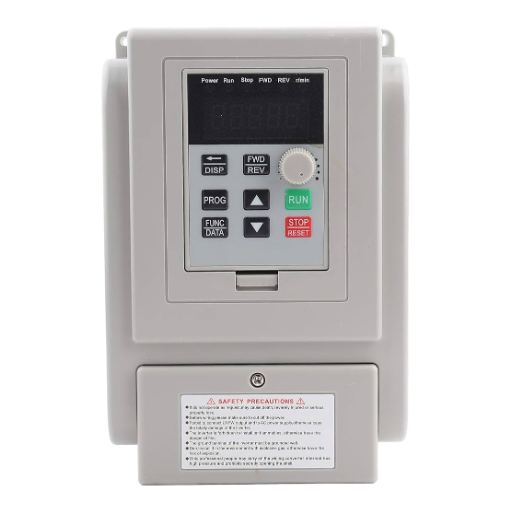
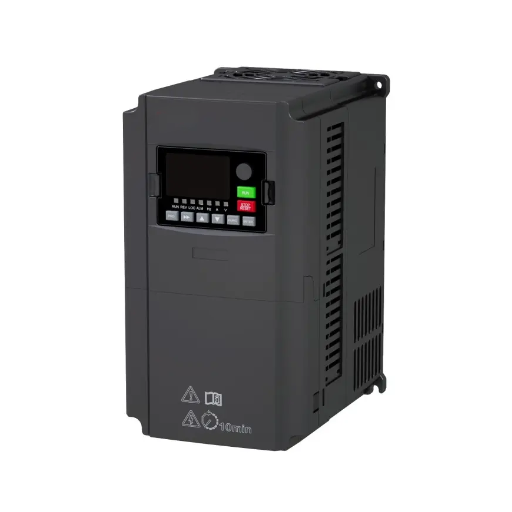
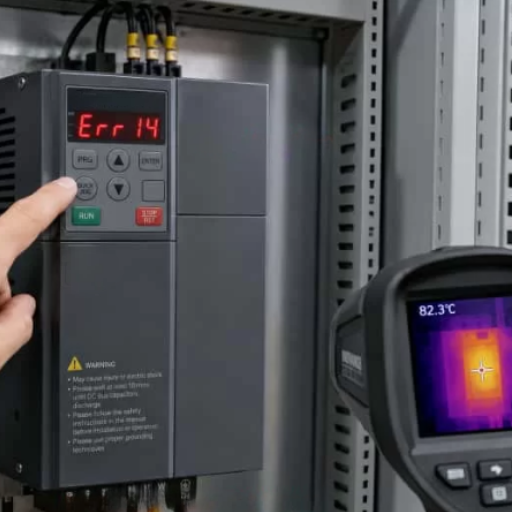
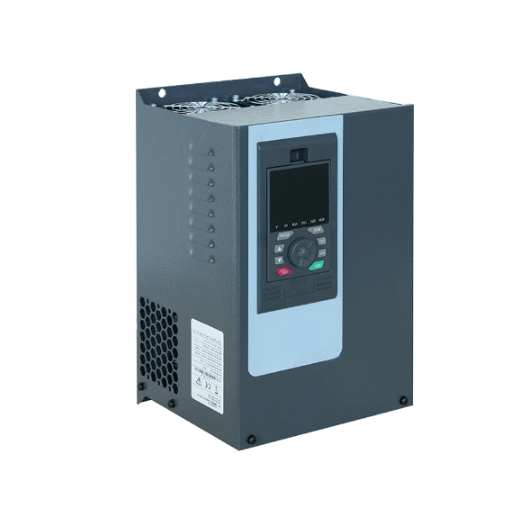
Ready to Get Your VFD Solution?
Whether you need a single drive or a complete system, we have the VFD products and engineering support to ensure your project's success.


A variable frequency drive works by converting incoming fixed-frequency AC power into variable-frequency AC output through three internal stages: a rectifier that converts AC to DC, a DC bus that smooths the power, and an inverter that generates adjustable-frequency AC using high-speed IGBT switching and pulse width modulation. If you have ever stood in front of a VFD enclosure and wondered what is actually happening inside those three aluminum heat sinks, you are not alone — even many commissioning engineers treat the drive as a black box.
Sarah Chen, a maintenance technician in Vietnam, spent three days troubleshooting a 30 kW VFD that kept tripping on overvoltage during deceleration. The fault code said DC bus overvoltage, but Sarah had no idea why the bus voltage was climbing or where the extra energy was coming from. Once she learned the VFD working principle — that a motor becomes a generator during deceleration and feeds energy back into the DC bus — the solution became obvious. A dynamic braking resistor dissipated the regenerated energy, and the drive stopped tripping. Understanding the working principle turned a black-box mystery into a solvable engineering problem.
By the end of this guide, you will understand the variable frequency drive working principle in full — from diode bridge operation to PWM waveform generation — and you will know how to interpret the real-world voltage and current waveforms that define drive performance. For a complete overview that connects every cluster topic, see our complete variable frequency drive guide.
Key Takeaways
- Every VFD contains three stages: a rectifier (AC to DC), a DC bus (energy storage), and an inverter (DC back to variable-frequency AC).
- Pulse width modulation (PWM) is the technique that lets the inverter create synthetic sine waves by rapidly switching IGBTs on and off.
- Voltage must scale with frequency to maintain constant motor flux; the V/f ratio is the foundation of proper motor control.
- Fast IGBT switching creates dV/dt voltage spikes that can damage motor insulation on long cables unless filters or inverter-duty motors are used.
- Carrier frequency is a critical commissioning tradeoff: higher frequencies reduce audible noise but increase switching losses and motor heating.
- Regenerative braking occurs when the motor overhauls the drive during deceleration, raising DC bus voltage unless a braking resistor or regenerative drive dissipates the energy.
Want to see how VFD control modes affect fan and pump performance? Read our article on VFD for motor control: speed, torque, and control modes explained.

The VFD working principle follows a single logical path: take AC power from the grid, convert it to DC, store it briefly, then convert it back to AC at a frequency you choose. This three-stage process is universal across every VFD manufacturer, from a 0.75 kW workshop drive to a 5 MW heavy-industry system.
A standard low-voltage VFD receives three-phase AC at 380, 400, or 415 volts and 50 or 60 hertz. The rectifier converts this to approximately 560 to 590 volts DC. The DC bus stores and smooths this power. The inverter then chops the DC into a synthetic AC waveform with adjustable frequency, typically from 0.1 Hz up to 400 Hz or more. By changing the switching pattern of the inverter’s power semiconductors, the drive controls both output frequency and voltage simultaneously.
Think of it as a water treatment plant. The rectifier is like a pump that draws water from a river. The DC bus is like a reservoir that stores water and smooths out pressure fluctuations. The inverter is like a set of valves that release water in precisely controlled pulses to create any flow rate the downstream process needs. Without understanding all three stages, you cannot diagnose drive faults, optimize performance, or specify the right accessories.
For a high-level introduction to VFDs written for non-engineers, see our article on what a VFD is. If you are confused by the many names for this technology, our VFD terminology guide clarifies the difference between AC drive, VFD, VSD, and inverter.
The first stage of the variable frequency drive working principle is the rectifier. Its job is simple: convert the incoming AC power into DC power. A VFD circuit diagram always starts with this six-diode bridge at the input. But the details matter for harmonic performance, power factor, and overall system efficiency.
Most low voltage VFD systems use a six-pulse diode bridge rectifier. Six diodes are arranged in a three-phase full-wave bridge. During each 60-degree segment of the AC cycle, two diodes conduct and feed current into the DC bus. The result is a pulsating DC voltage with six pulses per AC cycle.
For a 50 Hz input, the rectified output ripples at 300 Hz (50 x 6). For a 60 Hz input, it ripples at 360 Hz (60 x 6). The peak DC voltage equals approximately 1.414 times the RMS line-to-line AC voltage. On a 415 V system, the peak DC bus voltage is roughly 587 V. In practice, under load and with line impedance, the average DC bus voltage settles around 560 to 580 V for a 400 V class drive.
Standard diode bridges are simple and reliable, but they draw non-sinusoidal current from the grid and produce significant harmonic distortion. An active front end replaces the diode bridge with an IGBT-based rectifier that actively shapes the input current to be nearly sinusoidal. AFE drives achieve total harmonic distortion below 5 percent and can feed regenerated energy back into the grid.
The tradeoff is cost and complexity. AFE drives cost 30 to 50 percent more than standard diode-bridge units and require more sophisticated control algorithms. They are typically used in applications where harmonic compliance is strict, such as data centers or facilities with weak grid connections.
Engineers often need to know the exact DC bus voltage for fuse sizing, brake resistor selection, and insulation coordination. The calculation is straightforward:
V_DC_peak = sqrt(2) x V_AC_LL
For a 400 V three-phase system:
V_DC_peak = 1.414 x 400 V = 565.6 V
Under light load with minimal line impedance, the bus can sit closer to 580 V. Under heavy load with long supply cables, it may drop to 540 V. Most 400 V class drives are rated for a DC bus range of approximately 450 to 800 V before fault conditions trigger.
A six-pulse diode bridge draws current in short pulses, not a smooth sine wave. This creates harmonic currents on the supply side, particularly the 5th, 7th, 11th, and 13th harmonics. When multiple drives are installed on the same transformer, these harmonics can add up and cause transformer overheating or neutral conductor overload.
Line reactors or DC chokes are the standard mitigation. A 3 to 5 percent impedance line reactor reduces total harmonic current distortion from roughly 80 percent to 30 to 40 percent. For facilities with many drives, active harmonic filters or 12-pulse or 18-pulse rectifier configurations may be required to meet IEEE 519 limits.
The DC bus is the second stage of the VFD working principle. It sits between the rectifier and the inverter, absorbing energy from the rectifier, smoothing out voltage ripple, and delivering stable DC power to the inverter on demand. Engineers who ignore the DC bus miss half the diagnostic picture.
The heart of the DC bus is a bank of electrolytic capacitors, typically arranged in series-parallel strings to achieve the required voltage and capacitance ratings. These capacitors store energy and filter the rectifier’s pulsating output. A typical 400 V class drive might use capacitors rated for 450 V DC with a total bus capacitance of several thousand microfarads.
The capacitor bank determines how well the bus maintains voltage during sudden load changes. When the inverter demands a burst of current to accelerate the motor, the capacitors supply that energy instantly. When the motor decelerates and regenerates, the capacitors absorb the returning energy — up to a limit.
A DC choke is an inductor placed in series with the DC bus. It limits the rate of current change and further smooths the DC ripple. Some manufacturers use an AC line reactor on the input side instead of a DC choke; both serve a similar purpose of reducing harmonic current and protecting the rectifier from voltage transients.
The DC bus voltage is not perfectly constant. It sags under heavy inverter load and rises during regeneration. Most drives monitor the bus continuously and trigger a fault if voltage exceeds safe limits. An overvoltage fault typically occurs at 750 to 800 V on a 400 V class drive. An undervoltage fault typically occurs at 350 to 400 V.
When a VFD is first powered on, the DC bus capacitors act like a short circuit. Without a pre-charge circuit, the inrush current would blow fuses or damage the rectifier diodes. A pre-charge resistor limits current during the first few seconds until the capacitors charge up. Once the bus reaches approximately 80 percent of nominal voltage, a contactor bypasses the resistor and the drive is ready to run. If you ever hear a delayed click a few seconds after powering up a VFD, that is the pre-charge contactor closing.
The inverter is where the VFD working principle becomes truly elegant. It takes the stable DC from the bus and converts it back into AC with any frequency the control algorithm demands.
IGBT switching in a VFD is the foundation of modern inverter design. Insulated-gate bipolar transistors, or IGBTs, serve as the switching devices in virtually every PWM VFD today. An IGBT can turn on or off in less than one microsecond, and it can handle hundreds of amps at voltages up to 1,200 V or more. This combination of speed and power handling is what makes affordable PWM drives possible.
Each IGBT is paired with a free-wheeling diode across its collector and emitter. When the IGBT turns off, the motor’s inductive current continues to flow through this diode, preventing destructive voltage spikes. The IGBT and its diode are mounted on a common heat sink because switching losses generate significant heat.
The inverter stage uses six IGBTs arranged in a three-phase half-bridge. There are three legs — one for each motor phase — and each leg has a high-side switch and a low-side switch. By controlling which switches are on at any moment, the drive connects each motor terminal to either the positive DC bus rail or the negative DC bus rail.
The key constraint is that both switches in a leg must never be on simultaneously. Doing so would short the DC bus, a condition called shoot-through that destroys the IGBTs instantly. Modern gate drivers include hardware interlocks to prevent this.
PWM in a VFD is the technique that lets the inverter create a synthetic sine wave from DC voltage. Pulse width modulation — the rapid switching of IGBTs — is what makes modern variable frequency drives possible. Instead of producing a smooth analog voltage, the inverter outputs a rapid series of rectangular voltage pulses. The motor’s inductive windings act as a low-pass filter, averaging these pulses into a smooth current waveform.
The fundamental principle is simple. If the inverter outputs a 50 percent duty cycle pulse train at +565 V and -565 V, the average voltage is zero. If the duty cycle shifts so that positive pulses are wider than negative pulses, the average voltage becomes positive. By varying the pulse width sinusoidally over time, the drive creates an output whose average follows a sine wave.
The inverter does not vary the pulse amplitude — the amplitude is always the DC bus voltage. It only varies the width and timing of the pulses. That is why the technique is called pulse width modulation.
Not all PWM is created equal. The two most common methods are sine-coded PWM and space vector modulation.
Sine-coded PWM, or SPWM, compares a sinusoidal reference waveform with a high-frequency triangular carrier wave. Whenever the sine wave exceeds the triangle, the output switch turns on. This method is intuitive and easy to implement, but it wastes some DC bus voltage. The maximum AC output voltage is limited to about 78 percent of the DC bus voltage.
Space vector modulation, or SVM, takes a different approach. Instead of modulating each phase independently, SVM treats the three-phase output as a single vector rotating in space. By carefully sequencing the switching states, SVM can achieve a maximum AC output voltage of about 91 percent of the DC bus voltage. This 15 percent improvement in voltage utilization means a motor can produce more torque at high speeds without requiring a larger drive.
Most modern VFDs use SVM or a variant of it because the better voltage utilization directly translates to better motor performance.
The carrier frequency is the rate at which the PWM pulses are generated, typically 2 to 16 kHz. This is one of the most important commissioning parameters and one of the least understood.
At a low carrier frequency of 2 kHz, switching losses in the IGBTs are minimal, but the motor current contains more ripple and the drive produces an audible whine in the 2 kHz range. At a high carrier frequency of 12 kHz, the current is smoother and the audible noise shifts to a less annoying range above human hearing, but switching losses increase significantly. Motor heating can rise by 5 to 15 percent, and the drive’s maximum continuous output current may need to be derated.
A factory manager in Mumbai once complained that new VFD-driven HVAC fans produced an irritating whine. The site engineer found the carrier frequency was set to the factory default of 4 kHz, which sits squarely in the most annoying audible range. Raising it to 8 kHz eliminated the whine, but motor temperature increased by 8 degrees Celsius. Lowering it to 2 kHz reduced heating but brought the whine back. The final compromise at 6 kHz balanced both concerns. Engineers who understand the working principle can make these tradeoffs intelligently instead of guessing.

The VFD working principle is not just about changing frequency. Voltage must change too, or the motor will overheat. This is the V/f ratio, and it is the single most important concept for understanding how does a VFD control motor speed correctly.
The magnetic flux inside an AC motor is proportional to voltage divided by frequency. The exact relationship is:
Phi = V / (4.44 x f x N)
Where Phi is flux, V is voltage, f is frequency, and N is the number of turns. If you halve the frequency from 60 Hz to 30 Hz without changing voltage, the flux doubles. The motor core saturates, magnetizing current skyrockets, and the motor overheats within minutes.
To maintain constant flux, the drive must reduce voltage in direct proportion to frequency. At 30 Hz, the voltage must be half of the 60 Hz voltage. At 10 Hz, it must be one-sixth. This linear V/f relationship holds from zero speed up to the motor’s base frequency, typically 50 or 60 Hz.
Above base frequency, the drive cannot increase voltage beyond the rated value because it is limited by the DC bus voltage. So the drive holds voltage constant and continues to increase frequency. Flux decreases, torque decreases, but power remains approximately constant. This is the constant-power region, and it is why a motor cannot produce full torque at 120 Hz.
Most drives provide a programmable V/f curve. For constant-torque loads like conveyors and compressors, a linear curve is standard. For variable-torque loads like pumps and fans, a quadratic or cubic curve reduces voltage more aggressively at low speeds, saving energy and reducing motor heating.
The VFD working principle includes an important side effect of fast IGBT switching: dV/dt stress that can destroy motors if ignored. The voltage rise rate, or dV/dt, at each switching edge can reach 3 to 10 kilovolts per microsecond. This is fast enough to cause serious problems.
When an IGBT switches, it does not transition from off to on instantly — it takes a few hundred nanoseconds. During that brief interval, the voltage across the motor winding changes extremely rapidly. The motor winding itself has capacitance to ground, and the rapid voltage change drives a displacement current through the winding insulation.
The real problem appears when the drive is far from the motor. A PWM pulse travels down the motor cable at roughly half the speed of light. When it reaches the motor, the motor’s high impedance reflects the pulse back toward the drive. If the cable is long enough, the reflected pulse arrives back at the motor while the next pulse is being sent, causing the voltages to add.
On a 415 V system with a 200-meter cable, reflected waves can produce voltage spikes at the motor terminals exceeding 1,500 V. Standard motor insulation is rated for 1,000 V peak. Repeated exposure to these spikes degrades the insulation until it fails.
Liang Wei, a commissioning engineer in Suzhou, learned this lesson on a 75 kW pump installation. The drive was 200 meters from the motor on shielded cable, and standard inverter-duty motors were failing within six months. Liang scoped the motor terminals and saw peaks exceeding 1,800 V. Installing a sine wave filter at the drive output reduced the peaks to 590 V, and the motor problem disappeared. The filter cost 2,400.Thethreemotorreplacementshadalreadycost2,400.Thethreemotorreplacementshadalreadycost8,000. Understanding the inverter’s switching behavior saved the project.
There are three standard solutions. A dV/dt filter is a simple LC network at the drive output that slows the voltage rise time from microseconds to tens of microseconds. It is inexpensive and effective for cables up to roughly 100 meters.
A sine wave filter is a more sophisticated LC filter that reconstructs a near-perfect sine wave from the PWM output. It eliminates reflected waves entirely and is the right choice for cables longer than 150 meters or for motors with marginal insulation.
Inverter-duty motors have reinforced winding insulation rated for 1,600 V peak. They should always be used with VFDs, but even inverter-duty motors can fail on very long cables without a filter.
Most descriptions of the VFD working principle focus on motoring — the drive sending power to the motor. But drives also operate in braking and regenerative modes, and understanding these modes is essential for applications with cyclic loads or rapid deceleration.
During deceleration, the drive reduces output frequency faster than the motor can slow down mechanically. The motor’s rotor is now spinning faster than the synchronous speed set by the drive. The motor becomes an induction generator, converting mechanical energy back into electrical energy and feeding it into the DC bus.
The rectifier diodes block this energy from returning to the grid. So the energy has nowhere to go except into the DC bus capacitors. The bus voltage rises. If it rises above the overvoltage threshold, the drive trips.
The simplest solution is a dynamic braking resistor. When the bus voltage exceeds a set threshold — typically 720 to 750 V on a 400 V class drive — a transistor switches the resistor across the DC bus. The regenerated energy is converted to heat in the resistor. The bus voltage drops, and the drive continues operating.
Braking resistor sizing depends on the energy to be dissipated and the duty cycle. A heavy flywheel decelerating from 1,800 RPM to zero in five seconds generates far more energy than a small fan coasting to a stop. Shandong Electric provides braking resistor selection calculators as part of our engineering support and VFD sizing services.
For applications with frequent braking — cranes, hoists, downhill conveyors, test stands — dynamic braking resistors waste too much energy. A regenerative drive uses an active front-end rectifier that can pass energy in both directions. During braking, the drive feeds energy back into the grid at unity power factor.
Regenerative drives can recover 20 to 40 percent of the total system energy in highly cyclic applications, according to the U.S. Department of Energy. The payback period is typically 12 to 24 months for cranes and hoists with high duty cycles.

The final piece of the VFD working principle is understanding what you actually measure on a scope. Textbook diagrams show idealized sine waves, but a real drive produces waveforms that look very different.
The current drawn by a six-pulse diode bridge is not sinusoidal. It flows in short pulses at the voltage peaks, creating a peaked waveform with significant harmonic content. A current probe on the incoming supply will show pulses approximately 15 to 20 degrees wide, repeated six times per cycle. Total harmonic distortion is typically 80 to 120 percent without a line reactor.
The DC bus voltage ripples at six times the input frequency. On a 50 Hz supply, the ripple frequency is 300 Hz. The peak-to-peak ripple amplitude depends on load and bus capacitance. Under light load, it might be 10 to 20 V. Under heavy load with marginal capacitors, it can exceed 50 V. Excessive ripple causes torque pulsation and audible noise from the motor.
A scope on the motor terminals shows a series of rectangular voltage pulses switching between approximately +565 V and -565 V relative to the DC bus midpoint. The pulse width varies sinusoidally. The switching edges are extremely fast, with rise times under 100 nanoseconds. This is the raw output that creates the dV/dt stress discussed earlier.
Despite the chopped voltage, the motor current is remarkably smooth. The motor winding inductance acts as a low-pass filter, averaging the PWM pulses into a nearly sinusoidal current waveform. On a well-tuned drive, current total harmonic distortion is typically 3 to 8 percent. If you see jagged or discontinuous current, the drive parameters need tuning or the motor may be undersized.
The VFD working principle in simple terms is this: a VFD takes fixed-frequency AC power from the wall, converts it to DC, stores it briefly on a DC bus, then uses high-speed electronic switches to create synthetic AC power at any frequency you choose. Changing the frequency changes the motor speed.
The three main parts are the rectifier, which converts AC input to DC; the DC bus, which stores and smooths the DC power using capacitors; and the inverter, which converts the DC back into variable-frequency AC output using IGBT switches and PWM.
PWM stands for pulse width modulation. It is the technique the inverter uses to create variable-voltage, variable-frequency output from a fixed DC bus voltage. By rapidly switching IGBTs on and off with varying duty cycles, the drive produces output whose average follows a sine wave.
Motor flux is proportional to voltage divided by frequency. If frequency drops but voltage stays constant, flux increases, the motor core saturates, and the motor overheats. The V/f ratio keeps flux constant by reducing voltage in proportion to frequency.
Carrier frequency is the rate at which the PWM pulses are generated, typically 2 to 16 kHz. Higher carrier frequencies produce smoother motor current and less audible noise, but they increase switching losses and motor heating. Lower carrier frequencies are more efficient but noisier.
dV/dt is the rate of voltage change during each IGBT switching edge. Fast dV/dt of 3 to 10 kV per microsecond can stress motor insulation and create reflected voltage waves on long cables. dV/dt filters or sine wave filters slow the rise time and protect the motor.
When a motor decelerates faster than its mechanical load, it acts as a generator and feeds energy back into the VFD’s DC bus. This raises bus voltage. Dynamic braking resistors dissipate the energy as heat, or regenerative drives feed it back to the grid.
SPWM modulates each phase independently using a sine-triangle comparison. SVM treats the three-phase output as a single rotating vector. SVM achieves better DC bus voltage utilization, producing about 15 percent more output voltage than SPWM for the same DC bus.
DC bus peak voltage equals approximately 1.414 times the RMS line-to-line AC voltage. For a 400 V system, V_DC_peak = 1.414 x 400 = 565 V. The average operating voltage is typically 560 to 580 V under load.
Diode bridge rectifiers draw current in short pulses rather than smooth sine waves. These pulses contain harmonic frequencies — primarily the 5th, 7th, 11th, and 13th — that flow back into the power supply. Line reactors, DC chokes, or active harmonic filters reduce this distortion.
The VFD working principle is not magic. It is a straightforward three-stage process — rectify, smooth, invert — enabled by fast semiconductor switching and intelligent control algorithms. Understanding each stage transforms how you specify, commission, and troubleshoot drive systems.
If you know why the DC bus voltage rises during deceleration, you will never again guess at a braking resistor size. If you understand how PWM carrier frequency affects switching losses, you can optimize the tradeoff between noise and efficiency. If you recognize the dV/dt threat on long motor cables, you will specify the right filter before the first motor fails.
At Shandong Electric, we design VFDs with the working principle in mind at every stage of development — from rectifier topology selection to inverter switching algorithms to built-in braking control. Our engineering team supports clients from initial specification through commissioning, with technical documentation and system architecture guidance tailored to your facility.
Whether you need a standard low-voltage drive for a pump station or a regenerative system for a cyclic crane application, contact our engineering team for VFD selection support.