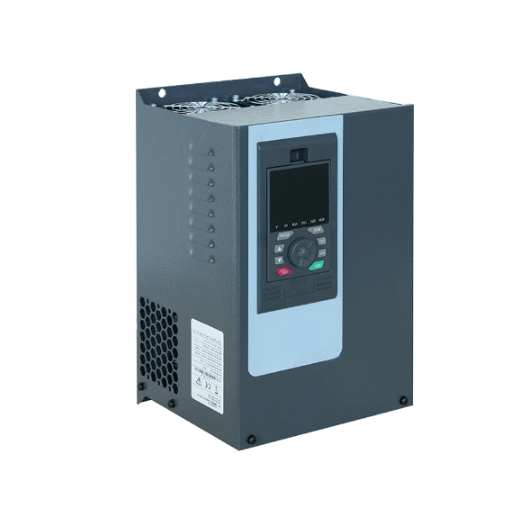
Ready to Get Your VFD Solution?
Whether you need a single drive or a complete system, we have the VFD products and engineering support to ensure your project's success.


A variable frequency drive — also called a frequency inverter or AC drive — controls motor speed by varying the frequency and voltage supplied to the motor stator. Since an induction motor’s synchronous speed equals 120 times frequency divided by pole count, reducing frequency slows the motor while the VFD also scales voltage proportionally to maintain constant magnetic flux. But the real engineering decision is selecting the control mode that matches your load’s torque and precision requirements.
In 2024, James Chen, a process engineer at a plastics extrusion plant in Ohio, specified standard V/f control for a 75-HP extruder. On startup, the motor stalled at 2 Hz because V/f only delivered 80% of the starting torque the application needed. After switching to sensorless vector control with auto-tuning, the drive delivered 180% starting torque at 0.3 Hz. Startup became smooth, scrap dropped 12%, and Chen learned that control mode selection is not a footnote. It is the foundation of every successful VFD for motor control installation.
If you are a specifying engineer, automation technician, or system integrator, you already understand that VFDs control speed. What you need is a clear decision framework for choosing among the four primary VFD control modes — also called variable frequency drive motor control modes. This article covers six things. First, how a VFD for motor control actually manipulates speed and torque. Second, when V/f control is sufficient and when it falls short. Third, what sensorless vector adds for torque-critical applications. Fourth, when encoder feedback justifies its cost. Fifth, how DTC delivers the fastest response. Sixth, a practical decision matrix that maps your application to the right mode.
Want to see how VFDs fit into a complete motor control strategy? Explore our complete guide to variable frequency drives for a deeper technical overview.
Key Takeaways
- The primary VFD control modes are V/f, sensorless vector, closed-loop vector, and direct torque control (DTC).
- V/f control handles roughly 70% of general-purpose applications but stalls on high-torque starts below 2 Hz.
- Sensorless vector delivers 150-200% starting torque at 0.5 Hz without an encoder, making it ideal for extruders, mixers, and conveyors.
- Closed-loop vector with encoder feedback achieves ±0.01% speed regulation and enables precise torque control for winding and tensioning.
- Direct torque control responds in under 1 millisecond, suiting cranes, test stands, and other dynamic loads.
- Auto-tuning measures motor resistance, inductance, and saturation to optimize parameters and can improve efficiency by 3-8%.
- The right control mode depends on load type, precision needs, and budget. This article gives you the decision matrix.
The four primary VFD control modes are:

The fundamental principle behind VFD for motor control is the V/f ratio. In an induction motor, the magnetic flux in the stator is proportional to voltage divided by frequency. If you lower frequency without lowering voltage, flux increases, the motor overheats, and insulation degrades. A VFD maintains a constant V/f ratio by scaling output voltage down in proportion to frequency reduction through pulse width modulation (PWM). At 30 Hz, the drive outputs roughly half the voltage it delivers at 60 Hz. This keeps flux constant and the motor thermally stable across its speed range. Motors operated on VFDs should meet NEMA MG-1 inverter-duty motor standards to withstand the voltage stress and thermal cycling associated with PWM waveforms.
For a deeper look at how the rectifier, DC bus, and inverter stages generate these variable waveforms, see our guide on how a VFD works internally.
An AC induction motor has no direct electrical connection between stator and rotor. The stator’s rotating magnetic field induces current in the rotor bars, and the resulting magnetic interaction produces torque. The speed of that rotating field, called synchronous speed, follows the simple formula N = 120f / p, where f is frequency in Hz and p is the number of poles. A 4-pole motor at 60 Hz has a synchronous speed of 1,800 RPM. Drop the frequency to 30 Hz and synchronous speed falls to 900 RPM. The actual rotor speed lags slightly behind because of slip, typically 2-4% at rated load. The VFD manipulates the only variable it can control, frequency, to command the exact speed the process requires.
Most industrial motors are designed for 60 Hz (or 50 Hz) operation at their base speed. Below base speed, the VFD maintains constant V/f and the motor produces constant torque. Above base speed, the VFD cannot increase voltage beyond the supply voltage, so it holds voltage constant while continuing to raise frequency. This is called field weakening. Flux drops, torque capability falls inversely with speed, but power remains approximately constant. A 1,800 RPM motor driven to 90 Hz spins at 2,700 RPM with roughly two-thirds of its base-speed torque but the same power output. Applications that need overspeed, such as certain machine tools, rely on this constant-power region. VFD performance classifications are defined by IEC 61800-2 VFD performance standards, which specify speed accuracy, torque response, and efficiency test methods.
V/f control, also called scalar control, is the simplest and most widely used VFD control mode. The drive outputs a voltage waveform with frequency proportional to the speed command, maintaining a fixed V/f ratio. It does not measure or respond to actual motor speed. The drive assumes the motor follows the commanded frequency and trusts the load to behave predictably. This open-loop approach works well because most pumps, fans, and light conveyors do not need precise speed holding or high starting torque. For roughly 70% of general-purpose applications, V/f is the right VFD for motor control choice.
The standard linear V/f curve maintains a straight-line ratio from zero to base frequency. For variable-torque loads such as centrifugal pumps and fans, where torque demand rises with the square of speed, a quadratic V/f curve reduces voltage slightly more at low frequencies. This matches the load’s actual torque requirement and saves a small amount of energy. Some drives also offer custom V/f curves where you define voltage points at specific frequencies. This is useful for older motors with non-standard characteristics or for applications where the motor runs at a fixed reduced speed for long periods. The U.S. Department of Energy motor systems guidance notes that variable-speed operation on pumps and fans can reduce energy consumption by 20-50% compared to throttling or damper control.
V/f control is sufficient when the application meets four conditions. First, starting torque demand is modest, less than 100% of rated torque. Second, speed regulation of ±2-3% is acceptable. Third, the load accelerates gradually. Fourth, the motor does not run at very low speeds for extended periods. V/f falls short when an application demands high starting torque at low Hz, precise speed holding, or rapid response to load changes. This is especially true if the motor is not an inverter-duty motor rated for VFD operation per NEMA MG-1 Part 31. At frequencies below 2-3 Hz, the voltage drop across stator resistance becomes a significant portion of the applied voltage. The drive cannot maintain proper flux, torque collapses, and the motor may stall or overheat. If your extruder, mixer, or hoist needs full torque from a standstill, V/f is the wrong choice.
Want to see how V/f control fits into the broader picture of variable frequency drive technology? Read our introduction to what a variable frequency drive is and how it works.
Sensorless vector control, also called open-loop vector control, adds two critical capabilities that V/f lacks. First, it estimates motor flux and torque in real time using a mathematical model of the motor. Second, it compensates for slip, the difference between commanded frequency and actual rotor speed. The drive measures output current and voltage, runs these values through flux and torque estimators, and adjusts the voltage vector to maintain the commanded torque regardless of load changes. The result is dramatically better low-speed torque and significantly tighter speed regulation than V/f can deliver.
In a V/f drive, slip is ignored. If a load suddenly increases, the motor slows down, slip increases, and the drive does nothing because it has no feedback. A sensorless vector drive continuously estimates rotor flux angle and calculates actual slip. When load increases, the drive raises voltage and frequency slightly to maintain speed. This slip compensation holds speed within roughly ±0.5% of setpoint under load variations. Flux estimation ensures the magnetic field stays at the optimal level for torque production, even when the motor operates well below base speed.
The most compelling advantage of sensorless vector control is starting torque at low frequencies. While V/f control may deliver only 60-80% of rated torque below 2 Hz, a properly tuned sensorless vector drive can produce 150-200% of rated starting torque at 0.5 Hz. This makes it suitable for extruders, mixers, positive-displacement pumps, and conveyors that must break away from a full load at low speed. The drive achieves this by independently controlling flux-producing current and torque-producing current, a technique derived from field-oriented control theory.
Upgrade from V/f to sensorless vector when any of these conditions apply. The load demands more than 100% starting torque. Speed regulation tighter than ±1% is required. The motor runs for extended periods below 5 Hz. Load torque varies dynamically. The application is a pump with high static head, a conveyor with heavy starting load, or any positive-displacement machine. Most modern general-purpose VFDs include sensorless vector as a configurable mode, so the hardware cost is zero. The only investment is the time to run auto-tuning and set the correct parameters.
For a deeper dive into vector control specifically in low voltage drive systems, see our article on vector control in low voltage drive systems.

Closed-loop vector control adds a physical encoder to the motor shaft, typically 1,024 pulses per revolution or higher. The encoder reports actual rotor position and speed to the drive in real time. This direct feedback eliminates the estimation errors inherent in sensorless vector, especially at very low speeds and during rapid load transients. The drive knows exactly where the rotor is, so it can align the stator magnetic field with optimal precision. The result is speed regulation of ±0.01% and torque response times measured in milliseconds rather than tens of milliseconds.
To appreciate the difference, consider a winding line running at 100 meters per minute. With sensorless vector at ±0.5% regulation, speed could vary by ±0.5 meters per minute. With closed-loop vector at ±0.01%, variation drops to ±0.01 meters per minute. In a textile plant in South Carolina, a manufacturer ran a winding line with V/f control. Web tension drifted ±8% because speed regulation was too loose. They added a 1,024 PPR encoder and switched to closed-loop vector. Speed regulation improved to ±0.02%, tension variation dropped to ±1.2%, and the customer stopped rejecting rolls. The $450 encoder paid for itself in three weeks.
Closed-loop vector enables a mode that V/f and sensorless vector cannot offer reliably: direct torque control of the motor. In torque mode, the drive commands a specific torque value rather than a speed. The motor produces exactly that torque regardless of speed, until it reaches a speed limit. This is essential for center-driven winders, where tension must remain constant as the roll diameter grows from 6 inches to 36 inches. The drive calculates required torque from tension setpoint and measured roll diameter, then commands the motor accordingly. Without encoder feedback, torque mode drifts as the motor heats up and resistance changes.
An encoder adds $200-800 to system cost, plus cabling, mounting, and maintenance. It is worth the investment when the application requires any of the following. Speed regulation better than ±0.1%. Precise torque control for winding, tensioning, or test stands. Positioning or indexing with accuracy better than one mechanical degree. Synchronization of multiple motors where speed matching is critical. High dynamic response to rapid load changes. For a standard HVAC fan or water pump, the encoder is unnecessary overhead. For a paper machine winder or a metal strip processing line, it is essential. For a complete overview of industrial VFD system architecture including encoders, feedback devices, and communication protocols, see our article on industrial VFD system design.
Direct torque control VFD technology, pioneered by ABB and now offered by several premium manufacturers, takes a fundamentally different approach from vector control. Instead of decoupling flux and torque into separate current components, DTC directly controls stator flux and electromagnetic torque as the primary variables. The drive uses a switching table to select the optimal inverter state for the next control cycle based on the instantaneous error between commanded and actual flux and torque. There is no PWM modulator, no current regulator loop, and no coordinate transformation. The control path is shorter, and the response is faster.
Because DTC bypasses the intermediate current-control loops used in vector control, its torque response time is under 1 millisecond, compared to 5-10 milliseconds for traditional vector control. In applications such as crane hoists, where the load can change from full upward torque to full braking torque in a fraction of a second, this speed matters. DTC also maintains full torque control down to zero speed without an encoder, something sensorless vector struggles to do. The trade-off is higher computational demand and typically a higher drive cost, which is why DTC appears mainly in mid-range and premium industrial drives.
DTC is worth the premium in applications where torque response speed and low-speed torque are both critical. Cranes and hoists need fast direction reversal at zero speed. Dynamometer test stands must follow rapidly changing torque profiles. Mining conveyors with heavy starting loads benefit from immediate torque availability. High-performance machine tool spindles require fast acceleration and precise torque during cutting. For most fans, pumps, and standard conveyors, the performance improvement of DTC over sensorless vector is measurable but economically unjustified.
| Control Mode | Speed Accuracy | Starting Torque | Best For | Cost Level |
|---|---|---|---|---|
| V/f control | ±2-3% | 60-80% at 2 Hz | Pumps, fans, light conveyors | Base drive cost |
| Sensorless vector | ±0.5% | 150-200% at 0.5 Hz | Extruders, mixers, conveyors | Base drive cost |
| Closed-loop vector | ±0.01% | 150-200% at 0 Hz | Winding, tensioning, positioning | Drive + $200-800 encoder |
| Direct torque control (DTC) | ±0.1% | Full torque at 0 Hz | Cranes, test stands, spindles | Premium drive cost |

Constant torque loads require the same torque regardless of speed. A conveyor belt needs the same pull at 10% speed as at 100% speed to overcome rolling friction and move the load. A positive-displacement pump or compressor needs the same torque per revolution at any speed. Power consumed is directly proportional to speed. These loads stress the motor and drive at low speeds because cooling fan effectiveness drops while torque demand stays high. They also need high starting torque, which makes V/f control marginal and sensorless vector or DTC preferable.
Variable torque loads follow the affinity laws. Torque demand rises with the square of speed, and power rises with the cube. A fan at 50% speed needs only 25% of full-load torque and 12.5% of full-load power. These loads are easy on the motor at low speeds because both torque and cooling requirements drop. V/f control is usually sufficient because starting torque is modest and speed regulation does not need to be tight. A quadratic V/f curve further optimizes performance by matching voltage to the load’s actual torque demand. For more on how VFD speed reduction translates to facility-wide energy savings, see our guide on VFD energy savings and payback analysis.
Understanding constant torque vs variable torque is the first step in selecting the right control mode, because the load type dictates whether V/f, vector, or DTC is appropriate.
| Characteristic | Constant Torque | Variable Torque | Examples |
|---|---|---|---|
| Torque demand vs. speed | Same at all speeds | Rises with square of speed | — |
| Power demand vs. speed | Linear with speed | Cube of speed | — |
| Starting torque required | High (100-200%) | Low (25-50%) | — |
| Motor cooling at low speed | Critical (fan loses effectiveness) | Less critical (load drops too) | — |
| Typical applications | Conveyors, compressors, hoists | Centrifugal pumps, fans, blowers | — |
| Preferred VFD control mode | Sensorless vector, closed-loop, DTC | V/f, sensorless vector | — |
The table below maps common applications to recommended VFD for motor control modes.
| Application | Load Type | Recommended Control Mode | Key Reason |
|---|---|---|---|
| Centrifugal pumps | Variable torque | V/f or sensorless vector | Modest starting torque, energy savings |
| HVAC fans | Variable torque | V/f with quadratic curve | Simple, cost-effective, sufficient torque |
| Cooling tower fans | Variable torque | V/f or sensorless vector | Long run hours, variable weather load |
| Conveyors | Constant torque | Sensorless vector or DTC | High starting torque, precise speed |
| Extruders | Constant torque | Sensorless vector or closed-loop | High starting torque, steady speed |
| Mixers | Constant torque | Sensorless vector | High torque at low speed during startup |
| Hoists and cranes | Constant torque | DTC or closed-loop vector | Fast torque reversal, zero-speed hold |
| Winding lines | Constant torque | Closed-loop vector | Precise torque control for tension |
| Machine tool spindles | Constant power above base | Closed-loop vector or DTC | Speed regulation and fast response |
| Positive-displacement pumps | Constant torque | Sensorless vector | High torque at all speeds |
VFD auto tuning is the process by which a variable frequency drive measures the electrical characteristics of the connected motor and calculates the internal model parameters needed for vector control. The drive applies low-voltage test signals and measures the resulting currents to determine stator resistance, rotor resistance, mutual inductance, and leakage inductance. Some drives also measure magnetizing current and saturation curves, which describe how inductance changes as flux density increases. These values are the foundation of the flux and torque estimators that make sensorless vector possible.
Static auto-tune, also called stationary auto-tune, measures motor parameters while the rotor is locked or spinning freely at very low excitation. It is safe, fast, and suitable for most applications. The motor does not need to be uncoupled from the load. Dynamic auto-tune requires the motor to accelerate and decelerate through its speed range while the drive records performance data. It produces more accurate parameters, especially for the saturation model, but requires the load to be disconnected or capable of free rotation. For most general-purpose applications, static auto-tune is sufficient. For high-precision servo-like applications, dynamic auto-tune yields better results.
Auto-tuning can fail or produce poor results for several reasons. In 2023, a maintenance technician at a paper mill ran auto-tune on a 20-year-old 50-HP motor with degraded insulation. The auto-tune completed, but the drive ran hot and produced erratic torque. Manual entry of nameplate values plus a static auto-tune on a replacement motor of the same model produced correct parameters. The lesson is that auto-tune assumes the motor is electrically healthy.
Other common failures include incorrect nameplate data entry, V/f mode selected instead of vector mode during tuning, excessive load inertia preventing rotation in dynamic mode, and cable runs so long that cable capacitance distorts the test signals. If auto-tune fails, verify nameplate data, confirm the drive is in vector mode, check motor insulation with a megohmmeter, and consider static tuning for older or loaded motors.
Properly executed VFD auto tuning can improve motor efficiency by 3-8% compared to default parameters because the drive no longer over-magnetizes the motor to compensate for unknown characteristics. This efficiency gain, documented in multiple manufacturer application notes, is a free bonus on top of the torque and stability improvements.
Need help sizing your drive before you select a control mode? Our guide on how to size a VFD for your motor walks through the current-based methodology step by step.

Use the following decision tree to select the right VFD for motor control mode for your application.
| Decision Point | If Yes | If No |
|---|---|---|
| Is the load a pump, fan, or blower with modest starting torque? | Use V/f control | Proceed to next question |
| Is speed regulation of ±0.5% acceptable? | Sensorless vector is sufficient | Consider closed-loop vector |
| Does the application need torque control (winding, tensioning)? | Use closed-loop vector with encoder | Proceed to next question |
| Is starting torque above 150% required below 1 Hz? | Use DTC or closed-loop vector | Sensorless vector is likely enough |
| Is the application a crane, hoist, or high-dynamic test stand? | Use DTC for fastest response | Sensorless vector or closed-loop |
Mistake one: defaulting to V/f for every application. V/f is simple and familiar, but it costs nothing extra to enable sensorless vector on a drive that supports it. If the motor ever stalls or overheats at low speed, the wrong control mode is the culprit.
Mistake two: skipping auto-tuning. A sensorless vector drive with default motor parameters performs only marginally better than V/f. Auto-tuning takes 30-120 seconds and unlocks the full torque and accuracy potential of the mode.
Mistake three: adding an encoder when sensorless vector would suffice. Encoders add cost, wiring complexity, and maintenance liability. If ±0.5% speed regulation and 150% starting torque meet your application’s needs, sensorless vector is the right choice. Reserve closed-loop vector for applications where the precision genuinely creates value.
These are the most common questions engineers ask about VFD for motor control after reading this guide.
A variable frequency drive (VFD) controls motor speed by varying the frequency and voltage of the AC power supplied to the motor stator. Since an induction motor’s synchronous speed equals 120 times frequency divided by pole count, reducing frequency slows the motor proportionally. The VFD also scales voltage down with frequency to maintain constant magnetic flux and prevent overheating.
V/f control vs vector control is the first decision most engineers face when configuring a VFD. V/f control outputs a voltage proportional to frequency without measuring actual motor performance. It is simple and sufficient for pumps and fans. Vector control estimates or measures actual motor flux and torque, then adjusts voltage and current independently to maintain precise speed and torque. It delivers far better low-speed performance and speed regulation.
You need an encoder when your application requires speed regulation tighter than ±0.1%, precise torque control for winding or tensioning, positioning accuracy better than one degree, or synchronization of multiple motors. For most conveyors, pumps, and fans, sensorless vector without an encoder is sufficient.
Yes, on most modern VFDs. Switching from V/f to sensorless vector typically requires only a parameter change and an auto-tuning cycle. Switching to closed-loop vector requires installing an encoder and configuring feedback parameters. Always consult the drive manual, as some drives require a power cycle or have restrictions on mode switching while running.
Auto-tuning is an automated procedure in which the VFD measures the connected motor’s electrical parameters to optimize its internal control model. It is necessary for sensorless vector and closed-loop vector modes. Without auto-tuning, the drive operates on default parameters that may not match your motor, resulting in reduced torque, poor stability, and lower efficiency.
Indirectly, yes. V/f and vector control both enable energy savings through speed reduction on variable-torque loads. However, a properly auto-tuned vector drive can improve motor efficiency by 3-8% compared to default V/f parameters because it optimizes flux levels for the specific motor. The dominant energy savings come from affinity-law speed reduction, not the control mode itself.
Most conveyors benefit from sensorless vector control because they need high starting torque to overcome static friction and precise speed regulation to maintain flow rates. For simple, lightly loaded conveyors, V/f may suffice. For high-precision indexing or heavy-duty mining conveyors, closed-loop vector or DTC is preferable.
VFD for motor control is not a one-size-fits-all technology. The same drive hardware can deliver dramatically different performance depending on whether it runs in V/f, sensorless vector, closed-loop vector, or direct torque control mode. V/f handles 70% of general-purpose applications with simplicity and low cost. Sensorless vector unlocks high torque at low speed for extruders, mixers, and conveyors. Closed-loop vector with an encoder delivers the precision that winding, tensioning, and synchronization demand. DTC provides the fastest torque response for cranes, test stands, and other dynamic loads.
The key to success is matching the mode to the load. Constant torque applications need vector or DTC. Variable torque applications often run fine on V/f. Auto-tuning is the unlock step that turns a vector-capable drive into a vector-performing drive.
Here are the five takeaways to bring back to your team:
If you are specifying a drive for an extruder, conveyor, winder, or other torque-critical application and need help selecting the right VFD control mode, contact our application engineers. We will walk through your motor specifications, load characteristics, and precision requirements and recommend the control mode that delivers the performance your process demands.