Ready to Get Your VFD Solution?
Whether you need a single drive or a complete system, we have the VFD products and engineering support to ensure your project's success.


A compact VFD system is a space-saving variable frequency drive engineered for tight panels, OEM machinery, and retrofit installations. It delivers the same motor control and energy savings as a standard chassis drive in 30 to 50 percent less enclosure volume. The right compact VFD depends on four factors: power rating, thermal headroom, mounting style, and IP protection class.
That sounds simple. The reality on a panel shop floor is anything but. Last March, an OEM design engineer named Marcus walked into a packaging machine build review with a problem most panel designers know too well: the cabinet was finalized, the spec was locked, and the standard frame size 3 drive he’d planned to use cleared the guard rail by exactly 4 millimeters. One vibration cycle and the door wouldn’t close. He needed a compact VFD that fit the same envelope but could still hold tight torque control on a 5.5 kW servo replacement motor.
If you’ve been there, you know the choice isn’t just about size. It’s about thermal headroom, EMC compliance, and serviceability when something goes wrong at 2 a.m. on a production line. This guide walks through what compact VFD systems are, where they earn their keep, how to select one without regret, and the installation moves that separate a clean retrofit from a thermal shutdown. For broader context on drive families and ratings, see our complete low voltage VFD guide.
Key Takeaways
- Compact VFD systems typically reduce enclosure volume by 30-50% versus standard chassis drives in the same power class
- Most compact VFD demand falls in the 0.75-7.5 kW range across 230V, 400V, and 480V classes
- At 50C ambient in an unventilated cabinet, a compact drive may need 15-25% current derating to prevent shutdown
- Choosing between IP20 (in-cabinet) and IP55 (standalone) drives early prevents costly enclosure rework
- The most common compact VFD failure mode is thermal, not electrical, caused by insufficient clearance
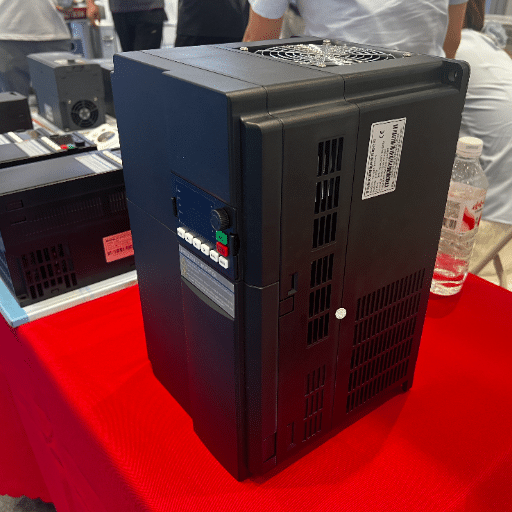
A compact VFD system is a low voltage variable frequency drive built into a smaller-than-standard chassis, designed to fit dense control panels, OEM machine cabinets, and retrofit slots where standard drives won’t physically clear. Compact drives typically cover the 0.1 kW to 22 kW range across 230V single-phase, 400V three-phase, and 480V three-phase supplies, though some manufacturers extend the form factor up to 30 kW with side-by-side mounting.
The category covers three common form factors. Book-style drives mount vertically with shallow depth, ideal for narrow cabinets. DIN-rail mount VFDs snap directly onto a standard 35mm rail, eliminating the need for separate mounting plates. Panel mount drives use through-panel cutouts, exposing the operator interface on the cabinet door while keeping the chassis behind it.
What makes a drive “compact” is volumetric efficiency, not feature reduction. Modern compact VFD systems include the same vector control modes (V/F, sensorless vector, closed-loop vector), the same protection suite (overcurrent, overvoltage, phase loss, thermal), and the same communication options (Modbus RTU, Profinet, EtherCAT) as their full-size siblings. The trade-off shows up in two places: thermal mass and serviceability access. A smaller heatsink means less margin at high ambient temperatures, and a smaller chassis means tighter terminal layouts.
For panel designers and OEMs, the core value proposition is simple: a compact VFD lets you build a smaller, lighter, less expensive enclosure without giving up control performance. For retrofit teams, it means fitting a modern drive into a legacy panel that was never designed to hold one.
Not every application needs a compact drive. But in four scenarios, the form factor is the difference between a clean install and a redesign.
OEM packaging lines run dozens of small motors, labelers, tampers, indexers, conveyors, each needing precise speed control inside a machine frame that’s already crowded with sensors, valves, and pneumatic actuators. Compact VFD systems mounted on shared DIN rails consolidate the drive count and shrink the electrical cabinet, which often gets bolted directly to the machine. A typical packaging OEM cuts cabinet depth by 40 percent when standardizing on compact drives, freeing space for HMI mounting or additional I/O without growing the footprint.
Long conveyor systems benefit from distributed drive architecture. Instead of running every motor cable back to a central MCC, designers place compact VFDs near each conveyor section in small wall-mounted enclosures. This shortens motor cables, reduces cable-induced voltage transients, and simplifies fault isolation. Compact drives with integrated EMC filters keep harmonic distortion in check even when distributed across hundreds of meters of plant.
Mechanical rooms in older commercial buildings rarely have spare panel real estate. Replacing legacy across-the-line starters with VFDs almost always means physical rework, unless the new drive fits the existing bucket. Compact VFD systems with NEMA 12 / IP55 enclosures bolt directly to the wall next to the motor, bypassing the crowded MCC entirely. For deeper guidance on this use case, see our walkthrough of VFD for HVAC systems.
Skid-mounted pump packages ship to wastewater plants, lift stations, and process facilities pre-built and pre-wired. Every cubic centimeter on the skid costs money in shipping, fabrication, and footprint at the customer site. Compact VFD systems let skid builders standardize on a drive family that fits enclosed in a small NEMA 4X panel, even when the skid runs three or four pumps. For application detail on variable-torque pump and fan loads, see our guide to VFDs for pumps and fans.
Choosing a compact VFD for machinery comes down to four interlocking decisions. Get one wrong and you’ll either oversize the cabinet or trigger nuisance faults under load.
Match the drive to the motor’s full-load amps (FLA), not just the kW or HP rating. Two motors at the same nameplate kW can pull different currents depending on efficiency class and service factor. Pull the FLA from the motor nameplate, add a 10 to 15 percent margin for overload events, and select the next compact drive frame above that current.
For variable-torque loads (pumps, fans), normal-duty ratings work. For constant-torque loads (conveyors, mixers, extruders), specify heavy-duty rating, which typically derates the drive’s continuous current by 10 to 20 percent. Don’t shortcut this, undersized drives in compact form factors trip on overload faster than full-size drives because the smaller chassis runs hotter.
This is where compact VFD systems live or die. The same kilowatt of heat dissipated by a smaller heatsink in a smaller cabinet means higher internal temperatures. Most compact drives are rated for 40C ambient at full output. At 50C inside a sealed enclosure on a hot summer day, expect to derate output current by 15 to 25 percent depending on the manufacturer’s curve.
Always check the manufacturer’s derating table before finalizing the size. If the cabinet hits 45C without ventilation, you may need the next frame up. NEMA’s MG-1 standard from NEMA covers motor and drive compatibility under thermal stress and is worth referencing for derate-sensitive applications.
DIN-rail mount works for drives below 4 kW where the rail can support the weight and vibration profile is moderate. Above 4 kW, screw-mounted panel installation provides better mechanical stability. Through-panel mounting (where the drive sits behind the door and the keypad protrudes through a cutout) suits operator-facing applications but adds sealing complexity in washdown environments.
IP20 drives belong inside a sealed control cabinet. They have no protection against airborne dust or water splash, so ambient conditions are inherited from the cabinet. IP55 and NEMA 12 compact drives mount standalone, on a wall, machine frame, or pump skid, and handle dust, splash, and washdown. Select IP rating early; switching from IP20 to IP55 mid-design forces a complete enclosure rework.
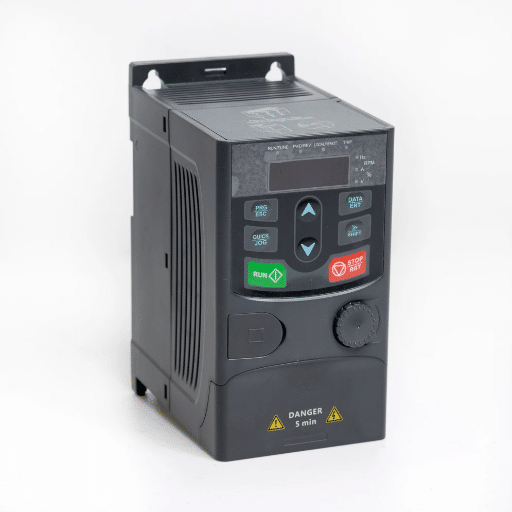
A compact VFD system installed wrong becomes the smallest expensive paperweight in the panel. Three installation factors carry most of the risk.
Manufacturer datasheets specify minimum clearance, typically 50mm above and below the drive, 25mm on the sides. Treat these as absolute minimums, not targets. In a dense cabinet, vertical channeling forces hot air upward through other heat-generating components (PLCs, power supplies, transformers), pre-heating the air entering the next drive in line.
Best practice: arrange compact VFDs in a single horizontal row when possible, with cooling air entering from below and exhausting through a top-mounted filtered fan. If vertical stacking is unavoidable, add baffles between drives to redirect hot exhaust away from the intake of the drive above.
Compact panels force power and control cables into closer proximity than full-size cabinets. Maintain at least 100mm separation between motor cables and control wiring. If they must cross, cross at 90 degrees to minimize coupling. Use shielded motor cables with the shield grounded at both ends, and route them through the drive’s EMC clamp where provided.
Don’t bundle motor cables from multiple drives together. The high-frequency switching noise from one drive will couple into the cables of another, creating phantom faults that are nearly impossible to diagnose after commissioning.
Tight panels amplify electromagnetic interference. Most compact VFDs include integrated Class A or Class B EMC filters, but in dense layouts even built-in filtering may be insufficient. Add a line reactor on the input side if you see harmonic issues, typically a 3 to 5 percent impedance reactor. The IEEE 519 standard from IEEE defines the harmonic distortion limits worth designing to, especially in commercial and shared-utility installations.
For longer motor cables (over 50 meters), add a dV/dt filter or output reactor. Compact drives with fast-switching IGBTs can produce voltage spikes at the motor terminals high enough to stress winding insulation, especially in retrofit applications where the motor wasn’t originally inverter-rated.
Need installation guidance? Our engineering team helps OEMs and retrofit contractors size compact VFD systems and validate panel layouts before fabrication. Contact our application engineers to review your panel drawing.
The decision between compact and standard form factor often gets made on instinct. A side-by-side comparison sharpens the call.
| Factor | Compact VFD | Standard VFD |
|---|---|---|
| Enclosure volume | 30-50% smaller | Reference baseline |
| Weight | 30-40% lighter | Reference baseline |
| Power range | 0.1-22 kW typical | 0.1-1000 kW |
| Thermal margin | Tighter (40C base) | Wider (50C common) |
| Service access | Tighter terminals | Spacious wiring |
| Mounting flexibility | DIN rail option | Panel mount only |
| Price (same kW) | 5-15% premium | Lower per-kW cost |
| Spare-part stocking | Manufacturer-specific | Often interchangeable |
Choose a compact VFD system when:
Choose a standard VFD when:
For most industrial buyers, the decision isn’t either/or, it’s a portfolio approach. Use compact drives where space is the binding constraint and standard drives where power or thermal headroom is.
For a deeper technical breakdown of the performance comparison, application scenarios and selection logic between low voltage and high voltage drives, see our Low Voltage Drive vs High Voltage Drive guide.

Five mistakes account for most compact VFD field failures we see in commissioning support.
Sizing on kW alone. A 7.5 kW IE3 motor pulls less current than a 7.5 kW IE1 motor of the same vintage. Always size on FLA, not nameplate kW.
Ignoring derating curves. A compact drive rated 40C at full current will silently undersize itself when the cabinet hits 50C. Read the derate curve before specifying.
Insufficient clearance. “We can squeeze it in” almost always means a thermal fault inside 90 days. Stick to manufacturer minimums or step up a frame size.
Mixing power and control wiring. In compact panels, this is the leading cause of phantom faults. Maintain separation, use shielded motor cables, ground shields at both ends.
Skipping the line reactor. Compact drives are sensitive to supply-side harmonics. A 3 percent impedance line reactor pays for itself in fault reduction within the first six months on most installations.
A panel builder we worked with, Meridian Manufacturing in Texas, built 50 identical pump skids for export to a Southeast Asian wastewater client. Their original design used standard 5.5 kW drives in 600mm-deep enclosures. Switching to compact VFD systems cut enclosure depth to 400mm, reduced shipping volume by 18 percent, and saved $34,000 in sheet-metal cost across the run. The catch: they undersized clearance on the first prototype, and three drives thermal-tripped during factory acceptance testing. Once they added baffles and bumped one frame size, every unit ran clean.
The lesson: compact doesn’t mean shortcuts. It means tighter discipline on the basics.
What is the smallest compact VFD available for industrial use?
Compact VFD systems start at 0.1 kW (about 1/8 HP) for 230V single-phase applications. Sub-1 kW drives in book-style or DIN-rail form factors typically measure under 150mm in any dimension and weigh less than 1.5 kg, fitting into junction-box-sized enclosures.
Can a compact VFD handle heavy-duty cycles?
Yes, when sized correctly. Specify the heavy-duty (constant torque) current rating rather than the normal-duty rating, and verify the overload capacity, typically 150 percent for 60 seconds. Above 7.5 kW heavy-duty, thermal margin gets tight in compact form factors, so consider stepping up a frame.
Do compact VFD systems need external braking resistors?
Most compact drives include a built-in brake chopper but require an external braking resistor for regenerative loads (cranes, conveyors with stored energy, fast-deceleration applications). The resistor mounts outside the drive enclosure to dissipate heat, which adds back some of the space the compact drive saved.
What is the difference between IP20 and IP55 compact drives?
IP20 drives have finger-protection only and must be installed inside a sealed cabinet. IP55 drives are sealed against dust ingress and water splash from any direction, allowing standalone installation on walls, machine frames, or skids. IP55 drives typically cost 20 to 30 percent more but eliminate the need for a separate enclosure.
How much panel space can I save with a compact VFD system?
Volumetric savings of 30 to 50 percent versus standard chassis drives in the same power class are typical. On a packaging machine cabinet built around 4-6 drives, this translates to 100-150mm of cabinet depth, often the difference between a wall-mount and floor-standing enclosure.
Are compact VFDs suitable for outdoor pump skids?
With IP55 or NEMA 4X rating and proper UV-resistant gland fittings, yes. Verify the manufacturer’s ambient temperature range, outdoor skids in hot climates can exceed 55C inside the enclosure, requiring active cooling or step-up sizing. Reference IEC 61800-2 for outdoor and harsh-environment drive standards.
Compact VFD systems aren’t a compromise, they’re a deliberate engineering choice for OEM machinery, retrofit projects, and distributed drive architectures where space is the binding constraint. Selected on FLA, sized for thermal margin, and installed with proper clearance and EMC discipline, a compact drive delivers the same motor control and energy savings as a full-size drive in a fraction of the cabinet volume.
Three takeaways to carry forward:
If you’re spec’ing compact VFD systems for a new machine build, retrofit, or pump skid project, our engineering team can help you size the drive, validate thermal margin, and review panel layout before fabrication. Get in touch with our application engineers → for a no-obligation drive selection consultation. The earlier the conversation, the cleaner the install.
For control-mode-specific commissioning, see our vector control commissioning walkthrough.