Ready to Get Your VFD Solution?
Whether you need a single drive or a complete system, we have the VFD products and engineering support to ensure your project's success.

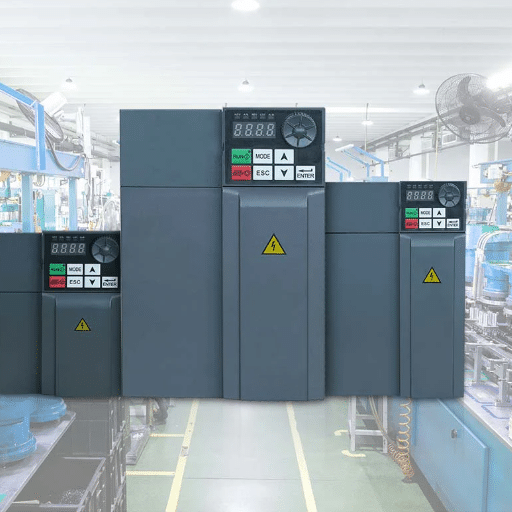
The most common VFD applications in manufacturing industry settings are conveyors, pumps, fans, compressors, machine tool spindles, mixers, and extruders. Across these applications, variable frequency drives typically cut motor energy use by 15 to 35 percent while reducing mechanical wear and improving process control.
Rajesh, a plant engineer at a tier-one automotive supplier in Chennai, saw what that looks like in practice. In January 2025 his paint shop ran six ventilation fans at full speed around the clock, dampers half-closed to control airflow. He retrofitted two of them with VFDs as a pilot. The drives paid for themselves in 11 months, and the plant converted the remaining four before the year ended. The motors were never the problem. Running them at one fixed speed was.
This guide maps where VFDs deliver value across manufacturing, sector by sector, so you can prioritize your own retrofit list. If you want the machine-type deep dive with control mode selection and torque frameworks, see our companion guide on VFD in manufacturing.
Key Takeaways
- Motor-driven equipment consumes 40 to 60% of a manufacturing plant’s electricity, which is why VFD retrofits target motors first.
- The highest-value VFD applications in factories are conveyors, pumps, fans, compressors, spindles, mixers, and extruders, with typical savings of 15 to 35%.
- Each sector prioritizes differently: automotive wants throughput, food and beverage wants hygiene and batch control, electronics wants precision and cleanroom stability.
- Start retrofits with variable torque loads (pumps and fans). They follow the affinity laws, so small speed reductions produce large savings.
- Match the drive to the load type and duty, not just the motor horsepower. Sizing mistakes erase the savings.

Most industrial motors were designed to run at one speed. But production demand is never constant. Conveyors surge and idle, pumps push against throttled valves, and fans fight closed dampers. Every one of those workarounds burns electricity to create resistance, a process the user never asked for. Closing that gap between fixed speed and variable demand is the common thread behind the most valuable VFD uses in manufacturing.
A variable frequency drive removes the workaround. It adjusts motor speed to match real demand by varying the frequency and voltage supplied to the motor. The result is less energy, less mechanical shock at startup, and tighter control over the process itself. According to the U.S. Department of Energy, motor systems account for the majority of industrial electricity use, which is why motor control is usually the first place efficiency programs look. The International Energy Agency identifies motor systems as one of the largest industrial efficiency opportunities worldwide.
Whatever the sector, seven applications account for most VFD installations on a factory floor:
| Application | Typical Role | Energy Savings |
|---|---|---|
| Conveyors | Material handling, assembly lines | 10 to 20% |
| Pumps | Coolant, process water, hydraulics | 20 to 50% |
| Fans | Ventilation, dust extraction, drying | 20 to 50% |
| Compressors | Plant air supply | 15 to 35% |
| Machine tool spindles | CNC, milling, grinding | 15 to 25% |
| Mixers and agitators | Batch processing | 15 to 25% |
| Extruders | Plastics, rubber, cable | 20 to 30% |
Pumps and fans deliver the largest percentages because they follow the affinity laws: power falls with the cube of speed. A fan at 80 percent speed consumes roughly half the power. Conveyors save less energy but repay through soft starts that extend belt and gearbox life. For the math behind these figures, see our VFD energy-saving calculation guide.

The same drive technology solves different problems depending on what the plant makes. Here is how priorities shift across five major sectors.
Automotive plants run some of the largest motor fleets in manufacturing: body shop conveyors, paint shop fans and pumps, stamping press hydraulics, and compressed air systems everywhere.
The priority here is throughput and uptime. Conveyor synchronization keeps body panels moving between stations without pile-ups, and soft starting protects gearboxes that run three shifts a day. Paint shop ventilation, like Rajesh’s pilot in Chennai, is usually the fastest energy win because the fans run continuously regardless of booth occupancy.
Food plants care about hygiene, batch consistency, and gentle handling. VFDs control mixer speed as dough viscosity changes through a batch, ramp conveyor speed to prevent product damage, and run Clean-in-Place pumps at the exact flow each cleaning stage requires.
Ana, who manages a beverage bottling line in Guadalajara, uses recipe-based speed profiles stored in her drives. The changeover between bottle formats once took her team a full hour of manual adjustments. With recipes loaded at the drive level, the same changeover takes under 15 minutes. Washdown-rated drives with suitable IP protection handle the daily sanitation cycle. For sector-specific parameter guidance, see our article on VFD for food processing.
Electronics manufacturing runs on precision and air quality. Cleanroom HVAC fans must hold pressure cascades steady around the clock, vacuum pumps support pick-and-place and testing equipment, and high-speed spindles demand tight speed regulation for drilling and routing circuit boards.
The VFD’s role here is stability more than raw savings. Closed-loop vector control holds spindle speed within fractions of a percent under changing loads, and fan speed tracking keeps cleanroom differential pressure inside specification as filters load up.
Extruders are the defining VFD application in this sector. They are constant torque loads that need 150 to 180 percent breakaway torque at startup and precise screw speed control after that, because screw speed directly determines product dimensions and surface quality.
Injection molding machines gain on two fronts: the hydraulic pump motor stops running at full speed between cycles, and servo or vector-controlled drives cut the machine’s energy use dramatically compared to fixed-displacement pump systems.
Machine shops combine constant power loads and constant torque loads on the same floor. CNC spindles need constant power across a wide speed range, sometimes 1:1000, while conveyors, cranes, and coolant pumps behave very differently.
This mix is where load-type identification matters most. Misreading a constant power spindle as a constant torque load leads to an undersized drive that trips under cutting load. Our guide on how to choose a VFD walks through the selection process step by step.

Wei, an energy manager at an electronics assembly plant in Suzhou, had a budget for five drives and a motor list of 60. Her method is worth copying. She scored every motor on three factors: annual running hours, whether the load was throttled or damped, and whether speed variation would improve the process itself.
Her top five were all fans and pumps over 15 kW running more than 6,000 hours a year. The retrofit cut her plant’s motor electricity bill by 22 percent, and the project paid back in 14 months. The lesson generalizes well to most VFD for manufacturing plants decisions:
For conveyor systems specifically, our VFD for conveyors article covers synchronization, load sharing, and ramp settings in detail.

Most variable frequency drive uses in production get the attention, but not every valuable drive sits on the factory floor. Plant utility systems often run longer hours than production equipment, which makes them strong retrofit candidates:
These systems are easy to overlook because they sit outside the production budget. Yet a cooling tower fan running 8,000 hours a year usually repays its drive faster than a machine tool running 2,000.
The main applications are conveyors, pumps, fans, compressors, machine tool spindles, mixers, and extruders. Together these cover most motor-driven equipment on a factory floor, and each one benefits from matching motor speed to actual production demand.
Pumps and fans benefit most in energy terms because their power consumption falls with the cube of speed. Extruders and packaging lines often gain more overall value through improved product quality, faster changeovers, and reduced mechanical wear.
Typical savings range from 15 to 35 percent on motor-driven equipment, with pump and fan applications reaching 20 to 50 percent when they replace throttling or damper control. Actual results depend on running hours, load profile, and how the motor was controlled before.
No. Motors that run at constant full load around the clock, such as some compressors and fixed-rate process motors, gain little from speed control. A VFD earns its cost where demand varies or where soft starting and process control add value.
One drive can run several motors simultaneously if they start together and carry similar loads, but each motor needs its own overload protection. For independent speed control, each motor needs its own drive.
Yes, and often the payback is faster. A small shop usually has a handful of motors with obvious throttling or idle-time waste, so the retrofit list is short and the savings are easy to meter. Compact low-voltage drives below 15 kW cover most workshop machines, from lathes and dust collectors to coolant pumps.
The pattern behind successful VFD applications in manufacturing industry projects is the same: motors sized for worst-case demand, running at full speed against average demand. Conveyors, pumps, fans, compressors, spindles, mixers, and extruders all recover value the moment their speed matches the work.
Rajesh started with two fans. Wei started with five motors out of sixty. Neither needed a plant-wide overhaul on day one, and both built the business case for everything that followed.
Your next step is simple: list your motors, rank them by running hours and throttled loads, and start with the top of the list. For a broader view across industries beyond manufacturing, see our overview of VFD applications.
Ready to identify the highest-payback VFD applications in your plant? The Shandong Electric engineering team supports projects from 0.1 kW workshop motors to multi-megawatt production lines, with selection, configuration, and commissioning support included. Send us your motor list and we will help you build the retrofit plan.