Ready to Get Your VFD Solution?
Whether you need a single drive or a complete system, we have the VFD products and engineering support to ensure your project's success.

The main VFD environmental benefits are lower electricity consumption (typically 20% to 50% on pumps and fans), direct reductions in carbon emissions, longer equipment life, and less water and noise pollution. If your facility runs motors, a variable frequency drive is one of the fastest ways to shrink its environmental footprint.
Here’s why that matters. According to the International Energy Agency, electric motor systems consume roughly 45% of all electricity generated worldwide. That makes motors the single largest end use of electricity on the planet, and the single largest opportunity for industrial decarbonization.
The problem is that most motors still run at one fixed speed, full power, all the time, regardless of what the process actually needs. You’ve probably seen this in your own facility: a pump throttled by a valve, a fan choked by a damper, energy burned for nothing.
In this guide, you’ll get a complete, quantified breakdown of every environmental benefit a VFD delivers, a worked CO2 calculation you can adapt to your own motors, and the compliance angles (ESG, ISO 50001, EU Ecodesign) that help you build the internal business case.
Key Takeaways
- Motor-driven systems use about 45% of global electricity, so motor speed control is the biggest lever for industrial decarbonization.
- Thanks to the affinity laws, cutting pump or fan speed by just 20% reduces energy use by roughly 50%.
- A single 100 kW HVAC fan on a VFD can avoid around 150 tonnes of CO2 per year, equivalent to the annual emissions of about 30 passenger cars.
- Beyond energy, VFDs extend equipment life, conserve water, cut noise, and can feed braking energy back to the grid.
- VFDs support ISO 50001, EU Ecodesign (IE3/IE4) compliance, and ESG reporting, and often qualify for utility rebates.

A variable frequency drive controls motor speed to match real-time demand. That one capability produces a chain of environmental benefits:
The environmental case is only part of the picture, so if you want the full quantified rundown of every gain a drive delivers, our guide to the advantages of VFD puts hard numbers to the energy, control, and protection benefits behind each one.
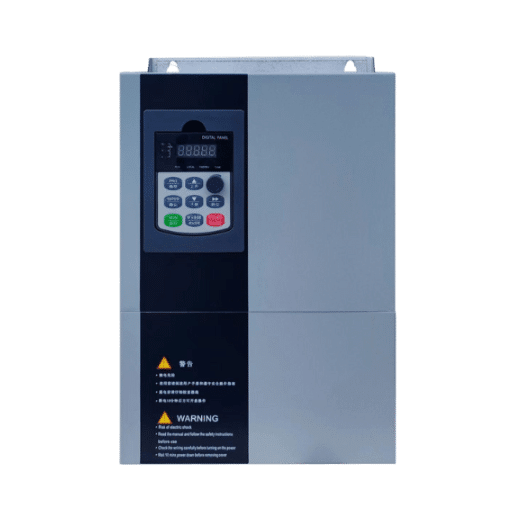
Want to see what these savings look like in hardware? Explore our low voltage VFD systems built for pumps, fans, and HVAC applications.
For centrifugal loads like pumps and fans, power consumption follows the cube of speed. This is the affinity law, and it’s the engine behind most VFD environmental benefits.
Run a fan at 80% speed and it draws only about 51% of rated power (0.8 cubed). Run it at 50% speed and power drops to roughly 12.5%. Small reductions in speed produce outsized reductions in energy use, and that relationship is why variable speed control beats every mechanical alternative.
A fixed-speed motor has exactly one trick: full speed. To reduce output, operators throttle valves, close dampers, or recirculate flow. The motor still consumes nearly full power while the extra energy is destroyed as turbulence and heat.
A VFD takes the opposite approach. It adjusts the frequency and voltage supplied to the motor, so the motor itself slows down. Output falls, and power consumption falls with it, cubically. No throttling, no waste.
Consider Daniel, a plant manager at a textile mill in Vietnam. In early 2025, his facility ran six 45 kW circulation pumps at full speed around the clock, throttled by manual valves. After retrofitting 3 phase VFDs and matching pump speed to actual dye-line demand, average motor speed settled at 75%. His electricity bill for that pump group dropped 42%, and the site cut its annual CO2 emissions by over 300 tonnes. The drives paid for themselves in 14 months.

VFDs reduce carbon emissions by cutting electricity consumption at the motor. Every kilowatt-hour a VFD saves avoids the emissions that would have been generated to produce it, roughly 0.4 to 0.6 kg of CO2 per kWh depending on the regional grid mix. Because VFDs commonly save 20% to 50% of motor energy, the carbon reduction is substantial and immediate.
Let’s make these VFD environmental benefits concrete. Take a 100 kW supply fan in a commercial HVAC system, running 6,000 hours per year:
One fan. One drive. About 150 tonnes of CO2 avoided annually, which is comparable to taking 30 passenger cars off the road.
| Application | Typical Speed Reduction | Typical Energy Savings | Example CO2 Reduction* |
|---|---|---|---|
| HVAC fan (100 kW) | 20% | ~49% | ~147 tonnes/year |
| Water pump (75 kW) | 15-25% | 35-50% | 80-110 tonnes/year |
| Air compressor (90 kW) | 10-20% | 15-35% | 40-90 tonnes/year |
| Conveyor (55 kW) | Variable | 10-30% | 15-45 tonnes/year |
*Assumes 6,000 operating hours/year and 0.5 kg CO2 per kWh. Your results depend on load profile, hours, and local grid emissions.
Want this calculation done for your own motors? Contact our engineering team for a free energy savings assessment based on your actual load profiles.
Energy gets the headlines, but the full environmental case for VFDs is broader.
Across-the-line starting hits a motor with 6 to 8 times its full-load current and a violent mechanical jolt. Do that thousands of times and bearings, couplings, belts, and windings wear out early.
A VFD ramps the motor up gently. Soft starts, controlled stops, and reduced operating speeds mean less stress on every component in the drive train. Equipment that lasts years longer means fewer replacements manufactured, shipped, and scrapped. That’s a real, if rarely counted, environmental benefit.
In water systems, over-pumping is invisible waste. Pumps sized for peak demand run at full speed even when demand is a fraction of that, pushing excess pressure through valves and accelerating pipe wear and leakage.
Rosa, an operations supervisor at a municipal wastewater plant in Spain, saw this firsthand. Her aeration blowers and transfer pumps ran flat out day and night. After installing VFDs with dissolved-oxygen feedback control in 2024, the plant cut pumping energy by 38% and reduced water hammer events that had been causing joint leaks in a 20-year-old distribution line. Less energy, less treated water lost to leaks, fewer emergency repairs.
Noise is pollution too. Fan and pump noise scales steeply with speed, so a fan running at 80% speed is dramatically quieter than one at full speed. For facilities near residential areas, or for worker health inside the plant, that’s a genuine environmental and occupational benefit.
Standard drives waste braking energy as heat in resistors. Drives with Active Front End (AFE) technology do something smarter: they capture the kinetic energy from decelerating loads, like a descending crane, a stopping elevator, or a downhill conveyor, and feed it back into the plant’s electrical supply.
On applications with frequent braking cycles, this recovered energy is meaningful. It turns a waste stream into a power source.

Regulators have noticed the motor opportunity. The EU’s Ecodesign Regulation (EU) 2019/1781 sets mandatory efficiency requirements for electric motors and variable speed drives, and similar IE3/IE4 efficiency standards are spreading across markets worldwide. Pairing efficient motors with properly selected VFDs is increasingly the straightforward path to compliance, not just a nice-to-have.
For most industrial companies, motor electricity sits squarely in Scope 2 emissions. That makes VFD retrofits one of the few decarbonization projects that is measurable, verifiable, and pays for itself, which is why variable frequency drive sustainability has become a board-level topic.
Priya, a sustainability manager at a packaging manufacturer, needed projects for her company’s 2026 CSRD-aligned disclosure. Instead of a vague offset purchase, she documented a VFD retrofit across 14 motors: metered kWh savings, converted to tonnes of CO2 with the local grid factor, verified by an external auditor. The project became the flagship line item in the company’s emissions reduction report, and it had a 2.1-year payback. VFD savings fit naturally into ISO 50001 energy management systems and ESG frameworks because the numbers are auditable.To build that business case with defensible numbers, our guide to the VFD payback period walks through the calculation step by step using energy rates, run hours, rebates, and installed cost.
Many utilities offer prescriptive or custom rebates for VFD installations on fans, pumps, and compressors, because they’d rather fund your efficiency than build new generation. VFD installations can also contribute points toward green building certifications like LEED and BREEAM. Between rebates and energy savings, payback periods frequently drop below two years.
Engineering credibility means telling the whole story. The VFD environmental benefits are real, but the technology isn’t impact-free, and you deserve the full picture.
VFDs draw non-linear current, which introduces harmonics into the electrical supply. Left unmanaged, harmonics cause extra heating in transformers and cables, which wastes energy and stresses equipment.
The good news: this is a solved problem. Line reactors, DC chokes, and passive or active harmonic filters bring distortion within IEEE 519 limits. Modern drive systems are routinely specified with mitigation built in, so the net environmental balance stays strongly positive.
A VFD itself consumes a small amount of power. Quality drives run at 97% to 98% efficiency, so losses are around 2% to 3% of throughput. Manufacturing the drive also carries embodied carbon.
Run the numbers, though, and the payback is overwhelming. On a typical pump or fan application, the embodied carbon of the drive is offset by its energy savings within the first few months of operation. Over a 10 to 15 year service life, a VFD prevents hundreds of times more emissions than its production created.

Not every motor is an equal opportunity. The biggest wins come from variable-torque loads with long run hours:
If you’re prioritizing, start where run hours and partial-load operation overlap. That’s where energy efficient motor control delivers the biggest carbon and cost wins.
When people ask how VFDs reduce carbon footprint, the answer starts at the meter. A VFD slows the motor to match demand, so it draws less power. Every kilowatt-hour saved avoids roughly 0.4 to 0.6 kg of CO2 from grid generation, and the savings are continuous, metered, and auditable.
On variable-torque loads like pumps and fans, typical savings run from 20% to 50%, thanks to the affinity laws. A 20% speed reduction alone cuts power draw by roughly half. Constant-torque loads like conveyors see smaller but still worthwhile savings of 10% to 30%.
Yes. Electricity consumption by electric motors typically falls under Scope 2 emissions; therefore, the energy savings and CO2 reductions achieved through the use of variable frequency drives (VFDs) can be directly translated into reportable data. As the relevant data is measurable and verifiable, VFD retrofit projects serve as a key component of ISO 50001 systems and ESG disclosures.
Start with motors that run many hours per year at partial load: HVAC fans, water and wastewater pumps, and compressors. These applications combine the highest savings percentages with the longest run hours, so they pay back fastest in both cost and carbon.
The VFD environmental benefits stack up quickly once you quantify them:
Few sustainability investments are this easy to justify. The technology is proven, the savings are metered and auditable, and payback typically arrives in one to three years.
Your next step is simple: identify your highest run-hour motors that still run at fixed speed, and get a savings calculation based on your real load profiles. Talk to the Shandong Electric engineering team for a free assessment, from motor sizing to commissioning support, and turn your biggest electricity cost into your biggest decarbonization win.