Ready to Get Your VFD Solution?
Whether you need a single drive or a complete system, we have the VFD products and engineering support to ensure your project's success.

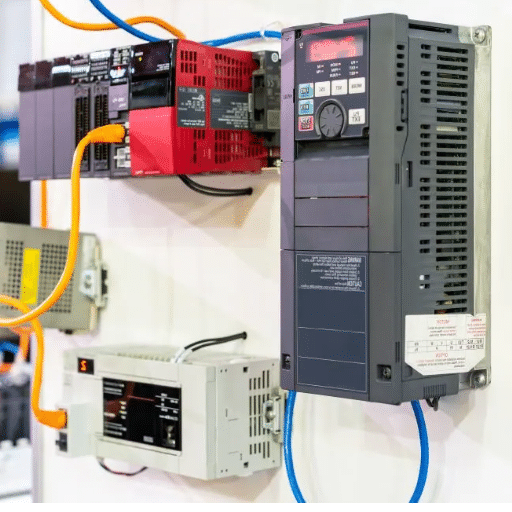
A VFD in Industry 4.0 is far more than a motor speed controller. It is a connected data source that monitors motor health, optimizes energy use in real time, and links your rotating equipment directly to plant-wide automation systems. If your facility runs motors, your variable frequency drives are the fastest, most affordable entry point into smart manufacturing.
Here is the part most digital transformation guides skip: you probably do not need to buy new equipment to get started. In February 2025, Priya, a plant manager at a packaging facility in Ohio, connected her existing pump drives to a monitoring dashboard.
Two weeks later, the system flagged a rising current signature on a 45 kW circulation pump. Her team inspected it and found a bearing in early failure. They replaced it during a planned stop, avoiding a 14-hour unplanned outage that would have cost roughly $38,000 in lost production.
No new drives. No artificial intelligence platform. Just data her VFDs were already collecting, finally being used.
This guide explains exactly how VFDs fit into Industry 4.0, which communication protocols matter, how to turn drive data into predictive maintenance, and a realistic four-phase roadmap for plants running older equipment.
Key Takeaways
- A modern VFD is a built-in condition monitoring sensor. It continuously measures current, voltage, torque, and temperature with no extra hardware required.
- Motor-driven systems consume 40-60% of industrial electricity, which makes connected VFDs the highest-impact starting point for Industry 4.0 energy management.
- Most existing drives can join an Industry 4.0 architecture through option cards or gateways. Full replacement is rarely necessary.
- VFD-based predictive maintenance typically reduces unplanned downtime by 30-50% and pays back faster than almost any other smart factory investment.
- The global VFD market is growing at roughly 6% per year through 2034, driven largely by Industry 4.0 integration and energy efficiency mandates.
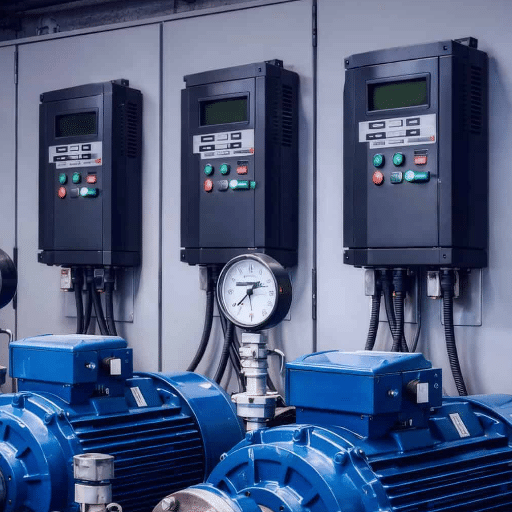
A VFD in Industry 4.0 is a variable frequency drive equipped with industrial communication capability, allowing it to exchange real-time operating data with PLCs, SCADA systems, and cloud platforms. Instead of running in isolation, the drive becomes an active node in a connected factory, reporting performance and responding to system-level commands.
Traditional variable frequency drive solutions do one job very well: they adjust motor speed by varying output frequency and voltage. That alone delivers major energy savings, often 20-50% on centrifugal loads like pumps and fans. For a full breakdown of every benefit a drive delivers beyond these energy savings, our guide to the advantages of VFD puts hard numbers to the energy, control, and protection gains.
Industry 4.0 adds a second job. The same drive now reports what it sees. Every connected VFD continuously streams operating data to higher-level systems, turning a passive power component into an active information source.
This shift matters because of scale. Motors drive pumps, fans, conveyors, compressors, and mixers across your entire plant. Connecting their drives means connecting the largest single group of energy consumers and failure points you own.
Here is an insight most vendors overlook. A modern VFD already functions as a precision sensor package. Every second of operation, it measures:
A peer-reviewed study in MDPI’s Eng journal confirms that drive data alone can support nondestructive testing and predictive maintenance of industrial motor systems, without installing additional sensors.
Planning a connected upgrade? Our low voltage VFD systems ship with Modbus communication built in, so integration starts on day one.
VFD Industry 4.0 integration delivers value through five distinct capabilities. Each one builds on the drive’s dual role as controller and sensor.

Protocol selection is where many VFD Industry 4.0 projects stall. The options look confusing, but the decision logic is simple: match the protocol to the level of the architecture you are connecting to. An IoT-enabled VFD typically supports at least two of the options below.
Modbus remains the most widely supported protocol in industrial drives. Modbus RTU runs over serial RS-485 wiring, costs almost nothing, and suits small installations of a few drives. Modbus TCP carries the same simple data model over Ethernet, making it the default choice for connecting drives to plant networks and IIoT gateways.
Siemens-centric plants standardize on Profibus (serial) or Profinet (Ethernet). If your facility runs SIMATIC PLCs, drives with Profinet option cards integrate cleanly into existing TIA Portal projects with minimal engineering time.
Rockwell and Allen-Bradley environments favor EtherNet/IP. Drives with native EtherNet/IP support appear directly in Studio 5000, which simplifies commissioning and diagnostics for North American plants in particular.
OPC UA solves a different problem. It provides secure, structured data exchange between plant equipment and IT or cloud systems. In practice, many brownfield sites place an edge gateway between drives and the cloud: the gateway polls drives over Modbus TCP and publishes OPC UA or MQTT upward.
| Protocol | Type | Best For | Architecture Level |
|---|---|---|---|
| Modbus RTU | Serial | Small, low-cost drive networks | Field |
| Modbus TCP | Ethernet | General plant integration, gateways | Field / Control |
| Profibus | Serial | Legacy Siemens installations | Field |
| Profinet | Ethernet | Modern Siemens PLC systems | Control |
| EtherNet/IP | Ethernet | Rockwell / Allen-Bradley plants | Control |
| OPC UA / MQTT | Ethernet / Cloud | IT integration, analytics, dashboards | Supervisory / Cloud |

If you connect your drives for only one reason, make it this one. VFD predictive maintenance consistently delivers the fastest, most measurable return of any Industry 4.0 motor control investment.
Every mechanical problem changes how a motor draws current. A worn bearing adds friction, which raises torque demand. A misaligned coupling creates load oscillation at specific frequencies. A clogged pump impeller shifts the entire current profile.
Because the drive measures these variables hundreds of times per second, it detects changes no periodic inspection can catch.
Most plants use only a fraction of this capability. The drive trips, someone reads the fault code, resets it, and moves on.
Industry 4.0 practice is different: stream the data continuously, establish baselines, and alarm on trends rather than trips. According to McKinsey & Company, predictive maintenance reduces machine downtime by 30-50% and cuts maintenance costs by 10-40%.
Priya’s $38,000 save from the introduction is typical, not exceptional. A single prevented outage on a critical line usually covers the entire first year of a monitoring project. Energy visibility then adds a second, ongoing return on top.
The most common question we hear from plant engineers is blunt: do we need to replace our drives? Usually, no. Brownfield retrofit is the realistic path for most facilities.
Drives installed in the last 10-15 years almost always include at least Modbus RTU, and many accept optional Ethernet communication cards. Even older drives with no network port can join a connected architecture through external gateways that read analog outputs and terminal signals. If your drives control speed reliably today, connectivity is an add-on, not a replacement project.
Replacement makes sense in three situations: the drive lacks any communication option and carries critical loads, the hardware is nearing end of life anyway, or you need advanced control modes like closed-loop vector control for process data quality. In heavy industry, upgrading to modern high power VFD systems with native Ethernet often costs less than engineering workarounds for obsolete units. For standard plant motors, a current-generation 3 phase VFD with sensorless vector control provides both better data and better control.
Daniel, a maintenance lead at a food processing plant, chose the retrofit route. He connected 14 existing drives through Modbus TCP gateways and had a live energy dashboard within six weeks.
The first discovery: a 30 kW exhaust fan running at full speed every night despite zero production. Fixing that one schedule saved $11,000 per year, more than the entire gateway hardware cost.
Connectivity introduces risk, so treat drives like any networked device:
These four steps address the large majority of real-world exposure for industrial drive networks.

Successful VFD Industry 4.0 projects follow the same sequence. Skipping phases is the most common cause of stalled initiatives.
Phase 1: Audit. Inventory every drive: manufacturer, model, age, communication options, and the criticality of the load it serves. Identify your ten highest-energy and ten highest-risk motors. This takes days, not months.
Phase 2: Connect. Choose protocols based on your existing PLC ecosystem, install option cards or gateways, and establish network segmentation. Start with one production line or one pump station as a pilot.
Phase 3: Monitor. Build dashboards for energy, runtime, and alarm data. Establish baselines over four to eight weeks of normal operation. Configure trend alarms on the critical motors identified in Phase 1.
Phase 4: Predict and optimize. Apply analytics to baseline deviations, automate responses where safe, and feed energy data into production reporting. Expand from the pilot to the full plant using lessons learned.
Current market conditions favor immediate action. Fortune Business Insights projects that the global variable frequency drive (VFD) market will grow from approximately $25.5 billion in 2026 to nearly $41 billion by 2034, with Grand View Research identifying smart, connected drives as a primary driver of this expansion. As connectivity features increasingly become an industry standard, those who lag behind risk a competitive disadvantage due to energy consumption and downtime costs.
What is the role of a VFD in Industry 4.0?
A VFD in Industry 4.0 acts as both motor controller and data source. It adjusts speed and torque based on real-time process demands while streaming operating data to PLCs, SCADA, and cloud platforms for monitoring, analytics, and predictive maintenance.
Can I connect old VFDs to an IIoT platform?
Yes, in most cases. Drives from the last 10-15 years typically include Modbus RTU or accept Ethernet option cards. Older units can connect through external gateways that translate drive signals into modern protocols like Modbus TCP, OPC UA, or MQTT.
How much energy can a smart VFD save?
Savings depend on load type. Centrifugal pumps and fans commonly achieve 20-50% reductions because power falls with the cube of speed. Manufacturing machines typically see 15-35% depending on duty cycle. Connectivity adds further savings by exposing waste, such as motors running unloaded.
What data does a VFD collect?
A modern drive continuously measures output current, voltage, torque, power, internal temperature, running hours, and fault events. This data set alone supports condition monitoring and energy analysis without additional sensors.
VFD Industry 4.0 integration is not a future technology decision. It is a decision about equipment you already own.
The core points worth remembering:
Motor-driven systems consume 40-60% of industrial electricity. Plants that connect their drives first gain a structural advantage in energy cost, uptime, and data visibility that compounds every year.
Ready to connect your motor control systems? As a VFD Industry 4.0 partner, Shandong Electric supplies low voltage and high voltage drive solutions with Modbus and Ethernet communication built in, plus engineering support from selection through commissioning. Contact our engineering team to assess your drive fleet and plan your first connected line.