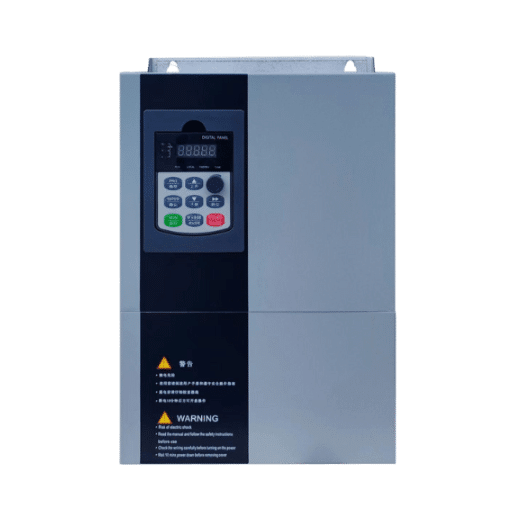
Ready to Get Your VFD Solution?
Whether you need a single drive or a complete system, we have the VFD products and engineering support to ensure your project's success.


A VFD soft start ramps a motor’s voltage and frequency together from zero to full speed, keeping starting current near the motor’s full-load amps while delivering controlled torque. Unlike a simple soft starter that only reduces voltage, a VFD also controls speed throughout the run, making it the best choice when a load needs variable flow or energy savings.
Starting a large motor direct-on-line is still one of the most stressful events in a plant. A 250 HP fan can pull six to eight times its full-load current, dimming lights, sagging bus voltage, and slamming couplings and belts. Engineers want the softest possible start, but they also want to avoid overspending on controls they do not need. This guide explains how VFD soft start works, when it beats a standalone soft starter, and how to commission it for pumps, fans, conveyors, and compressors.
Key Takeaways
- A VFD soft start limits inrush current to roughly 1.0–1.5 times full-load amps by ramping both voltage and frequency.
- A soft starter only reduces voltage and is limited to roughly 3–4 times full-load current, with no speed control during normal operation.
- VFD soft start is ideal for variable-torque loads such as pumps, fans, and compressors that also benefit from energy savings through affinity laws.
- For fixed-speed loads with high inertia, a soft starter may be the more cost-effective and simpler choice.
- Commissioning a VFD soft start requires setting acceleration time, current limit, V/Hz profile, and deceleration ramp for the specific load.

VFD soft start is the controlled acceleration of an AC motor using a variable frequency drive. Instead of applying full line voltage instantly, the drive gradually raises the output frequency and voltage along a programmed ramp. The motor sees a smooth, predictable torque profile from standstill to rated speed.
This differs from a conventional soft starter. A soft starter uses thyristors or silicon-controlled rectifiers to chop the AC voltage during start-up. It reduces voltage, and therefore current and torque, but it always supplies line frequency. Once the motor reaches full speed, the bypass contactor closes and the motor runs at fixed speed.
A VFD soft starter, by contrast, converts incoming AC to DC, then reconstructs variable-frequency AC. It can keep current low, control acceleration torque, and continue to modulate speed during normal operation. The trade-off is higher cost, more complexity, and harmonic output that must be managed in some installations.
Understanding the mechanics helps engineers set parameters correctly and justify the investment to maintenance and procurement teams. A VFD soft start works in three power stages and is governed by a volts-per-hertz relationship.
The input rectifier converts three-phase AC line power into DC. This DC charges a DC bus capacitor bank that acts as a stable energy reservoir. The inverter stage then uses insulated-gate bipolar transistors, or IGBTs, to switch the DC into pulse-width-modulated AC waveforms. By changing the pulse width and switching frequency, the VFD produces adjustable voltage and frequency for the motor.
AC induction motors need constant magnetic flux in the stator. Flux is roughly proportional to voltage divided by frequency. If voltage stays high while frequency drops, the motor saturates and overheats. If voltage drops too fast relative to frequency, torque collapses. A VFD maintains a constant volts-per-hertz ratio, so the motor develops rated torque without overcurrent or overheating across the speed range.
The acceleration ramp is the programmed time from zero frequency to the maximum operating frequency. A 10-second ramp on a 60 Hz drive means the output increases by 6 Hz per second. During the ramp, the VFD monitors output current. If the load demands more torque than the current limit allows, the drive extends the ramp automatically. This keeps VFD starting current near the motor’s full-load amps, typically 1.0 to 1.5 times FLA, even under heavy load.
The IGBTs turn on and off thousands of times per second. The resulting PWM waveform is not a pure sine wave, but its fundamental component matches the desired frequency. The motor’s inductance averages the pulses into smooth current. Modern drives use carrier frequencies from 2 to 16 kHz. Higher carrier frequencies reduce motor noise but increase switching losses and heat in the drive.

Choosing between a VFD soft starter and a standalone soft starter is a common engineering decision, and our detailed comparison of the differences between VFD and soft starter covers cost, harmonics, and lifecycle trade-offs. The right answer depends on starting current, speed control needs, energy savings potential, and budget.
| Feature | Soft Starter | VFD Soft Start |
|---|---|---|
| Starting current | 3–4× FLA | ~1.0–1.5× FLA |
| Speed control | None after start | Full range during operation |
| Energy savings | Minimal | Significant on variable-torque loads |
| Torque control | Reduced during start | Controlled throughout ramp |
| Harmonics | Low | Moderate to high; filters may be needed |
| Initial cost | Lower | 2–3× higher |
| Maintenance | Bypass contactor every 10–15 years | Cooling fans every 3–5 years, capacitors 7–10 years |
| Best for | Fixed-speed, high-inertia loads | Variable-speed pumps, fans, compressors |
When the load will always run at full speed and the only goal is to reduce mechanical shock, a soft starter is often enough. When the process needs flow or pressure control, a VFD soft start is the better long-term investment because it replaces both the starter and the throttling device.
| Starting Method | Typical Starting Current | Best Application |
|---|---|---|
| Direct-on-line | 6–8× FLA | Very small motors, low-impact starts |
| Star-delta | 3–4× FLA | Light-start loads, dual-voltage motors |
| Soft starter | 3–4× FLA | Fixed-speed loads with moderate inertia |
| VFD soft start | 1.0–1.5× FLA | Variable-speed loads, current-sensitive buses |
The lower inrush of a VFD soft start is valuable on generator sets, weak utility feeds, and older transformers. It also avoids the nuisance trips that occur when a large motor start pulls the whole bus below the under-voltage threshold of other drives.
A VFD soft start delivers electrical, mechanical, process, and protection benefits. The value of each benefit depends on the application. For a fuller, quantified breakdown of every one of these benefits, our guide to the advantages of VFD puts hard numbers to the energy, control, and protection gains covered below.
Low inrush current is the most visible advantage. A VFD soft start draws only slightly more than the motor’s running current, which reduces voltage sag on the plant bus and lowers demand charges from the utility. Power factor also improves near unity at the VFD input, reducing reactive power penalties. Generator-backed sites benefit because the drive can be programmed to start within the generator’s kVA capability.
Because torque rises smoothly, couplings, gearboxes, belts, and bearings see far less shock. The sudden jerk associated with DOL starting is eliminated. Soft stopping is equally useful. On a pump, a controlled deceleration ramp prevents water hammer. On a conveyor, it prevents product spillage and belt slack.Since these gentler starts and stops directly reduce wear on bearings and drivetrain components, our guide to protecting VFD motor life explains how smoother torque profiles translate into longer bearing and coupling service life.
This is where a VFD separates itself from a soft starter. A VFD can vary speed continuously to match demand. On pumps and fans, reducing speed by 20 percent can cut power by roughly 50 percent according to the pump and fan affinity laws. The drive can also run PID control loops for pressure, flow, or level, replacing separate controllers and valves. Integration with PLCs and SCADA systems is standard through Modbus, Profibus, Profinet, or EtherNet/IP.
Modern VFDs include motor overload, overcurrent, overvoltage, undervoltage, phase loss, ground fault, and thermal protection. These functions can replace a separate thermal overload relay and reduce panel components. When the VFD is correctly sized, it also provides stall prevention and short-circuit protection for the motor. Our guide to VFD protection settings explains how to configure these thresholds and avoid nuisance trips.

Pumps are one of the most common soft start motor control applications. VFD soft start prevents water hammer, reduces mechanical stress on the impeller and seals, and allows the system to maintain constant pressure without a throttle valve. Booster stations, wastewater treatment, HVAC chilled water loops, and irrigation systems all benefit. Variable-flow operation is the main reason to choose a VFD over a soft starter here; see our guide to VFD applications for pumps and fans for sizing, affinity-law savings, and piping considerations.
Mini-story: When the Greenville water reclamation plant upgraded its 75 HP raw-sewage pumps, project engineer Priya Nair chose a VFD soft start over a soft starter. The old DOL starts had caused repeated coupling failures and pressure spikes in the force main. After commissioning, starting current dropped from 480 A to 82 A, and the PID pressure loop eliminated the throttle valve. The station also saved 34 percent on energy in the first year because flow now matched demand rather than recirculating through a bypass.
Fans and blowers have high inertia and a strong affinity-law energy savings opportunity. HVAC variable-air-volume systems, cooling towers, dust collectors, and process ventilation all use VFD soft start to bring fans online gently. Because fan torque rises with the square of speed, starting current stays low even with large rotors. A Florida citrus processing facility reportedly reduced fan energy use by 28 percent after retrofitting 250 HP blowers with VFDs, achieving a 14-month payback.
Conveyors need controlled acceleration to avoid belt slip, product damage, and mechanical shock. A VFD soft start can ramp belts at different speeds and synchronize multiple zones. It is also useful for indexed conveyors that must stop at precise positions. For simple fixed-speed belts, a soft starter may be adequate, but multi-zone or variable-throughput systems almost always justify a VFD.
Compressors and crushers are high-inertia, constant-torque loads. Starting them DOL can cause belt squeal, gearbox stress, and nuisance trips. A VFD soft start limits current while building torque gradually. On compressors, it can also unload the machine during start, reducing the required starting torque. Crushers benefit from controlled acceleration because a sudden start can jam material and trip overloads.
A VFD is not always the right answer. There are honest cases where a soft starter or even DOL starting is preferable.For a complete decision framework that weighs load type, run hours, and energy savings, see our guide on when to use a VFD.
If a motor will run at full speed 100 percent of the time and the load is not variable torque, the VFD’s speed-control capability is wasted. A soft starter at one-third the cost delivers the same soft-start benefit without the efficiency losses and harmonic concerns of a VFD.
A VFD soft starter costs two to three times as much as a comparable soft starter. It also requires more panel space, additional heat dissipation, and possibly line or load reactors. For a small shop with many fixed-speed loads, standardizing on soft starters can reduce capital cost and spare-part inventory.
VFDs inject harmonic currents into the line. In facilities with sensitive instrumentation, power-factor correction capacitors, or weak transformers, harmonics can cause resonance or measurement errors. Adding line reactors, passive filters, or active front-end drives solves this, but it adds cost and complexity. If harmonics are a concern and speed control is not needed, a soft starter is cleaner.
Large fans with bypass dampers, constant-speed pumps, and simple conveyors that run continuously are classic soft-starter applications. If the process never asks the motor to run below full speed, the soft starter wins on simplicity and price.
Proper commissioning turns a VFD into a reliable soft starter. The most important parameters are acceleration time, current limit, torque boost, and deceleration ramp. For parameter-by-parameter setup beyond this section, see our complete VFD programming guide.
Set the acceleration time long enough to keep current within the limit, but short enough to avoid excessive process delay. A typical starting point is 5 to 15 seconds for pumps and fans, and 10 to 30 seconds for high-inertia loads such as crushers and large conveyors. If the drive trips on overcurrent during start, increase the acceleration time or raise the current limit.
The current limit sets the maximum output current during acceleration. A conservative value is 110 to 150 percent of motor FLA. On loads with high breakaway torque, such as loaded conveyors or positive-displacement pumps, a small torque boost at low speed can help the motor start without exceeding the current limit. Torque boost increases voltage slightly above the normal V/Hz ratio at very low frequencies.
Deceleration time controls how quickly the motor slows down. A fast deceleration on a high-inertia load can cause the motor to regenerate into the drive, tripping it on overvoltage. Either lengthen the deceleration ramp or add a braking resistor. DC injection braking applies DC to the motor windings at the end of the ramp to hold the shaft at zero speed. It is useful for stopping quickly but can cause motor heating if overused.
Before handing the system over, verify motor nameplate data, V/Hz profile, minimum and maximum frequency, current limit, and protection thresholds. Record the final parameter set and back it up to a keypad, USB drive, or software file. This makes future drive replacement or troubleshooting faster. For a deeper guide on preserving settings, see our article on VFD parameter backup.

A 50 HP soft starter might cost a few hundred dollars, while a comparable 50 HP VFD costs two to three times as much. The difference widens on larger drives and when line reactors, filters, or output reactors are required. Installation labor is also higher because VFDs need shielded motor cable, proper grounding, and heat management.
A 50 HP pump running at 80 percent average speed can save approximately 49 percent of the energy used by a throttle-valve system. On a fan, a 20 percent speed reduction saves roughly 50 percent of power. These savings are why VFDs often pay for themselves in 12 to 24 months on variable-flow applications. The 28 percent fan energy reduction at the citrus facility mentioned earlier is a realistic real-world result.
Payback depends on run hours, energy price, and the amount of time spent at reduced speed. A 24/7 HVAC fan running at partial load can pay back in under 18 months. A pump that runs only a few hours a day at full speed may never justify a VFD on energy savings alone. In those cases, the soft-start and mechanical-stress benefits must carry the business case.
VFDs require cooling-fan replacement every 3 to 5 years and DC bus capacitors every 7 to 10 years. Soft starters have fewer active components, and the bypass contactor typically lasts 10 to 15 years. However, a VFD’s diagnostic and protection capabilities can reduce motor failures and unplanned downtime, which often offsets the higher maintenance schedule.
A VFD soft start ramps both voltage and frequency to control speed and torque throughout the entire operating range. A soft starter only reduces voltage during start-up and then runs the motor at fixed line speed.
A properly configured VFD soft start typically draws 1.0 to 1.5 times the motor’s full-load amps. This is lower than a soft starter, which draws 3 to 4 times FLA, and far lower than direct-on-line starting, which draws 6 to 8 times FLA.
Yes, a VFD can replace a soft starter in almost every application. However, it is not always cost-effective. If the motor always runs at full speed and the only goal is to reduce inrush, a soft starter is usually the more economical choice.
Yes, VFD soft start is usually better for pumps because it prevents water hammer, enables variable flow, and saves energy by replacing throttle valves or bypass controls. If the pump always runs at full speed, a soft starter may be sufficient.
It saves energy only when the motor can run at reduced speed for part of the operating cycle. On pumps and fans, reducing speed according to affinity laws can cut power consumption dramatically. If the motor runs at full speed continuously, the VFD itself consumes a small amount of additional power.
The main parameters are acceleration time, maximum frequency, current limit, V/Hz profile, torque boost, and deceleration time. These are configured in the VFD keypad or programming software during commissioning.
A VFD soft start delivers the lowest inrush current, the smoothest mechanical acceleration, and the greatest process flexibility of any motor starting method. It is the right choice when variable speed, energy savings, and soft stopping matter. For fixed-speed loads where the only objective is to reduce start-up stress, a soft starter remains a practical and cost-effective alternative.
If you are deciding between a VFD soft start and a soft starter for your next project, start with the load characteristics, then read our guide on how to choose a VFD for sizing, voltage, and environmental ratings. Pumps, fans, and compressors with variable demand usually justify a VFD. High-inertia, constant-speed loads often do not. Need help selecting the right variable frequency drive soft start for your application? Contact our engineering team or explore our VFD product range for replacement drives and new installations.