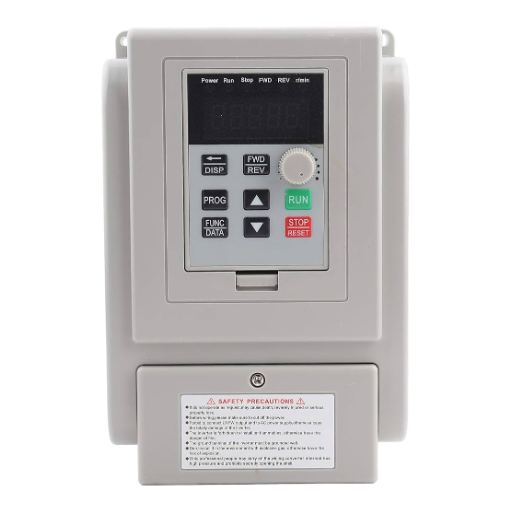
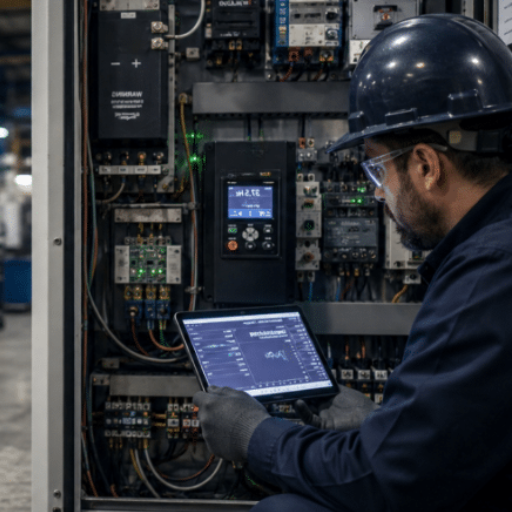
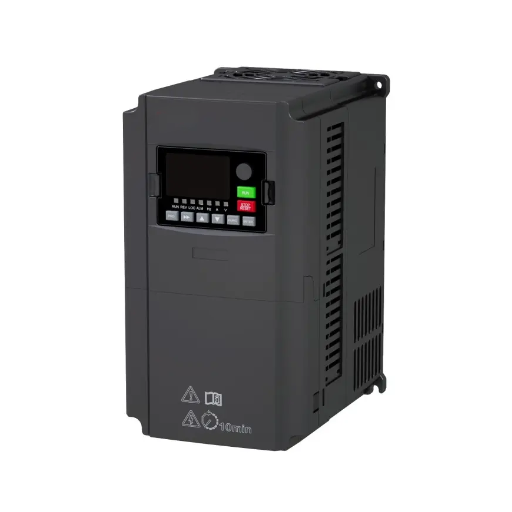
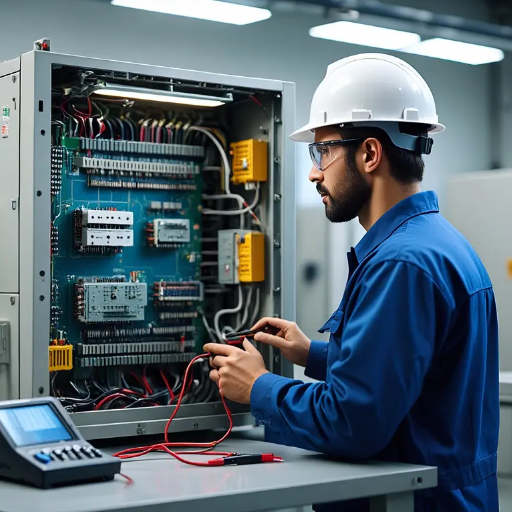
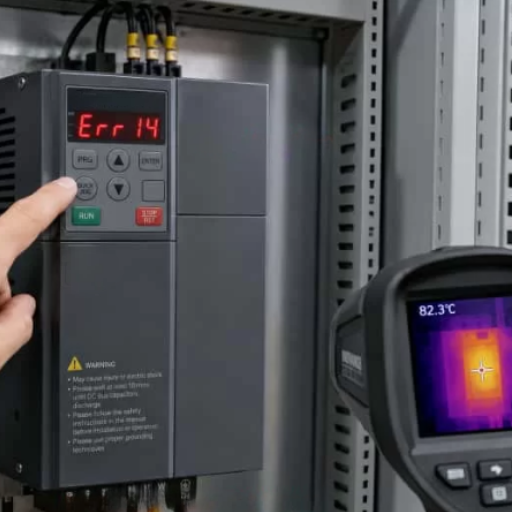
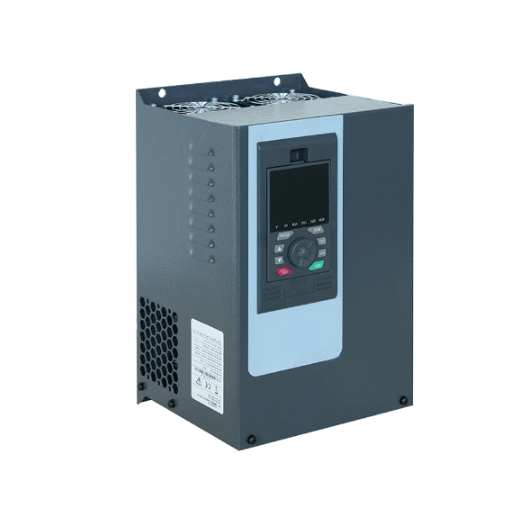
Ready to Get Your VFD Solution?
Whether you need a single drive or a complete system, we have the VFD products and engineering support to ensure your project's success.


A VFD in manufacturing is a variable frequency drive that controls motor speed and torque in machine tools, extruders, mixers, packaging lines, and VFD for textile machines applications such as winders and looms. By matching motor output to actual production demand, manufacturing VFDs cut energy consumption by 15-35%, reduce mechanical wear from fixed-speed operation, and improve product quality through precise speed control.
Most plant engineers know VFDs save energy on pumps and fans. But manufacturing machinery presents a different challenge: the load characteristic determines everything. An extruder needs constant torque with 150% breakaway capability. A CNC spindle needs constant power above base speed with a 1:1000 speed range. A packaging line needs rapid acceleration and PLC-linked recipe changes. Use the wrong control mode or undersize the drive, and the machine underperforms or fails prematurely.
In this guide, you will learn which manufacturing machines benefit most from VFDs, how constant torque and constant power loads require different drive configurations, which control mode fits each application, and how PLC integration turns standalone drives into smart factory components. Every recommendation includes real energy savings data and three case studies from operating facilities.
Key Takeaways
- Manufacturing plants spend 40-60% of electricity on motor-driven equipment, and most motors run at full speed regardless of demand.
- Constant torque loads (extruders, mixers, conveyors) need sensorless vector control minimum; constant power loads (CNC spindles) need vector or servo control.
- Extruders save 20-30% energy vs DC drives; packaging lines save 20-35%; CNC spindles save 15-25%.
- Inverter-duty motors are mandatory for any manufacturing machine that operates below 30% base speed for extended periods.
- PLC-linked VFDs enable recipe-based speed programming, reducing changeover time by up to 40% in multi-product plants.

A Variable Frequency Drive (VFD) in manufacturing is an electronic motor controller that varies the speed and torque of AC induction motors driving production machinery. Unlike simple on/off motor starters, a VFD in manufacturing provides continuous speed adjustment, soft starting, torque limiting, and automation integration.
The critical distinction for manufacturing is the load characteristic. Manufacturing machinery falls into two fundamental categories:
Misidentifying the load type is the most common mistake in manufacturing VFD selection. An extruder sized with a constant-power assumption will not start. A spindle configured for constant torque will overheat at high speed. For the complete guide to how load type affects VFD selection across all industries, see our VFD Applications pillar.
A manufacturing VFD delivers four primary benefits:
Not every manufacturing machine justifies a VFD. The economics depend on run hours, speed variation requirements, and the cost of the quality or mechanical problems a VFD would solve.
Extruders are among the most demanding VFD for extruder applications. A plastic extruder screw must turn at precisely controlled RPM to maintain consistent melt flow, pressure, and product dimensions. The load is constant torque — the screw requires the same turning force at 20 RPM as at 80 RPM — and breakaway torque can reach 150-180% of rated load when starting a cold, material-loaded screw.
DC drives were historically the standard for extruders, but DC motors require brush maintenance, generate carbon dust, and have lower efficiency. Modern VFD for extruder systems with sensorless vector control eliminate all three problems while cutting energy use 20-30%, as documented in industrial extruder retrofit studies.
The control mode matters here. Basic V/f control cannot maintain consistent torque at low speeds under varying material load. Sensorless vector control estimates rotor flux in real time and delivers stable torque down to 0.5 Hz. For co-extrusion or multi-layer applications requiring extreme precision, closed-loop vector with encoder feedback is the minimum.
A machine tool spindle VFD controls the AC motor driving the cutting tool in CNC machining centers, milling machines, and drilling equipment. Spindle applications are constant power loads: below base speed, the motor delivers constant torque; above base speed, torque decreases inversely with speed to maintain constant power output. Machine tool cooling systems often use VFD in HVAC systems for energy-efficient chiller control.Plant air systems serving these machines benefit too, and our overview of VFD for compressors shows how variable-speed control trims the large energy waste of fixed-speed compressed air supply.
This dual-mode requirement makes spindle VFDs unique. The drive must provide high torque at low speeds for heavy roughing cuts, then transition smoothly to high-speed operation for finishing passes. Speed ranges of 1:1000 or wider are common in precision machining.
Vector control is the minimum for machine tool spindle VFD applications. V/f control cannot maintain the speed precision needed for surface finish requirements. For positioning applications — tool changers, indexing tables, or tapping cycles — servo-mode VFDs with encoder feedback provide the positioning accuracy required.
Industrial mixers present a classic constant torque challenge with a twist: viscosity changes during the batch. A mixer starting with low-viscosity liquid requires modest torque. As ingredients thicken, torque demand rises. Without a VFD, the motor runs at full speed regardless, wasting energy during the low-viscosity phase and potentially overheating during peak load.
A VFD on a mixer provides batch profiling: slow speed during initial ingredient addition, ramping to full speed during the mixing phase, then coasting down during discharge. This profile control improves product consistency and reduces cycle time by 10-15%.In hygienic plants, these mixing and blending duties overlap heavily with the requirements covered in our guide to VFD for food processing, where gentle speed ramps and washdown-rated equipment protect both product quality and operator safety.
Packaging lines are one of the fastest-growing VFD for packaging machinery application areas, driven by e-commerce demand and the need for rapid product changeover. For smaller packaging machines where panel space is limited, see our guide to compact VFD systems. A typical packaging line includes conveyors, fillers, sealers, labelers, and case packers — each with independent motor drives that must synchronize.
The key value of VFD for packaging machinery is not just energy savings (20-35% is typical) but operational flexibility. Recipe-based speed programming allows operators to switch from 8-oz bottle packaging to 16-oz bottle packaging by loading a preconfigured recipe that adjusts every VFD setpoint simultaneously. Changeover time drops from 45 minutes to under 10 minutes.
Packaging VFDs also enable line speed synchronization. When the filler runs 5% faster than the sealer, product piles up and jams. PLC-linked VFDs with master-follower logic keep all stations matched to within 0.5%.
Textile manufacturing requires precise tension control, which is fundamentally a torque control problem. On a winder, as the roll diameter grows from 100 mm to 1,000 mm, the motor must reduce torque to maintain constant web tension. A VFD for textile machines with torque control mode uses dancer arm position or load cell feedback to adjust motor torque in real time.
Without a VFD for textile machines, mechanical clutches or pneumatic brakes provide crude tension control with high maintenance and limited precision. A VFD-based system provides closed-loop tension control, reduces material waste from overstretching, and enables higher line speeds.
| Manufacturing Application | Load Type | Control Mode | Typical Energy Savings | Key Consideration |
|---|---|---|---|---|
| Plastic extruder | Constant torque | Sensorless vector minimum | 20-30% | 150-180% breakaway torque required |
| CNC spindle | Constant power | Vector or servo | 15-25% | 1:1000 speed range for precision |
| Mixer/blender | Constant torque | Sensorless vector | 15-25% | Viscosity variation during batch |
| Packaging line | Mixed | Sensorless vector | 20-35% | Recipe-based changeover critical |
| Textile winder | Constant torque | Torque control mode | 10-20% | Tension feedback integration required |
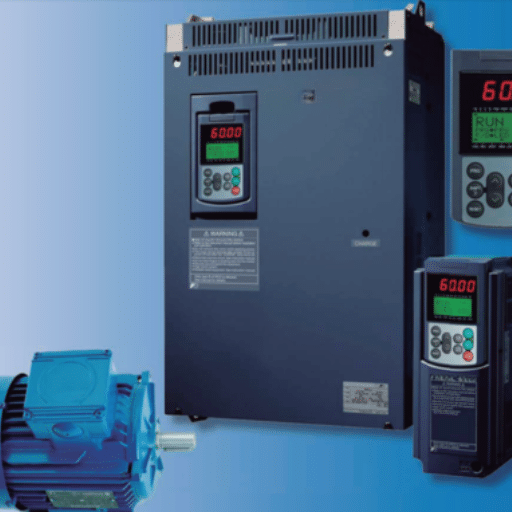
The control mode for a VFD in manufacturing determines how the drive manages motor flux and torque. Selecting the wrong mode is more costly than in pump or fan applications because product quality depends on it.
Volts-per-Hertz control maintains a fixed voltage-to-frequency ratio. It works for simple, lightly loaded applications with no precision requirements — basic conveyors, simple fans, or mixers with minimal load variation.
In manufacturing, V/f control is inadequate for: extruders (cannot deliver starting torque), CNC spindles (cannot maintain speed under cutting load), and packaging lines (poor dynamic response for rapid speed changes).
Sensorless vector control estimates rotor position using current and voltage feedback, enabling independent control of speed and torque without a physical encoder. This is the minimum recommended mode for most manufacturing applications.
Most modern low-voltage VFDs include sensorless vector as standard. The cost premium over V/f control is 10-15% — negligible compared to the cost of a scrapped VFD for extruder batch or damaged tooling.
Closed-loop vector control adds an encoder on the motor shaft to provide actual rotor position feedback. This enables:
For applications requiring positioning — threading, tapping, or coordinated multi-axis motion — servo-mode VFDs provide the motion control performance needed.
| Control Mode | Best For | Torque at Low Speed | Speed Range | Relative Cost |
|---|---|---|---|---|
| V/f Control | Simple conveyors, fans | Poor below 5 Hz | 1:10 | Base |
| Sensorless Vector | Extruders, mixers, packaging | 150-180% at 0.5 Hz | 1:100 | +10-15% |
| Closed-Loop Vector | CNC spindles, winders | 200%+ at 0 Hz | 1:1000 | +25-35% |
| Servo Mode | Positioning, multi-axis | 300%+ at 0 Hz | 1:5000 | +40-60% |
Understanding constant torque vs constant power VFD requirements determines sizing, control mode, and motor specification for any manufacturing machine.
In a constant torque load, the required turning force is independent of speed. The power required is directly proportional to speed:
Power = Torque × Speed
If you halve the speed, you halve the power. Examples include extruders, mixers, conveyors, and positive-displacement pumps.
For constant torque applications:
In a constant power load, the motor maintains constant power output. Torque decreases as speed increases above the motor’s base speed:
Torque = Power / Speed
If you double the speed above base speed, torque halves. Examples include CNC spindles, winders, and machine tools.
For constant power applications:
Some manufacturing machines operate in both regions. A CNC spindle runs at constant torque below base speed (for heavy roughing) and constant power above base speed (for high-speed finishing). The VFD must handle both modes seamlessly. For a deeper comparison of load types and their impact on VFD selection, see our guide to VFD for pumps and fans and VFD in water treatment, which explain how variable torque loads differ from both constant torque and constant power.

Properly sizing a VFD in manufacturing requires attention to details that general-purpose guides overlook.
Many engineers size the VFD to match the motor nameplate horsepower. In manufacturing, this can be conservative or inadequate depending on the application.
For extruders and mixers, the motor may be sized for peak torque that only occurs during startup. The continuous running current may be 60-70% of nameplate. In this case, a VFD sized to the actual running current with heavy-duty overload capability is sufficient and more economical.
For machine tool spindle VFD applications, the opposite is true. The motor may run at light load during positioning but draw 150-200% current during aggressive roughing cuts. The VFD must be sized for the worst-case cutting condition, not average load.
Manufacturing machinery often requires breakaway torque of 120-180% of rated torque to overcome static friction, material inertia, or cold-start conditions. Check the VFD’s overload rating:
Extruders and heavily loaded mixers require heavy-duty drives. Light-duty drives will fault on overload during startup.
Standard motors rely on an internal shaft-mounted fan for cooling. At low speeds, airflow decreases and the motor overheats. For any manufacturing machine that will operate below 30% of base speed for extended periods, specify an inverter-duty motor with independent forced ventilation or Class H insulation. The NEMA MG1 standard defines inverter-duty motor requirements for variable-speed operation.
Operating a standard motor below 20% speed on a VFD will cause thermal damage, typically within weeks. This is particularly critical for extruders running slow speeds for thin-wall products and mixers running at reduced speed during delicate blending phases.
Modern manufacturing is not about standalone machines — it is about connected production systems. A VFD in manufacturing becomes significantly more valuable when integrated into the plant automation architecture.This is where drives stop being simple speed controllers and become true building blocks of VFD industrial automation, feeding live data into the wider control and monitoring system.
Most modern VFDs support multiple industrial protocols:
Protocol selection depends on the existing plant infrastructure. Specifying a VFD with multi-protocol support provides flexibility for future upgrades.
In multi-product manufacturing plants, operators switch between products dozens of times per shift. Manually adjusting each VFD setpoint is slow and error-prone. Recipe-based control stores all VFD parameters for each product in the PLC:
When the operator selects Product B, the PLC downloads all parameters to every VFD simultaneously. Changeover time drops from 30-45 minutes to under 5 minutes, and setup errors are eliminated.
Modern VFDs monitor motor current, voltage, temperature, and vibration signatures. Analyzing these parameters enables predictive maintenance, a capability recognized by the U.S. Department of Energy as a key strategy for reducing industrial motor system energy waste:
When a German automotive supplier with 24 CNC machining centers began experiencing unplanned spindle failures every 6-8 weeks, the maintenance team installed VFDs with integrated condition monitoring. The drives detected increasing current irregularities 3-4 weeks before each bearing failure, enabling scheduled maintenance during planned downtime. Unplanned downtime dropped 78%, and tooling replacement costs fell by $42,000 annually because worn tools were identified by load signature before they damaged workpieces.

Even experienced engineers make these mistakes when specifying a VFD in manufacturing applications.
Using V/f control on extruders or mixers: V/f control cannot deliver the starting torque or low-speed stability these machines require. Sensorless vector is the minimum for any loaded-start manufacturing application.
Ignoring the constant torque vs constant power distinction: Sizing a spindle drive for constant torque wastes money on oversized equipment. Sizing an extruder for constant power guarantees startup failure.
Running standard motors at low speed: A standard motor on an extruder running at 15% speed for thin-wall production will overheat within days. Always specify inverter-duty motors for low-speed manufacturing operation.
Oversizing without considering the motor: A larger VFD will not make a small motor produce more torque. Motor torque is fixed by the motor’s design. Size the VFD to the motor’s full-load amperes and the application’s torque requirements.
Neglecting regenerative energy on fast-decelerating spindles: CNC spindles and high-inertia mixers pump energy back into the VDC bus during rapid deceleration. Without a braking resistor or regenerative unit, the drive trips on overvoltage. A machine tool spindle VFD with dynamic braking is essential for high-inertia tooling.
At a plastics compounder in Thailand, the engineering team retrofitted a 75 kW extruder from a DC drive to an AC VFD with sensorless vector control. The DC drive had required brush replacement every 4 months at a cost of 1,200perchange,plusweeklycarbondustcleaning.TheACVFDeliminatedallbrushmaintenance,reducedenergyconsumptionby281,200perchange,plusweeklycarbondustcleaning.TheACVFDeliminatedallbrushmaintenance,reducedenergyconsumptionby284,800 VFD investment paid for itself in 8 months from energy and maintenance savings combined.
Sensorless vector control is the minimum for any extruder application. V/f control cannot maintain consistent torque at low speeds under varying material load. For co-extrusion or precision applications, closed-loop vector with encoder feedback is recommended.
Yes, but with significant caveats. One VFD can power multiple motors in parallel if the total motor full-load amperes do not exceed the VFD rating and all motors are identical. However, this configuration loses individual motor protection and cannot provide encoder feedback. For manufacturing cells with different machine types or precision requirements, use one VFD per motor.
Yes, if the spindle or axis drive will operate below 30% of base speed for extended periods. Standard motors overheat at low speed because the internal fan cannot move enough air. Inverter-duty motors use independent forced ventilation or higher-grade insulation to handle reduced cooling. For continuous low-speed operation, specify an inverter-duty motor.
Realistic savings depend on the application and run hours. Extruders typically save 20-30% vs DC drives or fixed-speed operation. Packaging lines save 20-35%. CNC spindles save 15-25%. Mixers and blenders save 15-25%. A plant with ten 50 kW machines running 5,000 hours per year can save 15,000−15,000−30,000 annually at $0.075/kWh.
Constant torque loads require the same turning force regardless of speed — power drops linearly as speed decreases. Extruders, mixers, and conveyors are constant torque. Constant power loads maintain constant power output — torque decreases as speed increases above base speed. CNC spindles and winders are constant power. The distinction determines VFD sizing, control mode selection, and motor specification.
A VFD in manufacturing delivers measurable benefits when matched to the right machine with the right configuration. Extruders with DC drive retrofits, CNC spindles needing precision speed control, packaging lines requiring rapid changeover, and textile winders demanding tension regulation are the primary targets. Energy savings of 15-35% are realistic, with the strongest returns coming from high-run-hour machines where fixed-speed operation wastes the most energy.
The three rules for successful manufacturing VFD projects are straightforward: identify the load type correctly (constant torque vs constant power), select sensorless vector control as the minimum for any precision application, and specify inverter-duty motors for low-speed operation. Follow these rules, and the VFD will deliver both energy savings and improved product quality.
For plant engineers and production managers evaluating manufacturing upgrades, the priority sequence is clear: start with extruders and mixers running on outdated DC drives or fixed-speed AC motors, then move to packaging lines where recipe-based control reduces changeover time, and finally consider CNC spindle retrofits where precision speed control improves surface finish and extends tool life.
Ready to upgrade your manufacturing equipment with VFD technology? Contact our application engineering team for a free manufacturing compatibility audit and energy savings assessment, or browse our industrial-configured VFD systems designed for extruders, machine tools, packaging lines, and textile machinery worldwide.