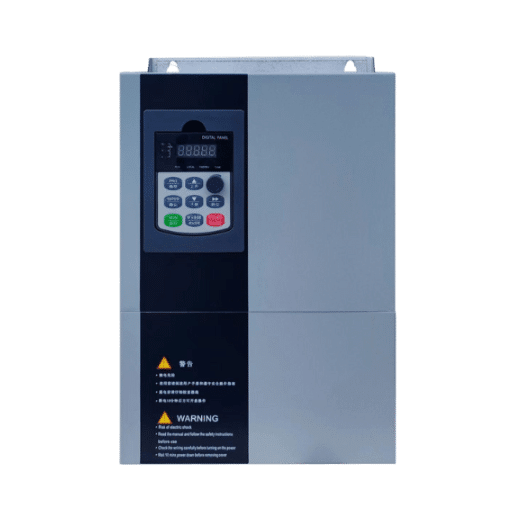
Ready to Get Your VFD Solution?
Whether you need a single drive or a complete system, we have the VFD products and engineering support to ensure your project's success.


The main industrial motor speed control solutions are variable frequency drives (VFDs), soft starters, DC drives, servo drives, and fixed-speed starters such as direct-on-line and star-delta. For most AC motor applications that need continuous speed variation or meaningful energy savings, a VFD is the standard industrial choice. The other methods still win in specific situations, and knowing when is the difference between a smart specification and an expensive mistake.
Daniel, a project engineer at a packaging plant in Poland, nearly signed off on servo drives at roughly $4,000 per axis for a conveyor line that only needed speed trimming between product changeovers. A standard VFD met every requirement at a fraction of the cost, with simpler maintenance and no encoder cabling. Over-specification wastes budget just as surely as under-specification causes failures.
This guide compares every major motor speed control method on what actually matters to plant managers and engineers: speed range, energy impact, cost, and best-fit applications. You will get a master comparison table, a selection framework built on real requirements, a 10-year cost example, and honest guidance on when a VFD is the wrong answer. If you already know you need a drive and want selection criteria instead, see our guide on how to choose a VFD.
Key Takeaways
- VFDs are the only common method offering continuous speed control plus 20-50% energy savings on pump and fan loads; every other electronic method trades one benefit for another.
- Soft starters reduce inrush current from 6-8x to 2-4x full-load current but cannot control running speed at all.
- Servo drives deliver positioning precision and fast dynamics that pumps, fans, and conveyors do not need, at several times the cost of a VFD.
- A fixed-speed motor running at full load actually wastes 2-4% energy through a VFD, so drives are not the answer to every problem.
- Match the method to the requirement first: continuous speed variation, gentle starting, energy savings, or precision motion.

Six methods cover nearly every industrial speed control requirement. This table is the quick reference; the sections below explain when each one earns its place.
| Method | Speed Control | Starting Inrush | Energy Savings | Relative Cost | Best For |
|---|---|---|---|---|---|
| Direct-on-line (DOL) | None | 6-8x FLA | None | Lowest | Small fixed-speed machines |
| Star-delta starter | None | ~2x FLA | None | Low | Fixed-speed motors above ~5 kW |
| Soft starter | None (ramp only) | 2-4x FLA | Minimal | Medium | Fixed-speed pumps, compressors |
| VFD | Full range, continuous | ~1x FLA | 20-50% on fans/pumps | Medium-High | Pumps, fans, conveyors, most AC duty |
| DC drive | Full range | Controlled | Moderate | Medium-High | Legacy DC installations |
| Servo drive | Full range + positioning | Controlled | Moderate | Highest | Packaging, robotics, CNC |
Two patterns stand out. Only three methods actually vary running speed: VFDs, DC drives, and servos. And only the VFD combines full speed range with serious energy savings at a cost most plants can justify.
A VFD controls an AC motor’s speed by varying the frequency of the power it supplies, adjusting voltage in proportion to keep the motor’s magnetic field stable. For the physics behind this, including the N = 120 x f / p speed formula, see our guide on how a VFD controls motor speed.
Three strengths make variable speed drive solutions the default answer for most industrial speed control:
The limitations are equally real. Drives introduce harmonics that need mitigation in multi-drive plants, older motors may need insulation checks on long cable runs, and a drive on a fixed-speed full-load motor adds 2-4% losses with no savings to offset them. Modern low voltage VFD systems run at 96-98% efficiency, but efficiency is not free energy.

A soft starter does exactly one thing: it ramps voltage during starting and stopping to reduce inrush current and mechanical stress. Inrush drops from the 6-8x full-load current of direct-on-line starting to a controlled 2-4x. Once the motor reaches full speed, the soft starter’s work is done, and many designs bypass it entirely.
Soft starters win where the load runs at constant speed but starts are hard on the system: fixed-speed pumps that water-hammer on startup, compressors on weak supplies, and conveyors whose belts and gearboxes suffer from DOL shock. They cost less than VFDs, generate no harmonics, and add almost no losses.
What they cannot do is change running speed. If your process needs flow, pressure, or throughput adjustment, a soft starter gives you nothing. For the full head-to-head breakdown, see our VFD vs soft starter comparison.
Direct-on-line starting connects the motor straight to the supply. It is simple, cheap, and brutal: 6-8x full-load current on every start, full torque instantly, and mechanical shock through every coupling and belt. For small motors under about 5 kW on a stiff supply, that tradeoff is acceptable and DOL remains the sensible choice.
Star-delta starting softens the blow by starting the motor in star configuration at reduced voltage, then switching to delta for the run. Inrush falls to roughly 2x full-load current. It suits fixed-speed machines that start unloaded, like fans and machine tools, but the changeover torque transient can still stress mechanical components.
Neither method offers any speed control or energy optimization. They exist in this comparison because plenty of machines genuinely run at one speed all their lives, and paying for control you never use is not engineering.
Before affordable AC drives, DC motors with armature voltage control were the only practical way to get variable speed with strong low-speed torque. A large installed base remains in steel, paper, and mining, which is why the global DC drive market still measured around $5.3 billion in 2024.
Keeping a healthy DC system running can make sense when the motor has remaining life and the duty is demanding. But the maintenance burden is real: brushes wear, commutators need attention, and efficiency trails modern AC packages. When the motor or drive reaches end of life, retrofitting to an AC motor with a VFD almost always wins on reliability, spare-part availability, and efficiency.
Servo systems pair a permanent-magnet motor with a high-resolution encoder and a fast control loop. They exist to position loads accurately and change speed in milliseconds, not to save energy or run pumps.
Packaging machines, robotics, CNC axes, and printing registration are genuine servo territory. A 55 kW cooling-tower fan is not. Servo hardware costs several times more than a VFD per kilowatt, and the encoder feedback, tuning, and cabling add commissioning complexity that a fan will never repay.
The rule is simple: if the requirement is positioning or rapid dynamic response, specify a servo. If the requirement is moving air, water, or material at an adjustable speed, specify a VFD.
Older plants still run pole-changing motors, wound-rotor slip control, and mechanical solutions like belt drives, gearboxes, and variable-pitch pulleys. Each delivers coarse or inefficient speed adjustment, and each still has niche uses: pole-changing fan motors are rugged and cheap, and a gearbox ratio is sometimes the right answer alongside a VFD rather than instead of one.
The retrofit question matters more than the theory. If a legacy method still meets the process requirement, run it. If operators are throttling valves or riding dampers to fake speed control, the energy waste usually funds a VFD retrofit on its own.

Strip away brand names and the decision comes down to four questions:
Applied to common applications:
| Application | Recommended Method | Why |
|---|---|---|
| Centrifugal pump | VFD | Flow matching + energy savings |
| Fan / blower | VFD | Affinity-law savings, soft start included |
| Conveyor | VFD | Speed matching, controlled acceleration |
| Fixed-speed compressor | Soft starter | Inrush control without unused speed control |
| Hoist / crane | VFD (closed-loop) | Torque control and holding at zero speed |
| Packaging axis | Servo | Positioning precision |
| Small machine tool | DOL or star-delta | Fixed speed, infrequent starts |
A water treatment plant in Southeast Asia worked through exactly this logic last year. Four 37 kW distribution pumps ran throttled by valves around the clock. The requirement was flow matching, not just gentle starting, so the plant installed VFDs with pressure PID control. Energy per cubic meter pumped dropped by about 40%, and the retrofit paid back in under two years.
Purchase price is the smallest number in the motor speed control decision. Consider a 55 kW supply fan running 6,000 hours per year at $0.10 per kWh:
The VFD costs more on the invoice and saves on the order of $160,000 over a decade. The U. S. Department of Energy reports typical savings of 20-50% on variable-torque loads, which matches this math across thousands of installations. For help structuring the calculation for your own plant, our VFD energy saving calculation guide walks through the full method.

Honest guidance builds better specifications, so here is where we advise against our own product category:
A cement plant in the Middle East put VFDs on three fixed-speed, full-load compressors a few years back, expecting savings that the physics could not deliver. They gained harmonics to manage and zero efficiency benefit. Soft starters would have cost less and done exactly what the application needed. The lesson is not that VFDs disappoint; it is that the method must match the requirement.
No. A soft starter only ramps voltage during starting and stopping. Once the motor reaches full speed it runs at line frequency with no speed adjustment. If your process needs speed control, you need a VFD, DC drive, or servo.
For coarse, fixed ratios, mechanical methods like pulley changes or gearboxes cost the least. For electronic speed control, a basic VFD in V/f mode is the lowest-cost option, and it adds soft starting and energy savings that mechanical methods cannot provide.
Usually not. If the load genuinely runs at full speed and full load continuously, a VFD adds 2-4% losses with no offsetting savings. The exception is when you value the soft start, protection features, or future flexibility enough to justify the small efficiency penalty.
Yes, in most cases. You need to verify motor insulation suitability (especially on cable runs over 30-50 meters), confirm the supply can handle the drive, and plan for harmonics if several drives share one transformer. Our industrial VFD system design guide covers the installation details.
Industrial motor speed control solutions succeed or fail on fit, not on technology fashion. Keep the core logic in view:
Whether your project is a single 2 kW pump or a megawatt-scale heavy-industry line, the selection framework above will point you at the right method. Shandong Electric manufactures drives from 0.1 kW to 53,000 kW and supports every project from method selection through commissioning.
Not sure which method your application needs? Contact our engineering team with your motor nameplate and duty description. We will tell you what we would install, and just as importantly, what we would not.