Ready to Get Your VFD Solution?
Whether you need a single drive or a complete system, we have the VFD products and engineering support to ensure your project's success.

The general-purpose vs. high-performance VFD decision comes down to five checks, and the general purpose drive wins unless one of them fails. The checks cover torque at standstill, speed accuracy beyond about ±0.5%, a loaded start, a permanent-magnet or encoder-fitted motor, and a shock or braking duty. If none of them fail, the premium buys capability your process will never call on.
The more expensive drive is not always the safer choice. It is the choice with more failure modes, because every capability you add is another specification to get right at commissioning.
Halina Nowak specified drives for a paper mill’s stock pumps in 2024 and chose the premium tier on all eleven, on the reasoning that nobody was ever dismissed for over-specifying. Eight months later two of the eleven were faulting on encoder feedback. The encoders had been fitted because the drives supported them, not because the pumps needed them, and the signal cable ran beside a drive output cable. The faults were real, they cost four days of commissioning, and they bought nothing.
This article treats the tier as a specification decision, not a safety net. It gives you five checks that produce a yes or no rather than a feeling. It also gives you the arithmetic on dual-rated frames and the two cases where the cheap answer is wrong.
You have probably been told to buy the better drive “to be safe”. That advice is not often wrong. It is only expensive when it is, and nobody ever tells you which of the six capabilities your pump is missing. Five checks settle it.
Key Takeaways
- Buy the general purpose drive unless one of five checks fails: zero-speed torque, ±0.5% accuracy, a loaded start, a PM or encoder motor, a shock or braking duty.
- The dual rating is the trap. A 25 hp normal-duty frame is the same hardware as a 20 hp heavy-duty unit, so the rating and the tier are two different axes.
- A general purpose VFD that is correctly sized will start a fan, a pump or a light conveyor for years. It will not hold a load at standstill at any setting.
- Axial-flow and positive-displacement pumps break the “pumps are easy” rule. So does a harmonic limit on a large installation.
- The premium buys about 15 to 40% on price, and it buys nothing your process cannot use.
All five checks reduce to one question. Does the load need controlled torque at or near zero speed, or a start it cannot make on about 110 to 150% of rated current?
Everything else in the general purpose vs high performance VFD decision is detail. A drive that holds torque at standstill has a rotor position reference. A drive that does not, does not, and no parameter setting invents one.
The five checks are below, with the condition that makes each one fail. Read down the middle column first. If your process sits there, the general-purpose drive is the answer.
| Check | Passes when | Fails when |
|---|---|---|
| 1. Torque at zero speed | The process never runs below roughly 3 Hz and never holds a load still | Winding, splicing, indexing, or holding against gravity |
| 2. Speed accuracy | About ±0.5% is enough for the product | Two motors must stay synchronised, or speed error shows up in the output |
| 3. The worst start | The load starts empty, slowly or rarely | The load starts full: conveyor, crusher, mixer, hoist, PD pump |
| 4. Motor type | Induction motor, no encoder | Permanent magnet, synchronous reluctance, or an encoder already in the loop |
| 5. Shock or braking | Smooth load, gentle or unbraked stop | Jams, plugs, brake releases, an inertial load pushed back into the drive |
Each check gets its own subsection below, with the condition that makes it fail. If you want the six capability figures behind them, what the premium tier actually buys has the table with its test conditions attached.
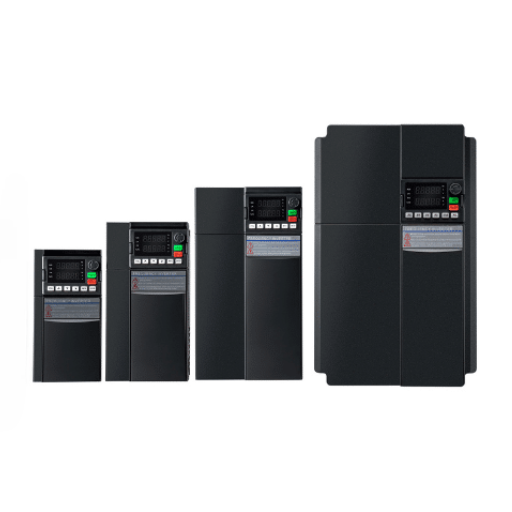
The general-purpose vs. high-performance VFD comparison is not a different inverter. In most families the power stage is shared, and what changes is the control platform bolted to it.
Siemens users describe the split that way. The SINAMICS G and S ranges are reported to share power modules and to differ in the control unit, which is where the position estimation and the encoder interface live. That claim comes from an engineering forum rather than a datasheet, so treat it as the shape of the answer rather than a specification.
What the better control unit adds is real. It estimates rotor position fast enough to hold torque at zero speed. It accepts encoder feedback. It closes the current loop faster, which is what the response figures measure.
The physical result is a bigger heatsink, an extra option slot and more terminals. A general purpose VFD cannot be asked for a standstill torque figure at any parameter setting.
What does not change is the inverter, the rectifier or the efficiency of either. Both tiers convert AC to DC and back. Both run an induction motor at speed. The general purpose and high performance ranges sit side by side for exactly this reason.
Run them against the process, not the motor nameplate. The motor tells you what it can deliver. The process tells you what it will be asked for.
Pass if the process never runs below roughly 3 Hz and never holds a load at standstill. A fan, a centrifugal pump and a smooth conveyor all pass.
Fail if the machine winds, splices, indexes or holds against gravity. Add splicers, unwinders, rotary tables and anything with a brake that releases onto a load.
The reading behind it. Sensorless vector control typically holds 150% of rated torque at 0.5 Hz. Closed loop holds 200% at 0 Hz. Only one of those is a standstill claim.
Sensorless vector control estimates position from motor currents, and the estimate fails as speed approaches zero. That is why the two figures are not the same claim at different strengths.
Pass if a few tenths of a percent never show up in the product. Most single-motor loads pass.
Fail if two motors must stay synchronised, or if speed error appears in the output. Web handling, wire drawing and multi-drive lines fail.
The reading behind it. Manufacturers publish ±0.2% to ±0.5% open loop and ±0.01% to ±0.02% closed loop. If ±0.5% is enough for you, this check passes and the encoder is optional.
Pass if the load starts empty, starts slowly or starts rarely. A clean conveyor that only ever starts unloaded passes.
Fail if the machine starts full. A loaded conveyor, a crusher, a loaded mixer, a hoist and a positive-displacement pump all fail.
The reading behind it. This is the check that most often flips the answer, and it is the one that has nothing to do with the premium control tier. It has its own section below.
Pass if it is an induction motor with no encoder.
Fail if it is a permanent magnet or synchronous reluctance, or if the process already depends on an encoder. Those motors need rotor position before the drive can commutate, and many general-purpose units cannot supply it.
The reading behind it. This check can fail before the other four are asked, which makes it worth doing first when the motor is new or unusual.
Pass if the load is smooth and deceleration is gentle or unbraked.
Fail if jams, plugs or brake releases happen, or if an inertial load is pushed back into the drive during a stop. Response time decides whether a shock is absorbed or trips the drive, and braking capability decides whether a deceleration trips on overvoltage.
Any single fail moves you up a tier. Two or more and the answer is not close.
Here is the part that decides budgets, and it sits outside the general-purpose vs. high-performance VFD comparison entirely.
Most modern drives are dual-rated. A dual-rated VFD carries two power ratings on one frame. Read as normal duty the unit is rated for roughly 110 to 120% overload for 60 seconds. Read as heavy duty the same unit is rated for 150% for 60 seconds, at a lower continuous power.
Three published examples show the pattern, and the normal duty vs heavy duty split is visible in all three. The ABB ACS550-U1-038A-4 at 380 to 480 V carries 25 hp normal duty at 38 A and 20 hp heavy duty at 31 A on frame R3. The ABB ACS880-01-075A-2 at 208 to 240 V carries 25 hp at 71 A against 20 hp at 61 A on frame R5. The Fuji FRENIC-Ace FRN0044E2S goes further and lists three levels on one frame: 30 hp normal duty, 25 hp heavy duty and 20 hp heavy-heavy-duty.
Ravi Menon met this on a bulk materials yard in 2025. He specified a conveyor drive for a 20 hp motor and asked for the heavy-duty rating, because the conveyor started full twice a shift. His supplier quoted the heavy-duty model at 20 hp, which was the 25 hp normal-duty frame. The drive he needed and the drive he was offered had the same part number.
What this means for the purchase. A buyer who needs the heavy-duty rating on a 20 hp motor is buying a 25 hp normal-duty box. That is not the premium control tier and it does not cost like it. The normal duty vs heavy duty choice is a separate axis from the control tier. Confusing the two is how people overpay in one direction and undersize in the other.
The counter-claim, attributed. TECO-Westinghouse states that buying heavy-duty unnecessarily for fans and pumps wastes roughly 20 to 40% of the budget. That is a manufacturer saying it about its own product line, which is worth more than an article asserting it.
One caution on the numbers. Schneider publishes 110% for normal duty on its own range, where other manufacturers publish 120%. Both are correct for their own products, so read the definition attached to the specific drive rather than the general convention.
Two cases break the “general purpose is fine” rule. Both are narrow. Both are expensive to get wrong.
Centrifugal pumps and fans are variable torque loads. Their torque requirement falls with the square of speed, so the bottom of the range is where they rarely go and where they need the least. The general-purpose VFD is right for them, and that covers most pumps on most sites.
Axial-flow pumps and positive-displacement pumps are different. They can demand high torque at low speed, and they will overload a normal-duty drive that looked correctly sized on the nameplate.
If the pump is a positive-displacement type, treat it as a constant torque load and run all five checks. Selection by load type covers the distinction in more depth.
A budget drive on a large fan can fail an IEEE-519 harmonic limit that a drive with a DC link choke would pass. The premium in that case is not buying control sophistication. It is buying compliance.
Compliance is not optional on a big installation. If the site has a harmonic study or a utility requirement, that requirement decides the drive long before the five checks do. Ask about it before the quote, not after.
Five things buyers assume about the general purpose vs high performance VFD premium, and should not.
Not efficiency. Efficiency is a property of the model and the power stage, not of the tier. A good general purpose drive will beat a mediocre premium one on the same motor.
Not reliability. The premium tier adds parts: an encoder, an interface card, a sensor. More parts is more surface for a fault, as the paper mill found.
Not harmonics, unless specified. Compliance follows from what is fitted. A choke or filter is an option on both tiers.
Not a longer warranty automatically. Warranty terms follow the manufacturer and the order, not the badge on the case.
Not better spares support. Spares follow the platform, and a dual-rated VFD and its premium sibling often share it.
Run the general purpose vs high performance VFD comparison on paper. Send both suppliers the same five checks and the same load description, then compare what comes back.
A quote that answers the price but not the torque at the lowest process speed is not comparable to one that does. Price guides put the closed-loop premium at roughly 15 to 40% over an open-loop unit at the same power, and the range is wide because it tracks how many capabilities you specify. No honest article can narrow that to one number, which is the point the pillar makes as well.
Ángela Ruiz did this on a Spanish bottling line in 2026. Two quotes came back within 6% of each other, but one was a heavy duty unit at the motor rating and the other a normal-duty unit one frame up. On the five checks the second was the better buy, because the line only ever started empty and the first quote was paying for an overload class the process never asked for.
Three red flags in a returned quote. A price with no duty class named. A duty class with no frame size named. A recommendation to go premium “to be safe”.
For how the price itself is built, and how to write an enquiry that gets comparable answers, see how VFD prices are built. That article owns the cost drivers and this one does not.
Only when one of the five checks fails. Zero-speed torque, closed-loop accuracy, a loaded start, a PM motor or a braking duty will each justify it alone. None of them, and the premium buys nothing you can use.
Yes, if the conveyor starts empty. A conveyor that starts full is check three and it fails, because the drive must pass a current the load demands before the belt is moving.
A drive sold with two ratings on one frame. The same unit carries a higher power with a lighter overload class and a lower power with a heavier one. A 25 hp normal-duty frame is often the 20 hp heavy-duty unit.
Not for a centrifugal pump. Check carefully for axial-flow and positive-displacement types, which can demand high torque at low speed and overload a normal-duty drive.
Usually not. The encoder interface is a build option, not a parameter you enable afterwards. If encoder feedback is plausible in the next five years, that alone argues for buying up now.
A faster processor, an encoder interface, a larger heatsink and higher-grade devices to survive the heavier overload. The full breakdown is in the pillar, and the band lands around 15 to 40%.
Five checks, one question behind them, and two axes that people confuse.
The general-purpose vs. high-performance VFD decision is a specification decision. Rank the checks against your process, watch for the one that fails, and buy the tier that answers it. If none of them fail, the general-purpose drive is not the budget option. It is the correct one.
Keep the dual rating separate. It decides the frame size, and it has nothing to do with the control tier, even when both come on one part number.
Most loads pass all five. That is not a coincidence, it is what “general purpose” means.