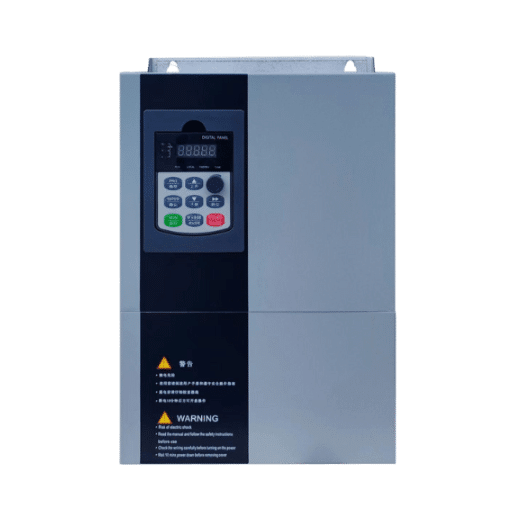
Ready to Get Your VFD Solution?
Whether you need a single drive or a complete system, we have the VFD products and engineering support to ensure your project's success.


The main use of VFD in HVAC systems is to control the speed of motors that drive fans, pumps, and compressors, so output matches real-time building demand instead of running at full speed all day. This single change typically cuts HVAC motor energy use by 20 to 60%.
Here is the problem that makes VFDs so valuable. Every fan and pump in a commercial HVAC system is sized for the hottest, most crowded day of the year. That day may never come. The other 95% of the time, fixed-speed motors run at full power while dampers and valves throttle away the excess. It is like driving with the accelerator floored and controlling your speed with the brake.
You already know HVAC is the largest electrical load in most commercial buildings. What you may not know is exactly where a variable frequency drive belongs in your system, what each one controls, and what it actually saves. This guide breaks down the six core applications, the control strategy behind each, and the honest cases where a VFD isn’t the right answer.
Key Takeaways
- VFDs are used in HVAC systems on six components: AHU fans, chilled water pumps, cooling tower fans, exhaust fans, compressors, and booster pumps.
- Thanks to the fan affinity laws, cutting motor speed by just 20% reduces power consumption by roughly 50%.
- Cooling tower fan retrofits deliver the fastest payback, often 12 to 18 months.
- ASHRAE 90.1-2022 now requires variable speed control on fans over 5 HP and chilled water pumps over 7.5 HP in most commercial construction.
- A VFD is not always the right choice. Constant full-load equipment and small constant-torque loads gain little from speed control.

A VFD (variable frequency drive) in HVAC is an electronic controller that adjusts the speed of AC motors driving fans, pumps, and compressors by varying the frequency and voltage of the power supplied to them. It replaces mechanical throttling devices like dampers and valves, matching motor output directly to the building’s actual heating or cooling demand.
Think of it as a dimmer switch for motors. Instead of a motor that is either fully on or fully off, a VFD lets the motor run at any speed between zero and maximum, continuously and automatically.
A VFD works in three stages. First, a rectifier converts incoming fixed-frequency AC power from the utility grid into DC power. Second, a DC bus uses capacitors to filter and store that power, creating a smooth, stable reserve. Third, an inverter converts the DC back into AC at a precisely controlled frequency and voltage using high-speed transistor switches (IGBTs).
Because an AC induction motor’s speed is proportional to the supply frequency, lowering the output frequency slows the motor down. A microprocessor inside the drive adjusts output continuously, usually based on a signal from a pressure, temperature, or CO2 sensor in the system.
For centrifugal loads like fans and pumps, power consumption is proportional to the cube of rotational speed. This is the affinity law, and it is the entire economic case for the use of VFD in HVAC systems:
| Speed Reduction | Power Consumption | Energy Saved |
|---|---|---|
| 10% slower | 73% of full power | ~27% |
| 20% slower | 51% of full power | ~49% |
| 50% slower | 13% of full power | ~87% |
HVAC systems operate at partial load 80 to 90% of the time. When a small speed reduction cuts power in half, and the system runs at reduced load most of the year, the savings compound fast. This is why VFD retrofits typically cut HVAC energy costs by 30 to 60%.

VFDs are used in HVAC systems on six types of equipment:
Each application has its own control strategy, sensor, and savings profile. Here is how each one works in practice.
This is the most common use of VFD in HVAC systems. In a variable air volume (VAV) system, zone dampers open and close as rooms call for more or less air. Without a VFD, the supply fan runs at full speed regardless, and pressure builds up in the ductwork.
A VFD on the AHU fan solves this with a duct static pressure sensor. When zones close their dampers, pressure rises, and the drive slows the fan until pressure returns to setpoint. The fan delivers exactly the airflow the building needs, no more. Typical savings run 35 to 50% on fan energy. In fact, VFDs are what made modern VAV systems practical in the first place.
Chilled water loops have the same problem as air loops. Two-way control valves at the cooling coils close as demand drops, which raises differential pressure across the loop. A fixed-speed pump keeps pushing full flow against those closing valves, wasting energy and stressing the valves.
A VFD-controlled pump uses a differential pressure sensor, usually mounted across the most remote coil in the loop. As valves close, the drive slows the pump to hold pressure at setpoint. Savings typically reach 20 to 40%, and valve wear drops noticeably because the system stops fighting itself.
Cooling tower fans are the fastest-payback VFD application in most buildings. The fan’s job is to hold condenser water temperature at setpoint, and outside air conditions change hour by hour. A fixed-speed fan cycling on and off cannot track those changes smoothly.
With a VFD, a temperature sensor in the condenser water line drives the fan speed continuously. Because towers spend much of the year in mild weather, fans run at reduced speed most of the time, delivering 40 to 60% energy savings. Payback periods of 12 to 18 months are common.
When Priya, a facilities engineer at a 14-story hotel in Dubai, retrofitted VFDs on two 15 kW cooling tower fans in early 2024, her utility data told the story. Average fan speed settled at around 60% for nine months of the year. Fan energy dropped 58%, and the project paid for itself in 14 months, helped by the region’s long cooling season and high ambient temperatures.
Commercial kitchens, parking garages, laboratories, and variable-occupancy spaces all need ventilation, but rarely at full design volume around the clock. Demand-controlled ventilation pairs a VFD with a CO2 sensor, occupancy sensor, or (in garages) a carbon monoxide sensor.
When the space is empty, the fan slows to a minimum ventilation rate. When occupancy rises, the drive ramps up. Savings of 20 to 35% are typical, and in spaces with predictable low-occupancy hours, they go higher. As a bonus, slower fans are dramatically quieter, often 10 to 15 dB lower, which matters in offices, hotels, and hospitals.
Traditional fixed-speed compressors control capacity the crude way: cycling on and off, or using inlet guide vanes and slide valves while the motor spins at full speed. Every start draws an inrush current of six to eight times the motor’s rated current, stressing both the electrical system and the compressor itself.
A VFD-driven compressor modulates speed to match the cooling load directly. Capacity control becomes continuous, part-load efficiency improves, and mechanical stress from hard starts disappears. One hospital facilities team documented by CSI Engineering used VFDs on chiller equipment to capture substantial annual savings while smoothing out the temperature swings that had generated occupant complaints.
Secondary booster pumps, heating hot water circulators, and zone pumps round out the list. These are smaller motors, but they often run 24/7, which makes even modest percentage savings meaningful over a year.
Control strategy depends on the loop: differential pressure for booster sets, temperature differential for heating circulators. The principle stays the same. Match speed to demand, and stop paying for pressure the system does not need.

The benefits of using VFD in HVAC systems go well beyond the utility bill. Facility teams usually end up valuing four other gains just as much as the energy savings.
| HVAC Component | Typical Savings | Control Signal |
|---|---|---|
| AHU supply/return fans | 35–50% | Duct static pressure |
| Cooling tower fans | 40–60% | Condenser water temperature |
| Chilled water pumps | 20–40% | Differential pressure |
| Exhaust/ventilation fans | 20–35% | CO2 / occupancy |
A VFD ramps the motor up gradually instead of slamming it across the line. That eliminates the six to eight times inrush current of a direct-on-line start, removes belt squeal and water hammer, and takes the shock out of every start cycle. Fewer hard starts mean longer life for belts, bearings, couplings, and the motor itself. Maintenance teams commonly report around 40% lower mechanical maintenance costs after a retrofit.
Precise speed control means tighter temperature and humidity regulation. PID closed-loop control can hold space temperature within about half a degree, instead of the swings that come with on/off cycling. Fans running at 70% speed are far quieter than fans at 100%, and every component in the airstream lasts longer when it stops being pushed to its limit all day.
There is also a compliance dimension. ASHRAE 90.1-2022 mandates variable speed control for fans over 5 HP and chilled water pumps over 7.5 HP in most commercial buildings, per the ASHRAE Standard 90.1 requirements.
Most articles on this topic skip this part, but honest engineering guidance builds better projects. A VFD saves energy only when the load varies. If any of these describe your equipment, think twice:
When Daniel, an HVAC contractor in Texas, audited a small medical clinic in 2025, he recommended VFDs on the AHU fans but advised against one on a dedicated exhaust fan that code required to run at full speed 24/7. That kind of selective honesty is exactly what a good audit looks like. Put drives where the load varies, and leave the rest alone.

Once you have confirmed the application justifies a drive, three factors determine whether the installation succeeds.
Modern inverter-duty motors are built to handle the voltage spikes a VFD produces. Motors wound before 2000 may not be. On long cable runs or older motors, specify dv/dt output filters, and consider shaft grounding rings to prevent bearing currents from pitting the motor bearings. This is cheap insurance compared to a premature motor failure.
Match the enclosure to the location. An IP20 drive belongs in a clean mechanical room. Rooftop units and cooling tower areas call for IP55 or IP66 protection against moisture and dust. Ambient temperature matters too: drives mounted outdoors in hot climates may need derating or panel cooling.
A VFD reaches its full potential only when it talks to the building automation system. BACnet and Modbus support is now standard on quality drives, letting the BAS read energy data, adjust setpoints, and log faults remotely. Plan the sensor strategy at the same time: a drive without a properly placed pressure or temperature sensor is just an expensive motor starter.
For most commercial HVAC motors, a 3 phase VFD with sensorless vector control covers the requirement, and our low voltage VFD systems are built for exactly these fan and pump applications, with the protection ratings and protocol support mechanical rooms demand.
Need help matching a drive to your fan or pump? Our engineers size VFDs for HVAC applications every day. Contact the Shandong Electric team with your motor nameplate data and load profile, and we will recommend the right configuration.
The main use is controlling the speed of fan, pump, and compressor motors so HVAC output matches real-time demand. Instead of running motors at full speed and throttling with dampers or valves, the VFD slows the motor itself, which cuts energy use by 20 to 60% depending on the application.
Fan and pump power consumption follows the cube of speed. Reducing motor speed by 20% cuts power use by roughly half. Since HVAC systems run at partial load 80 to 90% of the time, matching speed to demand eliminates enormous waste compared to mechanical throttling.
The six most common locations are AHU supply and return fans, chilled and condenser water pumps, cooling tower fans, exhaust and ventilation fans, chiller compressors, and booster or circulation pumps.
In most commercial construction, yes. ASHRAE 90.1-2022 requires variable speed control for fans over 5 HP and chilled water pumps over 7.5 HP. Local codes based on recent ASHRAE or IECC versions adopt similar requirements.
Usually, yes. Most modern three-phase motors accept VFD control without modification. Motors built before 2000 may need dv/dt filters or shaft grounding protection, and you should verify the motor’s insulation class before retrofitting.
Typically 12 to 36 months. Cooling tower fan retrofits are the fastest at 12 to 18 months. Utility rebates covering 30 to 50% of project costs can significantly shorten payback.
The use of VFD in HVAC systems comes down to one principle: motors should work only as hard as the building needs them to. Across the six core applications, the pattern repeats. A sensor measures demand, the drive adjusts speed, and the affinity laws turn modest speed reductions into major energy savings.
To recap:
Buildings do not stand still, and neither should the motors that serve them. If you’re planning an HVAC retrofit or specifying drives for a new project, start with your load profile, then match the equipment to it. The Shandong Electric engineering team supplies low voltage VFD systems for fan and pump applications worldwide, with selection and commissioning support at every step. Get in touch with our engineers to find the right drive for your system.