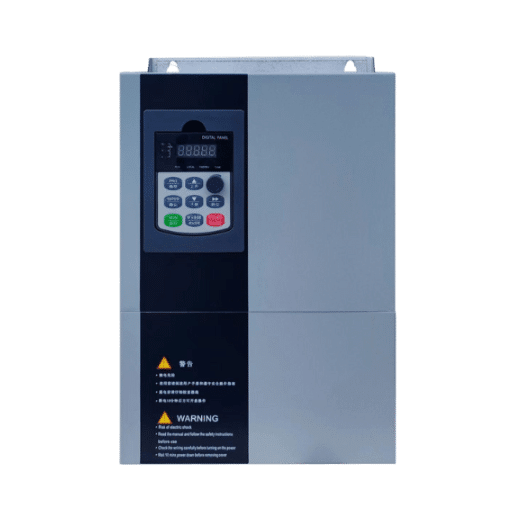
Ready to Get Your VFD Solution?
Whether you need a single drive or a complete system, we have the VFD products and engineering support to ensure your project's success.


A Variable Frequency Drive (VFD) for wastewater treatment plants controls the speed of aeration blowers, influent and lift station pumps, mixers, and sludge equipment to match real-time process demand. The result is typically 20-50% energy savings on blowers and centrifugal pumps, with whole-plant retrofits paying back in 6-24 months.
Aeration alone consumes 40-60% of a wastewater plant’s electricity, and most of that air is blown past what the biology actually needs. Fixed-speed blowers and pumps sized for peak flow run at full power around the clock, while demand swings with diurnal flow patterns every single day.
You already know VFDs save energy in pump and fan applications. What makes wastewater different is the scale of the opportunity and the specificity of the engineering. This guide maps every VFD opportunity in a treatment plant, stage by stage, with realistic savings numbers and the four specification issues that separate wastewater from any other drive application.
Key Takeaways
- Aeration blowers are the #1 VFD target: 40-60% of plant energy use, with 20-50% savings available through dissolved oxygen (DO) based speed control.
- Pumping is #2: influent, lift station, and RAS pumps save 20-50% and gain water-hammer elimination and anti-ragging functions.
- Whole-plant VFD retrofits typically pay back in 6-24 months, with documented cases as fast as 9 months.
- Never throttle a positive displacement blower. VFD speed control is the only efficient option.
- Wastewater VFDs need H2S-resistant enclosures (conformal coating, IP54/IP55 minimum) and IEEE 519 harmonic mitigation to protect SCADA reliability.
- Size by motor full-load amps, with roughly 110% margin for submersible sewage pumps.
Specifying drives for a treatment plant? Send our engineering team your motor list and process requirements, and we will recommend matched low voltage VFD systems for each application.

Few industries combine such large motor loads with such variable demand. Water and wastewater systems account for 30-40% of a typical municipality’s total energy consumption, according to the U. S. EPA. Inside the plant, two loads dominate:
Meanwhile, influent flow follows a diurnal curve, peaking in the morning and evening and dropping sharply overnight. Fixed-speed equipment is correctly sized at exactly one point on that curve. Everywhere else, it is wasting energy or cycling itself to death.
Centrifugal pumps, fans, and blowers follow the affinity laws. Flow is proportional to speed, head is proportional to speed squared, and power is proportional to speed cubed:
| Speed | Flow | Power |
|---|---|---|
| 100% | 100% | 100% |
| 80% | 80% | ~51% |
| 60% | 60% | ~22% |
| 50% | 50% | ~12.5% |
A 20% reduction in airflow cuts blower power nearly in half. A throttling valve achieves the same flow reduction while burning the difference as turbulence and heat. The VFD simply never draws that power from the grid. For a deeper look at the same math in clean-water systems, see our guide to VFD in water treatment.

The most useful way to evaluate VFD for wastewater treatment plants is to walk the process train and ask the same question at every stage: is this motor running at one speed against a variable demand?
Influent pumps and lift station pumps face the most variable duty in the plant. With fixed-speed control, they cycle on and off against wet-well level, sometimes dozens of times per day. Each across-the-line start slams the check valve, stresses the windings, and sends a pressure transient down the force main.
A VFD running constant-level PID control from a wet-well transducer matches pump speed to inflow in real time. Soft start and stop eliminate water hammer entirely. Multi-pump cascade control, built into modern drives for up to eight pumps, removes the need for an external PLC.
Modern wastewater drives also include anti-ragging functions. When the drive detects the torque signature of fibrous solids winding onto the impeller, it runs an automatic reverse and forward cleaning cycle to clear the blockage. For municipalities paying for deragging callouts, this feature alone can justify the retrofit.
Aeration is the largest and most controllable load in the plant. The control architecture is straightforward:
Without this loop, operators over-aerate to guarantee compliance, paying for air the biology never uses. In multi-basin plants, Most-Open-Valve (MOV) control takes this further by trimming the header pressure setpoint so the most open basin valve sits near 100%, minimizing throttling losses across the system.
Blower technology determines the right VFD approach:
| Blower Type | Efficient Control Method | VFD Notes |
|---|---|---|
| Positive displacement (Roots, screw) | VFD speed control only | Never throttle; heavy-duty drive rating |
| Multistage centrifugal | VFD (throttling common but wasteful) | Retrofit pays back quickly |
| High-speed turbo | Integrated VFD package | Ships with drive, filters, and PLC |
One honest caveat: positive displacement machines save energy roughly in proportion to speed reduction, not by the cube law. Expect 15-20% savings there, not 50%. Install the drive anyway, because it is the only efficient way to control them.
Return activated sludge pumps paced to influent flow or MLSS targets replace constant-speed overpumping, and gentler speed control protects the floc structure that treatment depends on. Anoxic zone mixers need high starting torque for viscous sludge, which calls for sensorless vector control rather than basic V/f.
Dewatering centrifuges use paired VFDs for bowl and scroll differential control, with regenerative options recovering braking energy from the bowl drive. Polymer dosing pumps gain precise low-flow metering. Odor control fans are simple variable torque loads, delivering straightforward cube-law savings in air laden with the same corrosive gas that threatens the drive itself.

Generic VFD selection guides miss what fails in treatment plants. These four issues belong in every municipal specification.
Hydrogen sulfide attacks copper traces and standard electronics, especially near headworks, digesters, and sludge processing. Specify conformal-coated circuit boards as a minimum, IP54/IP55 or NEMA 4X/12 enclosures in exposed locations, and remote mounting in a clean MCC room wherever cable length allows.
VFDs are nonlinear loads. Their input current distortion can interfere with PLC and SCADA communications, corrupt sensitive instrumentation signals, and overheat transformers. Municipal specifications typically require IEEE 519 compliance, achieved with line reactors or DC link chokes on small drives and passive or active filters on large ones. On the positive side, the drive’s DC bus capacitors improve motor power factor, a genuine secondary benefit on utility bills with power factor penalties.
Size every drive by motor full-load amps, never horsepower alone, and apply roughly 110% margin for submersible sewage pumps. Use heavy-duty ratings (150% overload for 60 seconds) for positive displacement blowers, mixers, and dewatering equipment. For cable runs longer than 50 meters to submersible pumps, add output reactors or dV/dt filters to protect motor insulation and bearings from reflected-wave voltage spikes.
Critical lift station pumps need bypass contactors so they can run across the line if a drive faults. Blower systems should be configured N+1 with a drive on each unit for load sharing. And plan heat rejection in the MCC room, applying ambient temperature derating above 40°C.

Utility incentive programs and documented retrofits give this topic unusually solid data. According to the Focus on Energy 2024 Wastewater Guide, VFD retrofits typically save 15-35% of facility energy, rising to 40% where throttling is replaced, with paybacks from six months to five years depending on operating hours and load variability.
Consider what this looks like in practice. When Dana, the operations manager at a 4 MGD municipal plant in the Midwest, retrofitted a 250 kW aeration blower with VFD-based DO control, aeration energy dropped 38%. The project saved roughly $144,000 per year and paid back in 14 months. The maintenance team noticed a second benefit within weeks: the basins stopped swinging between over-aerated and under-aerated, and effluent ammonia stabilized.
Lift stations show the same pattern. A regional utility retrofitted VFDs on a duplex station that had been cycling 45 times per day. Pump energy fell 34%, daily starts dropped to 8, and the project paid back in 9 months. Check-valve slam complaints from the neighborhood stopped entirely.
The East Bay Municipal Utility District documented a 50% reduction in pump electricity use after its VFD program, one of the most-cited results in the sector.
Baseline each motor: nameplate kW multiplied by operating hours and load factor gives current kWh. Apply realistic savings ranges by application: 20-50% for centrifugal pumps and aeration blowers, 15-20% for positive displacement blowers, 10-20% for mixers. Then add demand-charge reduction and avoided maintenance, and check your utility’s rebate program before finalizing the payback figure. Our companion guide to VFD for water treatment systems walks through the savings math in more detail.
VFDs match motor speed to real-time process demand: airflow to dissolved oxygen targets, pump flow to variable influent. Because aeration and pumping consume 60-80% of plant electricity and demand varies constantly, wastewater plants see some of the fastest VFD paybacks in any industry, typically 6-24 months.
Expect 20-50% on centrifugal pumps and aeration blowers, and 15-35% across the whole facility in documented retrofits. Aeration is the biggest target because it consumes 40-60% of plant electricity, and a 20% airflow reduction cuts blower power nearly in half through the affinity laws.
Yes, and it is the only efficient way to control one. Positive displacement blowers cannot be throttled, so speed control is the correct method. Savings are roughly proportional to speed reduction, typically 15-20%, and the drive should carry a heavy-duty overload rating.
Size by the motor’s full-load current, not horsepower: the drive’s continuous output current must meet or exceed the motor’s FLA, with about a 110% margin recommended for submersible sewage pumps. Add output reactors or dV/dt filters for cable runs longer than 50 meters.
They can if harmonics are not addressed. VFD input current distortion can interfere with PLC and SCADA communications and sensitive instruments. Municipal specifications typically require IEEE 519 compliance, achieved with line reactors, DC link chokes, or harmonic filters on larger drives.
By ramping pump speed up and down over seconds instead of starting across the line, a VFD eliminates the pressure transients that slam check valves and stress pipework. It also cuts pump cycling dramatically; documented retrofits have reduced daily starts from 45 to 8.
VFD for wastewater treatment plants is not one application but a plant-wide strategy. Start with aeration, where 40-60% of your energy budget lives and DO-based control delivers 20-50% savings. Move to influent and RAS pumping for another 20-50% plus water-hammer elimination and anti-ragging. Then cover mixers, dewatering, and odor control.
Respect the four wastewater spec rules throughout: H2S-resistant enclosures, IEEE 519 harmonic mitigation, FLA-based sizing with submersible margins, and bypass or redundancy on critical pumps. Plants that follow this sequence routinely recover their investment in 6-24 months and keep saving for the 15- 20-year life of the drives.
Ready to scope your retrofit? Send the Shandong Electric engineering team your motor list, operating hours, and process requirements. We will recommend a matched drive for every stage, from blower duty to submersible pump protection. Contact our engineering team to get started.