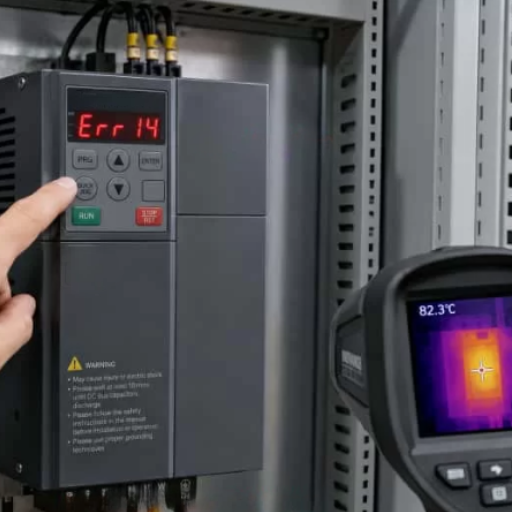
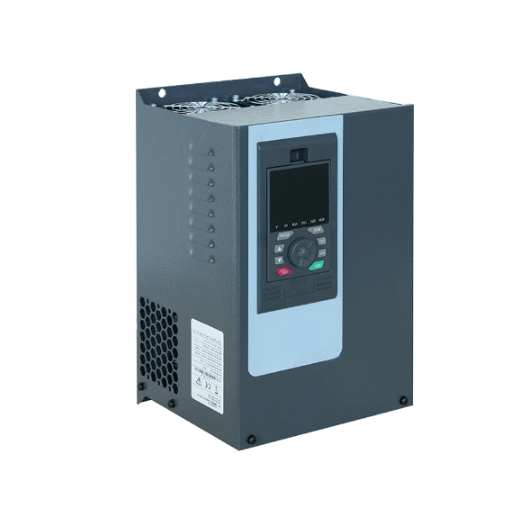
Ready to Get Your VFD Solution?
Whether you need a single drive or a complete system, we have the VFD products and engineering support to ensure your project's success.


A VFD for conveyors is a variable frequency drive that controls conveyor motor speed to match material flow, reducing energy consumption by 10-30% while eliminating the mechanical shock that destroys belts, gearboxes, and couplings. Unlike pumps and fans — where energy savings follow the cube of speed reduction — conveyors are constant torque loads, meaning power drops linearly as the belt slows.
Most engineers understand VFDs for pumps and fans. But conveyor applications require different thinking: the control mode matters more, breakaway torque can exceed 150% of rated load, and standard motors will overheat at low speed without an inverter-duty rating. Get any of these wrong, and the drive will underperform or fail prematurely.
In this guide, you will learn which conveyor types benefit most from VFDs, how to select the right control mode, when to specify braking resistors and regenerative drives, and how to synchronize multiple conveyor zones for warehouse automation. Every recommendation is backed by real application data and three case studies from operating facilities.
Key Takeaways
- Conveyors are constant torque loads: VFD energy savings are typically 10-30%, not the 20-50% seen on centrifugal pumps and fans.
- Sensorless vector control is the minimum recommended mode for most conveyors; basic V/f control struggles with heavy starting torque.
- Inverter-duty motors are mandatory — standard motors overheat below 30% speed due to reduced fan cooling.
- Braking resistors are required for high-inertia loads and downhill conveyors; regenerative VFDs can recover 15-25% of braking energy.
- PLC-linked VFDs enable real-time line speed synchronization, increasing throughput up to 18% in multi-zone distribution centers.
A Variable Frequency Drive (VFD) for conveyor applications is an electronic motor controller that varies the speed and torque of AC induction motors driving belt, roller, or chain conveyor systems. Conveyor motor speed control via VFD replaces the traditional approach of running the motor at full speed and mechanically throttling or cycling the conveyor on and off. For the complete guide to VFD applications across industries — including pumps, fans, manufacturing, and mining — see our VFD Applications pillar.
The critical distinction for conveyors is the constant torque load characteristic. A conveyor requires the same amount of turning force to move material regardless of belt speed. Slowing the belt from 100% to 50% speed reduces material throughput by half, and the motor power also drops by roughly half. This linear relationship means conveyor VFD savings are real but more modest than the dramatic cube-law savings possible on centrifugal pumps and fans.
A VFD for conveyors delivers four primary benefits:
For a deeper comparison of how load type affects VFD selection and energy savings, see our guide to VFD for pumps and fans, which explains the difference between constant torque and variable torque applications.

Not every conveyor justifies a VFD for conveyor belt systems. The economics depend on conveyor type, duty cycle, and the cost of the mechanical problems a VFD would solve.
Belt conveyors are the most common VFD material handling application. In packaging lines, distribution centers, and bulk material transport, belt speed often needs to vary with upstream production rate. A variable frequency drive conveyor system adjusts belt speed in real time, preventing product pile-up at zone transitions and eliminating the stop-start cycling that wears drive pulleys and splices.
Gravity roller conveyors do not use motors and cannot use VFDs. Powered roller conveyors — common in warehouse automation — use multiple small motors, each typically 0.25-0.75 kW. VFDs are viable here but often economically marginal unless the system runs 4,000+ hours per year or requires zone-to-zone speed synchronization. Where space is limited at each motor location, compact VFD systems designed for tight enclosure installations can simplify panel layout and reduce wiring costs.
Screw conveyors move powder, granule, or slurry materials. A VFD for screw conveyors enables precise feed rate control, which is essential in batching and mixing operations. Energy savings are secondary to process control in these applications.
Bucket elevators are high-inertia machines that benefit enormously from soft starting. A DOL start creates severe mechanical shock in the chain or belt. A VFD ramps torque smoothly, extending chain life by years. The energy savings are a bonus; the real value is mechanical protection.
High-speed sortation conveyors require rapid acceleration and deceleration for accurate package positioning. Basic V/f control is inadequate here. Direct Torque Control (DTC) or closed-loop vector control provides the dynamic response needed for precise diverting.
Inclined conveyors need full torque at low speed to overcome gravity. Declined conveyors present a unique opportunity: when the belt moves downhill, the load drives the motor, turning it into a generator. A regenerative VFD captures this energy and feeds it back to the line instead of wasting it as heat in a braking resistor.
| Conveyor Type | VFD Suitability | Typical Energy Savings | Key Consideration |
|---|---|---|---|
| Belt conveyor (packaging) | Excellent | 15-25% | Soft start extends belt and splice life |
| Belt conveyor (bulk handling) | Good | 10-20% | High breakaway torque may require oversizing |
| Powered roller conveyor | Moderate | 5-15% | Marginal unless high run hours or sync required |
| Screw/auger conveyor | Good | 10-20% | The primary benefit is feed rate control, not energy |
| Bucket elevator | Excellent | 10-15% | Soft start is the primary value; energy savings are secondary |
| Sortation conveyor | Excellent | N/A | Speed control and positioning are the main benefits |
| Inclined conveyor | Good | 10-20% | Requires 150%+ torque at low speed |
| Declined conveyor | Excellent | 15-25% regenerative | Regenerative braking recovers downhill energy |

The control mode you select determines how the VFD manages conveyor motor speed control and torque response. For conveyors, this choice is more important than it is for pumps and fans.
Volts-per-Hertz (V/f) control is the simplest and most common VFD mode. The drive maintains a fixed ratio between output voltage and frequency, which produces constant motor flux and approximately constant torque. V/f control works adequately for lightly loaded belt conveyors with minimal starting torque requirements and no need for precise speed holding.
However, V/f control has limitations on conveyors. At very low speeds (below 5 Hz), the motor may not develop enough torque to start a loaded belt. Speed regulation under varying load is also poor — if material weight suddenly increases, the belt speed will sag until the operator manually adjusts the frequency.
Sensorless vector control estimates motor rotor position and flux in real time using current and voltage feedback, without requiring a physical encoder. This enables precise torque control, excellent low-speed performance, and strong starting torque — typically 150-180% of rated torque at 0.5 Hz.
For the vast majority of conveyor applications, sensorless vector is the minimum recommended control mode. It handles loaded starts, maintains speed under varying load, and provides the torque limiting needed for jam protection. Most modern low-voltage VFDs include sensorless vector as a standard feature.
Direct Torque Control (DTC) is the fastest-responding control architecture available. Instead of controlling voltage and frequency indirectly, DTC directly manipulates motor torque and flux. Response times are typically under 5 milliseconds, compared to 10-50 milliseconds for sensorless vector.
DTC is overkill for most conveyors but essential for high-speed sortation, flying shear applications, and any system where the conveyor must accelerate or decelerate rapidly for accurate positioning. ABB and some other manufacturers offer DTC as a premium feature on their industrial drive platforms.
| Control Mode | Best For | Torque at Low Speed | Dynamic Response | Relative Cost |
|---|---|---|---|---|
| V/f Control | Light, constant-load belts | Poor below 5 Hz | Slow | Base |
| Sensorless Vector | Most belt and screw conveyors | 150-180% at 0.5 Hz | Moderate | +10-15% |
| Direct Torque Control | Sortation, high-speed positioning | 200%+ at 0 Hz | <5 ms | +25-40% |
Understanding realistic savings expectations is essential for justifying a VFD for conveyor belt systems or any conveyor VFD project. Unlike pump and fan applications where affinity laws create dramatic savings, conveyor savings are more modest and highly dependent on duty cycle.
A VFD for conveyors delivers the strongest energy returns on systems with:
VFD payback is weak on:
| Conveyor Application | Typical Energy Savings | Annual Savings (100 HP, 6,000 hrs) | Payback Period |
|---|---|---|---|
| Packaging line with variable throughput | 15-25% | 6,800−6,800−11,300 | 1-2 years |
| Warehouse distribution (zone control) | 10-20% | 4,500−4,500−9,000 | 2-3 years |
| Bulk material handling (variable load) | 10-15% | 4,500−4,500−6,800 | 2-4 years |
| Bucket elevator | 10-15% | 4,500−4,500−6,800 | 3-5 years |
| Screw conveyor (feed control) | 10-20% | 4,500−4,500−9,000 | 2-3 years |
| Downhill conveyor (regenerative) | 15-25% recovered | 6,800−6,800−11,300 | 1-3 years |
A 100 HP motor running 6,000 hours per year at 0.075/kWhconsumesapproximately0.075/kWhconsumesapproximately45,000 in electricity annually. A 20% reduction saves $9,000 per year. The U.S. Department of Energy publishes motor systems tip sheets that quantify VFD savings across material handling applications.
When the maintenance team at a food packaging plant in Thailand investigated why they were replacing conveyor belts every 8 weeks, the root cause was clear: DOL starters were jerking the belt from 0 to full speed in under 2 seconds. The mechanical shock was destroying splices and premature belt covers. After retrofitting with VFDs and programming 5-second acceleration ramps, belt life extended to 14 months. The $3,200 VFD investment paid for itself in avoided belt replacements within 4 months — before any energy savings were counted.

Properly sizing a VFD for conveyors requires attention to details that general-purpose sizing guides often overlook.
Many engineers size the VFD to the motor nameplate horsepower. For conveyors, this can be a mistake. Belt conveyors, bucket elevators, and screw conveyors often require breakaway torque of 120-150% of rated torque to overcome static friction and initial load inertia. If the VFD cannot deliver this torque, the conveyor will not start.
Check the VFD’s overload rating. Heavy-duty VFDs offer 150% current for 60 seconds and 180% for 3 seconds. If your application requires high starting torque, select a drive with these overload capabilities or oversize by one frame size. Our step-by-step VFD sizing methodology walks through nameplate data, load type, braking requirements, and environmental derating in full detail.
When a conveyor decelerates, the motor becomes a generator and pumps energy back into the VFD’s DC bus. Without a braking resistor to dissipate this energy, the DC bus voltage will rise until the drive trips on overvoltage.
Braking resistors are required for:
Braking resistor sizing depends on the kinetic energy of the rotating mass and the required deceleration time. Most VFD manufacturers provide online calculators; the key inputs are motor inertia, load inertia, operating speed, and desired stop time.
Standard AC induction motors rely on an internal fan for cooling. At low speeds, this fan moves less air, and the motor overheats. Inverter-duty motors solve this problem with independent forced ventilation or higher-temperature insulation systems.
For any conveyor that will operate below 30% of full speed for extended periods, specify an inverter-duty motor or add a separately powered cooling fan. Operating a standard motor below 20% speed on a VFD will result in thermal damage, typically within weeks. The NEMA MG1 standard defines inverter-duty motor requirements for variable-frequency operation.
Modern warehouse automation and packaging lines require a VFD for conveyors setup that keeps multiple zones running at precisely matched speeds. Line speed synchronization across conveyor zones prevents product jams, tipping, and damaged packaging. PLC integration with VFDs is the standard method for achieving this synchronization in automated distribution centers. For a deeper look at PLC-VFD integration on the factory floor, see our guide to VFDs in manufacturing automation.
The simplest synchronization method is a master frequency reference. One VFD acts as the master, and all downstream VFDs follow its output frequency via analog signal (4-20 mA or 0-10 V) or digital communication (Modbus, Profibus, or Ethernet/IP). This ensures all zones run at the same base speed.
For more precise matching, encoder feedback on the master conveyor provides actual speed rather than commanded frequency. This compensates for belt slippage and load-induced speed variation.
Long conveyors sometimes use two motors driving the same belt through a common gearbox or dual drive pulleys. In these applications, the VFDs must share load evenly to prevent one motor from doing all the work and overheating.
Load sharing can be achieved through:
In fully automated distribution centers, PLCs coordinate conveyor speed with upstream barcode scanners, package weighers, and robotic palletizers. The PLC sends speed commands to each VFD via fieldbus, adjusts line speed based on real-time throughput data, and commands emergency stops when jams are detected.
When a German e-commerce distribution center with 15 conveyor zones began experiencing package jams at zone transitions, the engineering team traced the problem to speed mismatches. Zone 3 was running 4% faster than Zone 4, causing packages to pile up at the handoff point 12-15 times per shift. After installing VFDs with PLC-linked speed references and encoder feedback, all 15 zones synchronized to within 0.5% of setpoint. Throughput increased 18%, and jam-related downtime dropped 85%. The system now dynamically reduces line speed during low-volume periods and ramps up during peak hours, cutting energy use by an additional 12%.

Even experienced engineers make these mistakes when specifying a VFD for conveyors.
Using a standard motor without an inverter-duty rating: Standard motors overheat at low speed because the internal fan cannot move enough air. Specify inverter-duty motors or add external cooling for any application below 30% speed.
Ignoring braking requirements: High-inertia conveyors and downhill applications will trip the VFD on overvoltage during deceleration if a braking resistor or regenerative unit is not included. Size the braking circuit during initial design, not after the first fault.
Selecting V/f control for heavy loads: A lightly loaded packaging conveyor may run fine on V/f control. A fully loaded bulk handling conveyor will not. Use a sensorless vector as the minimum for any conveyor with significant starting torque or load variation.
Forgetting torque limiting for jam protection: Conveyors occasionally jam due to fallen product or mechanical failure. Without torque limiting, the VFD will attempt to maintain speed by increasing torque, potentially destroying the gearbox or burning out the motor. Program a torque limit of 110-120% of rated torque.
Oversizing the VFD without considering the motor: A larger VFD will not make a small motor produce more torque. Torque is limited by motor design, not drive size. Size the VFD to the motor’s full-load amperes and the application’s torque requirements.
At an Australian iron ore mine, a 2.5 km downhill overland conveyor was wasting 1.2 MW of braking energy as heat in mechanical brakes. The engineering team retrofit the system with regenerative VFDs that capture braking energy during descent and feed it back into the mine’s 11 kV distribution network. The system now recovers approximately $340,000 worth of electricity annually. The regenerative drives paid for themselves in 18 months — and the mechanical brake maintenance budget dropped by 90% because the brakes are now only used as an emergency backup. For more on large-scale regenerative VFDs on downhill overland conveyors, see our mining industry guide.
No. VFDs save the most energy on conveyors with variable material flow, intermittent operation, or multiple speed setpoints. Constantly loaded bulk conveyors running at full speed 24/7 will see minimal energy savings, though a VFD still adds valuable soft-starting and process control capabilities.
For lightly loaded belt conveyors with minimal starting torque, V/f control is adequate. For the vast majority of conveyor applications — including loaded belt starts, screw conveyors, and bucket elevators — sensorless vector control is the minimum recommended mode. For high-speed sortation or positioning applications, use Direct Torque Control (DTC).
Yes, if the conveyor will operate below 30% of full speed for extended periods. Standard motors rely on an internal shaft-mounted fan for cooling. At low speeds, this fan moves insufficient air and the motor overheats. Inverter-duty motors use independent forced ventilation or higher-grade insulation (Class H or higher) to handle reduced cooling.
Braking resistor sizing depends on the kinetic energy of the rotating mass and the required deceleration time. The key formula is: braking power = rotational kinetic energy/deceleration time. Most VFD manufacturers provide online calculators.
Yes, but with caveats. One VFD can power multiple motors in parallel if the total motor full-load amperes do not exceed the VFD rating and all motors are identical. However, this configuration loses individual motor protection and cannot provide encoder feedback for any single motor. For critical applications, use one VFD per motor.
A soft starter ramps voltage during start and stop but always runs the motor at full speed. It provides mechanical protection during starting but cannot vary speed or save energy during operation. A conveyor soft start VFD provides soft starting and variable speed operation, enabling energy savings and process control that a soft starter cannot deliver. For conveyors that only need starting protection and never vary speed, a soft starter is the lower-cost choice. For any conveyor that benefits from speed variation, a VFD for conveyors is required.
A VFD for conveyors delivers measurable benefits — but only when matched to the right application with the right configuration. Belt conveyors with variable throughput, bucket elevators needing soft start, and automated warehouse systems requiring zone synchronization are the primary targets. Energy savings of 10-30% are realistic, with the strongest returns coming from intermittent-duty systems and multi-zone automation.
The three rules for successful conveyor VFD projects are straightforward: select sensorless vector control as the minimum for any loaded start, specify inverter-duty motors for low-speed operation, and size the braking circuit for the actual deceleration requirements. Follow these rules, and the VFD will deliver both energy savings and extended mechanical life.
For manufacturing engineers and warehouse automation specialists evaluating conveyor upgrades, the priority sequence is clear: start with high-run-hour belt systems where soft start will extend mechanical life, then move to multi-zone synchronization projects where PLC-linked VFDs increase throughput, and finally consider regenerative drives on any downhill conveyor where braking energy is currently wasted as heat.
Ready to upgrade your conveyor system with VFD technology? Contact our application engineering team for a free conveyor compatibility audit and braking energy assessment, or browse our VFD material handling systems designed for warehouse automation, packaging lines, and bulk handling worldwide.