Ready to Get Your VFD Solution?
Whether you need a single drive or a complete system, we have the VFD products and engineering support to ensure your project's success.

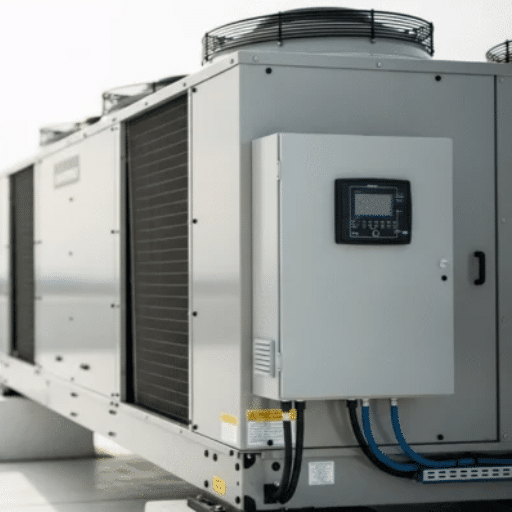
A VFD in HVAC systems controls the speed of fans and pumps to match actual heating and cooling demand, reducing energy consumption by 25–50% compared to constant-speed operation. For facility managers evaluating a VFD for HVAC upgrade, the decision is no longer optional — they are mandated by modern energy codes and represent one of the fastest-payback efficiency upgrades available in commercial buildings.
If your building still runs fans at full speed and throttles airflow with dampers, you are wasting energy and money every hour of every day. The good news is that a VFD retrofit typically pays for itself in 12–24 months, while simultaneously improving tenant comfort and extending equipment life.
What you will learn in this guide:
Key Takeaways
- VFDs in HVAC systems reduce energy use by 25–50%, with AHU fans and chilled water pumps delivering the fastest payback.
- ASHRAE 90.1 and IECC now mandate variable speed control for HVAC fans over 5 hp and pumps over 7.5 hp.
- VAV systems with VFDs use 30% less energy than constant-air-volume systems with damper control.
- Retrofit payback is typically 12–24 months for commercial buildings with high run hours.
- BACnet and Modbus integration allow VFDs to communicate directly with building management systems for centralized control.

A variable frequency drive HVAC solution — commonly called a VFD — is an electronic controller that varies the speed of AC motors driving fans, pumps, and compressors. By reducing motor speed when full output is not required, a VFD matches system capacity to actual demand rather than running at full speed and wasting energy. Learn more about what a VFD is and how it works.
Traditional HVAC systems use constant-speed motors and control output by restricting flow with dampers or valves. A damper does not reduce motor power — it simply wastes energy by creating resistance. A VFD, by contrast, reduces the motor’s speed and power consumption proportionally. For fans and pumps, power drops with the cube of speed reduction. Slowing a fan by just 20% cuts its energy use by nearly 50%.
In modern buildings, a VFD for fans and pumps controls virtually every motorized HVAC component: Air Handling Unit (AHU) supply and return fans, cooling tower fans, chilled water circulation pumps, exhaust fans, and even refrigeration compressors. See the complete guide to VFD applications across all industries.
Energy codes have made VFDs mandatory for most commercial HVAC applications. Understanding these requirements is critical for new construction, major renovations, and compliance audits.
ASHRAE 90.1, the baseline energy standard for commercial buildings in the United States, requires variable speed control for:
The International Energy Conservation Code (IECC) has adopted similar provisions, and many local jurisdictions enforce these requirements through building permits and inspections. Non-compliance can result in failed inspections, delayed occupancy permits, and in some cases, financial penalties.
For existing buildings, ASHRAE 90.1 compliance is typically triggered during major renovations or equipment replacement. A facility manager replacing a 10 hp AHU fan motor cannot legally install a constant-speed motor without variable speed control in most jurisdictions.
The bottom line: whether you are designing a new building or retrofitting an existing one, a VFD in HVAC systems is no longer a nice-to-have efficiency option. It is a code requirement.
Air Handling Units are the heart of most commercial HVAC systems, and their supply and return fans are among the most energy-intensive components. A VFD on an AHU fan allows the system to modulate airflow based on actual zone demand rather than delivering a fixed volume of air around the clock.
Variable Air Volume (VAV) versus Constant Air Volume (CAV):
A CAV system delivers the same airflow regardless of demand, using reheat coils or mixing dampers to adjust temperature in individual zones. This is inherently wasteful — the fan runs at full speed even when most zones need little or no cooling.
A VAV system uses VFD-controlled supply fans that slow down as zone dampers close. When cooling demand drops, the VFD reduces fan speed to maintain duct static pressure at a lower setpoint. The fan uses less power, the cooling coil sees less airflow, and the chiller load drops.
Energy savings: 30–50% for VAV retrofits versus CAV systems. The U.S. Department of Energy estimates that VAV systems with VFDs use approximately 30% less fan energy than constant-volume alternatives.
For standard AHU fans, V/f control with a quadratic V/f curve is the economical and effective choice. For systems requiring precise airflow control, such as cleanrooms, operating rooms, or laboratories, closed-loop vector control with airflow sensors provides tighter regulation.
Chilled water pumps circulate water between chillers and air handlers, while hot water pumps distribute heating water to terminal units. Both are excellent candidates for VFD control because their flow demand varies with building load.
In a traditional constant-flow system, the pump runs at full speed and a bypass valve recirculates excess flow back to the chiller. The pump consumes full power while delivering only the flow actually needed. In a variable-primary or primary-secondary system with VFDs, the pump speed modulates to maintain a differential pressure setpoint across the most remote coil or riser.
PID control is essential for chilled water applications. The VFD receives a 4–20 mA signal from a differential pressure transmitter and adjusts pump speed to maintain the setpoint. Most modern VFDs include built-in PID controllers, eliminating the need for external control hardware.
Energy savings: 20–35% for chilled water pumps; 15–25% for hot water pumps. The Hydraulic Institute confirms that variable-flow pumping systems with VFDs consistently outperform constant-flow systems in energy efficiency.
For primary-secondary chilled water systems, VFDs on the secondary loop pumps are the standard approach. On variable-primary systems, VFDs on the primary pumps allow the chiller to see variable flow, which requires chiller manufacturer approval but can deliver even greater savings. Read our guide to VFD for pumps and fans for detailed sizing and PID tuning guidance.
Cooling tower fans move air across the fill material to reject heat from the condenser water loop. Because ambient conditions and building load vary continuously, the tower rarely needs full fan capacity.
A VFD in HVAC systems on the cooling tower fan modulates speed based on condenser water temperature or approach temperature. When the cooling load is low or the ambient wet-bulb temperature is favorable, the VFD slows the fan. When the chiller demands more heat rejection, the VFD speeds the fan up.
This control strategy not only saves fan energy but also improves chiller efficiency. By maintaining a lower condenser water temperature at part load, the VFD allows the chiller to operate at a more efficient lift, reducing compressor energy consumption.
Energy savings: 20–30% for cooling tower fans. In cold weather, VFDs can slow fans dramatically or even shut them off entirely when free cooling (economizer mode) is available.
Exhaust and ventilation fans present some of the most compelling VFD applications in HVAC systems because their demand is often highly variable. Kitchen exhaust, garage ventilation, and laboratory fume hoods all operate on schedules that rarely require full capacity.
Demand-controlled ventilation (DCV) uses CO2 sensors or occupancy detectors to modulate outdoor air intake and exhaust flow. When a space is unoccupied or sparsely occupied, the VFD slows the supply and exhaust fans. When occupancy increases, the VFD speeds the fans up to maintain indoor air quality.
ASHRAE Standard 62.1 specifies minimum ventilation rates based on occupancy and floor area. A DCV system with VFDs delivers exactly the required ventilation — no more, no less. This eliminates the energy waste of over-ventilating spaces during off-peak hours.
Energy savings: 30–50% for DCV systems in variable-occupancy buildings such as schools, offices, and conference centers. The U.S. DOE estimates that DCV with VFDs can reduce ventilation energy by 10–30% in commercial buildings.

Many existing buildings still use outlet dampers or inlet vanes to control fan output. These methods are fundamentally inefficient because they do not reduce motor power — they simply convert excess energy into heat, noise, and vibration.
| Control Method | How It Works | Energy at 70% Flow | Efficiency |
|---|---|---|---|
| Outlet damper | Restricts airflow at fan discharge | ~90% of full-load power | Very poor |
| Inlet vanes | Pre-spins air entering fan | ~80% of full-load power | Poor |
| Variable pitch blades | Adjusts fan blade angle | ~65% of full-load power | Moderate |
| VFD speed control | Reduces motor speed | ~35% of full-load power | Excellent |
At 70% airflow — a common operating point for many HVAC systems — a damper-controlled fan still consumes approximately 90% of full-load power. A VFD-controlled fan at the same airflow consumes only about 35% of full-load power. That is a 55 percentage point difference in efficiency.
The reason is simple physics. Dampers create resistance, which the motor must overcome. VFDs reduce the motor’s actual speed and power demand. According to the fan affinity laws, power is proportional to the cube of speed. Reducing speed by 30% cuts power by 65%.
For new construction, damper control is effectively obsolete. No engineer would specify outlet dampers over VFDs for a modern commercial building. For retrofits, replacing damper control with VFD speed control is one of the highest-ROI upgrades a facility manager can make.
A VFD retrofit HVAC project depends on whether you are working with existing equipment or designing a new system.
Retrofit Considerations:
New Build Advantages:
Decision framework: If your HVAC equipment is more than 15 years old, a full replacement with VFD-ready equipment is usually more cost-effective than retrofitting. If the equipment is less than 10 years old and in good condition, a VFD retrofit is typically the better investment.
When Ahmad Al-Rashid took over as facilities director for a 12-story commercial building in Dubai, the chiller plant was the building’s biggest energy drain. The chilled water pumps and AHU fans all ran at full speed with outlet dampers throttling airflow. After retrofitting all major HVAC motors with VFDs, the building reduced HVAC energy consumption by 32%. The annual savings of $89,000 meant the retrofit paid for itself in 18 months. Tenant comfort complaints dropped by 60% because the system could now match cooling output to actual occupancy rather than overcooling every floor.
A VFD in an HVAC system is most valuable when it communicates with the building management system (BMS). Without integration, the VFD operates as a standalone device, missing opportunities for coordinated optimization.
BACnet is the dominant protocol for building automation in North America. Most modern HVAC VFDs support BACnet MS/TP (serial) or BACnet/IP (Ethernet), allowing the BMS to read status, write setpoints, and receive alarms directly.
Modbus RTU (serial) and Modbus TCP (Ethernet) are widely used in older buildings and industrial facilities. Modbus is simpler than BACnet but less flexible for complex automation tasks.
LON (LonWorks) is less common in new installations but still present in some legacy systems. LON-compatible VFDs are available for retrofit applications.
For facilities building smart automation systems, VFD in HVAC systems selection should include communication protocol compatibility as a primary criterion. A drive with excellent motor control but no BACnet interface may require an expensive gateway that negates any cost savings.
Integration enables advanced strategies such as static pressure reset, optimal start/stop, and demand response. During peak utility pricing periods, the BMS can automatically reduce HVAC motor speeds via the VFD to shed load and avoid demand charges.
Understanding HVAC VFD energy savings by system type helps prioritize which investments to make first. See VFD energy savings by load type for a deeper breakdown across all motor applications.
| HVAC System | Typical Energy Savings | Payback Period | Key Driver |
|---|---|---|---|
| AHU supply/return fans (VAV) | 30–50% | 1–2 years | Affinity laws + elimination of damper loss |
| Chilled water pumps | 20–35% | 1–3 years | Variable flow vs. constant flow + bypass |
| Cooling tower fans | 20–30% | 1–2 years | Temperature-based speed control |
| Exhaust/ventilation fans (DCV) | 30–50% | 1–2 years | CO2-based demand control |
| Hot water pumps | 15–25% | 2–4 years | Lower run hours in heating season |
Worked example: Assuming a 50-horsepower chilled water pump operates for 5,000 hours per year, with an electricity price of $0.12 per kilowatt-hour, the pump consumes approximately 38 kilowatts of electricity at full load. Installing a variable frequency drive (VFD) can reduce the average speed by 200 kilowatts. Typical VFD installation costs between $6,000 and $9,000, with a payback period of 8 to 14 months.
When the engineering team at a 500-bed hospital in Phoenix, Arizona, audited their HVAC energy profile, they discovered that 24 AHU supply and return fans accounted for nearly 40% of total building electricity use. Every fan ran at full speed with outlet dampers. After a systematic VFD retrofit on all 24 fans, the hospital saved 180,000inelectricitycostsinthefirstyear.Theprojectcost180,000inelectricitycostsinthefirstyear.Theprojectcost220,000, delivering a 15-month payback. More importantly, the hospital met ASHRAE 90.1 compliance requirements for an upcoming state energy audit, avoiding an estimated $50,000 in penalties and remediation costs.

Even the best VFD in HVAC systems can underperform if not properly specified and commissioned. Here are the most common mistakes facility managers and engineers make with HVAC VFDs.
Oversizing the VFD: A VFD should be sized to the motor’s full load amperes (FLA), not just horsepower. Oversizing increases cost and can cause control instability at low speeds. Size the VFD for 110% of motor FLA.
Ignoring bypass requirements: For critical systems such as hospital AHUs or data center cooling, always include a manual bypass contactor. If the VFD fails, maintenance staff can switch the motor to across-the-line operation without shutting down the system.
Poor BMS integration causing hunting: If the VFD PID loop and the BMS control loop are both trying to control the same variable, the system will hunt — oscillating between too fast and too slow. Ensure clear control hierarchy: typically the VFD handles local PID while the BMS writes setpoints.
Not accounting for motor insulation: VFDs generate voltage spikes that can damage motor insulation. For motors more than 15 years old, specify inverter-duty rewind or add an output reactor/dv/dt filter.
Forgetting to commission PID parameters: Default PID settings are rarely optimal. Commission the VFD’s PID loop with the actual system connected, tuning proportional and integral gains for a stable response without overshoot.
Yes. ASHRAE 90.1 and the International Energy Conservation Code (IECC) mandate variable speed control for HVAC fans over 5 hp and pumps over 7.5 hp in most commercial buildings. Local jurisdictions enforce these requirements through building permits and inspections. Existing buildings are typically required to comply during major renovations or equipment replacement.
Energy savings in HVAC applications typically range from 20% to 50%, depending on the system type and duty cycle. AHU fans in VAV systems save 30–50%. Chilled water pumps save 20–35%. Cooling tower fans save 20–30%. Exhaust fans with demand-controlled ventilation save 30–50%. The fastest paybacks are usually found on AHU fans and chilled water pumps in buildings with high run hours.
Yes, in most cases. Standard induction motors can operate with VFDs, but motors manufactured before the 1990s may require an insulation upgrade or output filter to protect against voltage spikes. The VFD must be sized to the motor’s full load amperes, and critical systems should include a manual bypass. Retrofit payback is typically 12–24 months for commercial buildings.
V/f (Volts per Hertz) control with a quadratic V/f curve is the standard choice for HVAC fans. It is economical, reliable, and well-suited to the variable-torque load profile of centrifugal fans. For applications requiring precise airflow control, such as cleanrooms or laboratories, closed-loop vector control with airflow sensors provides tighter regulation. Most commercial HVAC applications do not require the added cost and complexity of vector control.
Yes. Modern HVAC VFDs support standard building automation protocols including BACnet MS/TP, BACnet/IP, Modbus RTU, and Modbus TCP. Integration allows the BMS to monitor VFD status, write speed setpoints, and receive fault alarms. Advanced strategies such as static pressure reset, optimal start/stop, and demand response all depend on reliable VFD-to-BMS communication.
The best VFD for HVAC depends on motor size, control precision, and communication requirements. For standard AHU and pump motors up to 100 hp, a general-purpose VFD with V/f control and BACnet integration is sufficient. For critical applications such as hospital operating rooms or cleanrooms, specify a vector-control VFD in HVAC systems with closed-loop feedback and redundant bypass.
A variable frequency drive HVAC system works by converting fixed-frequency AC power to variable frequency output, allowing motors to run at precisely the speed needed for current load conditions. When cooling demand drops, the drive reduces motor speed; when demand rises, it increases speed. This modulation eliminates the energy waste of constant-speed operation.
VFDs in HVAC systems deliver measurable energy savings, ensure code compliance, and improve occupant comfort. From AHU fans and chilled water pumps to cooling towers and exhaust systems, virtually every motorized HVAC component can benefit from variable speed control.
The business case is straightforward. A typical VFD retrofit HVAC project saves 25–50% on HVAC motor energy, with payback periods of 12–24 months. New construction projects that specify a VFD for HVAC from the outset avoid the cost of inefficient constant-speed equipment and qualify for utility rebates that can offset 30–50% of equipment costs.
For facility managers evaluating HVAC efficiency upgrades, the priority sequence is clear: start with AHU supply fans and chilled water pumps, then expand to cooling tower fans and exhaust ventilation. Each system type has proven savings data, established control strategies, and straightforward integration paths.
Ready to upgrade your HVAC system with VFD technology? Contact our application engineering team for a free energy audit and retrofit assessment, or browse our HVAC-configured VFD systems designed for commercial building efficiency worldwide.