Ready to Get Your VFD Solution?
Whether you need a single drive or a complete system, we have the VFD products and engineering support to ensure your project's success.


Selecting the best technology for a motion control system is a crucial decision to make, it could have a huge effect on the performance and efficiency of the application. The two most common choices available are servo drives and stepper motors but they differ largely in terms of speed, torque, and accuracy. That is why it will be really important for engineers and plant designers to not only know the difference but also become very familiar with it very well, so as to opt for the suitable one based on their needs. This write-up takes a really critical look at the two technologies in a side-by-side comparison and even goes as far as advising on which technology is the most preferred one for individual type of applications. Hence, you could be very much on the same path in terms of understanding technologies performances under different circumstances and selecting project-appropriate one by the time the article is over.
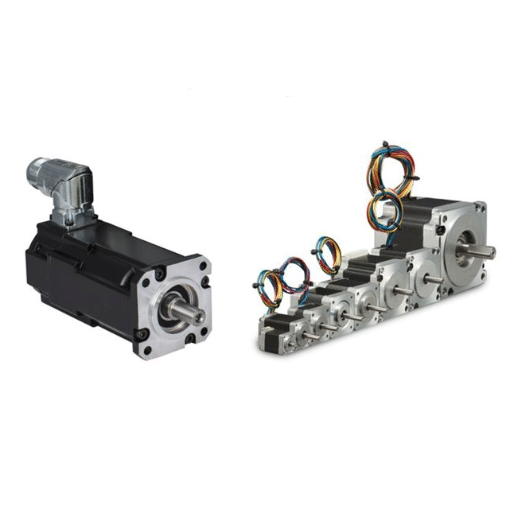
It is a well-established fact that stepper motors can provide accurate positioning using some kind of feedback or sensors. Instead of using a continuous motion, the rotor of a stepper motor moves around with a fixed angle which is equivalent to one step of that motor. This is called the full-step mode of operation, and stepper motors are principally designed to work on such step-by-step movement in a precise way. Step and direction signals, as in the case of the 3D printer and CNC machine mentioned above, are usually the software inputs to the stepper motor drive.
By contrast, servo motors use a closed-loop feedback method following before mentioned categories which are continuously adjusting their location, speed, and torque. This ability leads to the creation of very accurate and dynamic servo systems that are used the most in the application of industrial robots and conveyor systems where the operations need to be fast and precise. Their speed performance is better than that of steppers and they can handle large loads, but the downside of it is that they frequently need complex controls and are typically more expensive than stepper motors.
A stepper motor is a digital device, that changes digital signals into mechanical movement. Unlike in servo machines, stepper motors have an open-loop control system, which means they can only move very accurately, i.e. in incremental steps that depend on the number of poles in their construction. Such a nature of mechanism makes them the best candidates for very precise positioning and repeatability applications such as in 3D printers, CNC machines and some types of automated assembly lines. The stepper motors are very simple and low-cost devices, while at the same time they offer precise control without the need for feedback systems. However, those are in general not as powerful as servo motors, and also, the performance of stepper motors may drop as a result of torque limitations at higher operational speeds. The latest advancements in the driver technology have further raised their efficiency, so there is a good chance that they will be extensively employed in many demanding, precision-centric applications.
A servo motor is a very specialized actuation or linear actuator that is designed for accurate control of the angular or linear position, speed, and acceleration. The servo motor is much smaller than the stepper motor and operates within a closed-loop system which, apart from the motor itself, also includes the controller and a position feedback device such as an encoder or resolver. The closed-loop system with the feedback mechanism guarantees high accuracy of the motor’s position and the desired movement. This type of actuator is very often used in applications requiring dynamic motion control such as robots, conveyors, CNC machines.
By employing digital technology and getting feedback, servo motors have been made very powerful in terms of speed, torque, and energy efficiency, even in very demanding cases. They are available in various designs, such as AC, DC, and brushless, to satisfy the various operational requirements. Servo motors, through their high-quality and adaptable architecture, have indeed been the movers in the industry to a great extent in a consistent drive of innovation in various industries, most of them needing to be extremely accurate and reliable.
| Feature | Stepper Motor | Servo Motor |
|---|---|---|
| Control Mechanism | Open-loop feedback | Closed-loop feedback |
| Position Accuracy | Moderate | High |
| Torque at High Speeds | Limited | Excellent |
| Power Consumption | Generally higher | More efficient |
| Rotational Speed Range | Limited | Wide speed range |
| Motor Design | Simpler construction | Complex design |
| Maintenance Requirement | Low | Moderate to high |
| Noise Level | Higher | Quieter |
| Programming Complexity | Easy to program | Complex programming |
| Cost | Affordable | Relatively expensive |
| Use Case | Simple, low-precision applications | High-precision, demanding applications |
| Dynamic Performance | Basic | Advanced, responsive |
| Overheating Risk | Higher under heavy loads | Lower due to efficient feedback |
| Versatility | Application-specific | Highly versatile across industries |

With regard to the speed capabilities, servo motors display higher performance in almost every situation compared to stepper motors. Servo motors are made for fast-moving machines and equipment and turn much faster than stepper motors with great precision and power. The quick reversal of motion through the closed-loop control enables them for the quick start-stop cycle favored for applications with dynamic performance requirements thus very difficult tasks demanding high performance.
On the other hand, stepper motors are expected to move at reduced speeds in terms of open-loop operation because beyond this limit, the motor may cause missed steps and will endure a significant loss of torque. The said characteristics are responsible for the major use of stepper motors in low to medium-speed operations where very frequent movement is not a requirement.
Stepper motors are naturally intended to function with high efficiency at low to moderate speeds, where the most common ranges are from 200 to 1200 revolutions per minute (RPM) depending on the motor’s specs and the demands of the application. The step rate is the output of the pulse frequency input, where higher frequencies result in more stepping. Still, stepper motors show restrictions at high speeds due to their torque-speed characteristic curve. The torque lowers following the speed increment and even not enough to keep the motor in an effective range of high-speed applications.
Stepper motor technology has advanced by leaps and bounds, owing greatly to microstepping and closed-loop systems. And at higher pulse frequencies, they can also suffer less from the drawbacks of such systems. Nonetheless, stepper motors are still predominantly used for tasks which involves high-speed output with fine positional control. Their main applications are found in 3D printers, robotic arms, and CNC machines—computers whose role is primarily to initiate and control precision motion in production lines, and the speed of operation is thus a less crucial factor still.
The acute thing about servo engines is that they can be fast — extremely. The fact that through the feedback control systems they are capable of following continuously and adjusting their position, velocity, and torque is what makes their speed capability superior. In fact, these days servo motors are known for being able to achieve rotational speeds in excess of 5,000 RPM, making them the first choice for quick-paced tasks. Their high performance is backed up by the employment of top-of-the-notch controllers and high-resolution encoders that make certain even minute changes in the setup are instant.
On top of that, the servo systems can easily get the consistent torque in different kinds of speeds which is immensely useful for controlled and hectic industrial scenarios like packaging machines, conveyor systems, and high-performance robotics. On the one hand, the high-speed performance is also characteristic of a closed-loop system, which is why the lag is minimal, production cycles are faster with fewer overshoots, and all in all, the dynamic operations are done as efficiently as possible.
By focusing on the semiconductor sector, it is clear that there is wide use of servo-driven equipment due to its high-precision and quick repositioning for wafer processing and electronic chip assembly. Also, concerning the automotive industry, the same applies. Robots in the painting, welding, and assembly sectors heavily rely on high-speed, precise servo systems – both limiting and guaranteeing the quality standards and production efficiency level at the same time.
Another vitally crucial sector to consider is the textile industrial performance for which high-speed servo motors assist in the smooth operation of the machines trying to do complicated patterns and a huge amount of production but at the same time without losing accuracy. It is the same situation with printing and packaging areas. The use of servos makes it possible to combine all the necessary components like cutters, rollers, and feeders and run them at very high speeds, hence providing the industry with the most accurate and reliable solution. Even though the technology is going forward, these kinds of systems will be still the hub for the industries looking to the maximum optimization of the operations, as the latter would require both high speed and precision.
Stepper motors and servo motors differ in the torque output under careful examination, and each of them has specific characteristics according to the application. Stepper motors supply steady torque at low and moderate speeds, thereby making them suitable for the applications which involve predictable and sequential movements. Nevertheless, their torque falls off drastically as the speed goes up because of the open-loop control and the absence of feedback mechanisms.
Servo motors, conversely, provide a large torque that can be maintained over a wider speed range. Their closed-loop system, backed by encoders’ information coming from feedback, guarantees the uniformity of the torque delivery even in environments with variable loads. This, therefore, allows the servo motors to be used for various types of and hard applications that need a quick increase and decrease of the speed or a steady torque to be kept at a certain level, the servo motor becoming also the more reliable and rapid option. The speed, load, and precision would be some of the application requirements, and those must be the factors to determine the system to be used.
Whenever one decides to search for a motor that is best suited for the specific torque, a few major factors are to be taken into consideration for the motor to perform at its best and be compatible with the system. Most importantly, the mechanical power consumption of the machine, operating speed, and the rate at which acceleration and deceleration take place are the main points. To prevent the motor from being overloaded or not completely used, the motor’s continuous and peak torque ratings should not only be known but should also be compared with the application’s operation profile.
To maintain a high torque output yet a long service life, it is very important that the materials, rotor design, and cooling system in the motor are of the highest quality. In the case of precision uses, e.g., robots or automatic production in the factory, a servo motor that is of high torque-to-inertia ratio with feedback mechanisms that are automatic is usually the best choice. Moreover, the performance of the motor can now be easily fine-tuned by the motors are more programmable with the enhanced efficiency they offer and that is due to the motor technology advancements and according to the requirements of the latest and most difficult applications.

Accurate work of motors, whether they are stepper or servo motors, in motion control, lies in the interactions of motors and feedback mechanisms based on their operation principles. The character of stepper motors is to perform precision only during their divided motion, where each step is represented by an equal angle. This intrinsic step-by-step nature is sometimes good enough and in many applications external feedback systems are not required, complementarily open-loop control systems are the perfect environment for them for moderate precision. However, things like varying loads or steps being missed can degrade the accuracy of the system as a whole under some particular circumstances.
On the contrary, servo motors have the benefit of closed-loop systems and hence are much more precise. The servo motors take the sensors, such as encoders, as their witness to always track down position and speed and by these the respective motors adjust dynamically to give the accurate motion regardless of the varying loads. This feature makes them not only the belief but also the choice of high-accuracy systems, for which the factors like real-time adjustments and stable performance are super important. In order to get the best precise performance out of systems, servo motors are usually the most reliable choice.
One of the inherent capabilities of stepper motors is that of achieving very precise position control without having to be supplemented with any additional feedback system. The accuracy of these machines is nothing but the result of the way they are made – they divide a full rotation into an exact number of steps, say, 200 to 400 steps for one revolution of standard motors. The buttery smooth microstepping technique can further break the resolution down to a fine 0.0072 degrees per step hence making stepper motors appropriate for applications requesting the same precise movement, over and over. The motors that do not need any encoders to be able to perform commutation, i.e., the stepper motors, have a very nice feature. One consideration for their use, however, is that the heavier the load the less torque is available and also certain restrictions in positioning reliability are present. The relative range of removable disturbances and the operations of the stepper motor are considered during the process of selecting the appropriate type of output for a given application.
Servo motors are widely known for the high accuracy that they achieve through the closed-loop control integration. Servo systems are control feedback techniques that include signals from sensors like encoders or resolvers, to keep track of the motor position, speed, and acceleration at all times. Different from stepper motors that use open-loop control, servo motors self-regulate their operation and automatically expand the difference between the load variations in order to arrive at the perfect position, hence the need for precision and reliability under harsh or adverse conditions. The present servo technology can locate the position of the motor with an error of a fraction of a degree which is traditionally set at ±0.05° or even better.
Moreover, peerless servo motors require intricate control algorithm and PID (Proportional-Integral-Derivative) is such a regulation which fine-tunes their response to positional errors,-speed fluctuations, and torque demands. Also, the above-mentioned factors make servo motors the right choice for high-speed precision applications such as in robotics, CNC machinery, and automatic manufacturing systems. The past years have seen a transformation in the design of motors and the associated sensors in the servo systems to lead to energy-efficient products, lesser heat generation, and longer life. Thus, the application of servo motors in precise and high-performing systems is further consolidated.
The accuracy is of great importance in such applications where a very detailed specification is a must for operation, safety, and compliance reasons. Healthcare, aviation, and automation are the sectors that cannot do without this. It is very important for these areas to have a faultless start and to avoid errors that could cause a significant cost increase. Thus, medical devices such as insulin pumps or imaging devices need to be extremely accurate, as even the slightest errors can expose to fatal health injuries. The same situation is in the air transport navigation and auto-pilot systems, where the accurate data receipt and reaction are the very heart of the problem in order to keep the flight going straight and safe for passengers.
To determine the components or create the systems, as well as developers, should also depend on positional accuracy, resolution, and system tolerances, the most important metrics of all. However, accuracy is also essential when it comes to situations where the operations or measurements have to be exactly the same repeatedly, as it happens in CNC machining or quality control applications. The use of high-precision sensors, sophisticated control algorithms, and real-time feedback loops can really impact the system’s precision in a positive way, which eventually leads to the best results and system reliability in these applications where a lot is at stake.

There are many instances when Stepper motors are used because they are able to provide very exact and repeatable positioning, which is especially important when the cost is a big issue, so they are used everywhere also because of being quite cheap. They are not difficult to find in 3D printers, textile machines, and automated robotics, as machines in those places move over short distances and have to be very accurate this is a must too. The most common problem with stepper motors is that they have to be used with some kind of motion control, as they don’t control the speed by themselves; they just decide the position and move according.
Servo motors, another type of motors, are mainly in the leading places in the industries where the need for high speed, torque, and the presence of very accurate feedback are main factors. These motors are the ones that are most commonly applied in the industries of CNC machining, industrial robotics, and conveyor systems, as without their real-time adjustments and high performance, the machine would not work properly. One of the main benefits of a closed-loop control system for the servo motor operation is the accuracy and speed of the response.
Accuracy and repeatability are two major advantages of servos, as encoders make the closed-loop control by position and error correction possible, which in turn effectively reduces instability and the occurrence of miss-stepping. One of the advantages of stepper motors is that they are quite accurate in open-loop mode at low speeds by providing a practical step size of walking, yet, with no feedback in the system, loss of steps makes the position not correct over time. Servo drives, when it comes to the demanding requirements of tight positioning, high resolution, and closed-loop correction, are the preferred ones.
Servo systems are more effective under dynamic loads due to the fact that power is delivered where and when it is needed, while on the other hand, the stepper motors quite often “keep the current on” just to balance the holding torque with the generation of more heat. So, it is very common for the stepper motor to be too hot at high currents that are used to increase the torque, and that heat is an issue in the performance and reliability of the system. The right motor, driver settings, and thermal management are very significant choices for each system to make so that the whole thing would yield the highest productivity as well as the least heat.
Inertia mismatch and resonance are among the key issues: stepper motors are very much at the mercy of resonances produced at certain speeds, unless this is tamed through microstepping or dampers, while servos are supported by closed-loop tuning as a way of handling inertia and they can often afford a wider range of observer inertia. If the inertia of the motor and the load is properly matched and resonance is dealt with, which is the way to go, the system stability and efficiency of both types are improved. Servo will have the upper hand in situations with fast and unpredictable changes in load and the need for higher torque because of its ability to not only control the torque but also the feedback from the encoder.