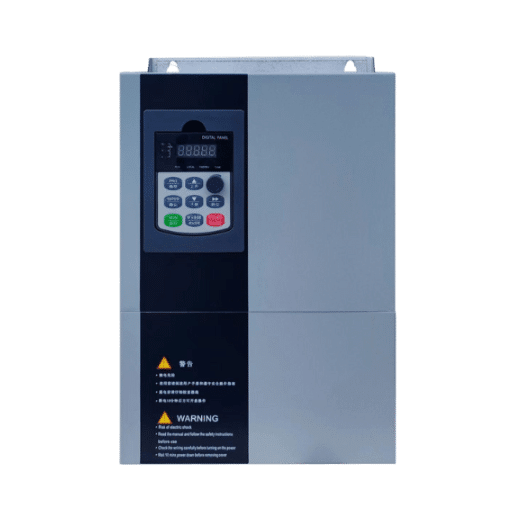
Ready to Get Your VFD Solution?
Whether you need a single drive or a complete system, we have the VFD products and engineering support to ensure your project's success.


A high-voltage VFD controls the speed and torque of large industrial motors by varying the frequency and voltage supplied to the motor. In everyday industrial language, “high voltage VFD” usually means a medium voltage drive operating between 2.3 kV and 13.8 kV, powering motors from roughly 400 kW to more than 25 MW. These drives are used in mining crushers, oil and gas pipeline pumps, power plant boiler feed pumps, and large water treatment facilities where low-voltage drives would require impractical current levels and cable sizes. This guide explains how to select, install, and justify high-voltage VFDs for heavy industry.
When a 300 MW coal plant in Southeast Asia retrofitted its induced draft fans, the engineering team faced a familiar choice. The six 6.6 kV, 2,500 kW fans ran at fixed speed with inlet dampers throttling airflow. Upgrading the dampers would have cost less upfront but left the motors wasting energy.
Instead, the plant installed 6.6 kV variable frequency drives with closed-loop airflow control. Fan energy consumption dropped 34%, damper maintenance disappeared, and boiler drum level control improved because feedwater pumps could follow load more smoothly. The project paid back in under three years through energy savings and reduced maintenance alone.
That story is not unusual. According to SNS Insider and Market Growth Reports, the global VFD market reached USD 27.31 billion in 2025 and is projected to grow to USD 45.60 billion by 2035 at a CAGR of 5.26%. Medium voltage drives are expanding faster than the overall market, with Global Market Insights projecting a CAGR above 6% through 2035.
The high-power segment above 1,000 kW is growing at roughly 7.4% annually. As plants push for lower energy intensity and tighter process control, high-voltage VFDs have moved from niche options to standard equipment in heavy industry.
Key Takeaways
- Most “high voltage VFDs” sold for industrial plants are technically medium voltage drives (2.3 kV to 13.8 kV) that handle motors from 400 kW to 25+ MW.
- Multi-level topologies, including three-level NPC and cascaded H-bridge designs, reduce harmonics and often eliminate output transformers.
- Air-cooled drives cost less upfront but need more electrical room space and HVAC capacity; water-cooled drives save up to 50% footprint but add plumbing and maintenance.
- Energy savings typically range from 20% to 40% on pumps and fans, with modern drive efficiency between 96% and 98.5%.
- Harmonic compliance with IEEE 519 and IEC 61800-3 can be built into the drive through multi-pulse rectifiers or active front ends, but retrofit plants may still need external filters.
- Regenerative drives recover braking energy on downhill conveyors, mine hoists, and high-inertia loads, but they cost more and require careful grid studies.

A high-voltage variable-frequency drive is a power electronics system that converts fixed-frequency, fixed-voltage grid power into adjustable frequency and voltage output. The result is precise control of motor speed, torque, and direction. In industrial procurement, the term “high voltage VFD” almost always refers to a drive rated between 2.3 kV and 13.8 kV, with common nameplate ratings of 3.3 kV, 4.16 kV, 6 kV, 6.6 kV, 10 kV, 11 kV, and 13.8 kV.
Power ratings start around 400 kW and extend beyond 25 MW. The upper end is limited by semiconductor current ratings, cooling capacity, and transformer design rather than voltage alone. For buyers, this means a high-voltage VFD is not defined by a single kilowatt threshold. A 1,000 kW motor might use a low voltage drive if the plant already has a 690 V infrastructure, while a 400 kW motor in a 6.6 kV facility will almost certainly use a high voltage drive.For a closer look at how these drives are engineered to manage large motors safely, our guide to high voltage motor control explains the selection principles behind matching a drive to a large-motor application.
Low-voltage VFDs operate at 220 V to 690 V and dominate the market by unit volume. They are compact, relatively inexpensive per kilowatt, and familiar to most maintenance teams. However, current rises quickly as power increases. At 1,000 kW and 690 V, full-load current exceeds 1,000 A, requiring large cables, buswork, and switchgear.
High-voltage VFDs solve this by raising voltage instead of current. A 6.6 kV, 2,500 kW drive draws roughly 260 A on the motor side, allowing smaller cables and simpler terminations. The trade-off is for more complex power electronics.
High voltage drives almost always use multi-level inverter topologies, phase-shifting input transformers, and dedicated cooling systems. They also require specialized commissioning and protection practices.
A high voltage VFD is a motor control system that adjusts the frequency and voltage supplied to large AC motors rated from 2.3 kV to 13.8 kV. It is used for motors from 400 kW to over 25 MW in industries such as mining, oil and gas, power generation, and water treatment, where low voltage drives would need excessive current and cable size.
The terminology around voltage classes creates real confusion. Under IEC standards, low voltage (LV) is up to 1,000 V AC, medium voltage (MV) spans 1 kV to 35 kV, and high voltage (HV) is above 35 kV. NEMA uses a different cutoff, generally treating 600 V and below as low voltage. The drive industry usually follows IEC for ratings above 1 kV, which is why a 6.6 kV drive is called a medium voltage drive in engineering documents but often marketed as a high voltage VFD.
For plant engineers, the practical distinction is simple. If your motor nameplate says 690 V or below, you need a low voltage VFD. If it says 2.3 kV to 13.8 kV, you are in medium voltage territory, which suppliers and many buyers call high voltage. True high voltage drives above 35 kV exist in utility-scale applications but are rare in ordinary industrial plants.
Marketing language follows customer habits. Buyers searching for a 6 kV or 10 kV drive often type “high voltage VFD” because the term feels more natural than “medium voltage VFD.” Manufacturers respond by using both terms interchangeably on product pages and datasheets. The result is that “high voltage VFD” has become a commercial label for the entire 2.3 kV to 13.8 kV range.If you want a clearer picture of where the medium voltage class begins and ends, our dedicated overview of the medium voltage VFD explains the ratings and terminology behind these labels in more detail.
This does not change the engineering reality. Specifications, protection relay settings, cable selection, and harmonic studies all depend on the exact voltage class. A 3.3 kV installation is not the same as a 10 kV installation, even if both are sold as high voltage drives. Buyers should always confirm the motor nameplate voltage and match it exactly to the drive.
| Factor | Low Voltage VFD | Medium Voltage VFD | High Voltage VFD (true HV) |
|---|---|---|---|
| Voltage | 220 V to 690 V | 2.3 kV to 13.8 kV | Above 35 kV |
| Typical power | Up to ~2,000 kW | 400 kW to 25 MW | Above 20 MW, utility-scale |
| Common applications | Pumps, fans, conveyors | Crushers, mills, compressors | Grid systems, large utilities |
| Relative cost per kW | USD 50 to 150 | USD 200 to 400 | Project-specific |
| Cable current at 2,500 kW | ~2,100 A at 690 V | ~260 A at 6.6 kV | Not applicable |
| Topology | 2-level common | 3-level NPC, cascaded H-bridge | Custom multi-level |
For a deeper comparison of when to cross from low voltage to high voltage, see our low voltage vs high voltage drive comparison.
For very large motors where power levels push into the multi-megawatt range, our guide to high power VFD systems covers the design considerations that come into play at the top end of this range.

Selection starts with the motor nameplate. Record rated voltage, kW or HP, full-load current (FLA), power factor, speed, and insulation class. The drive must match the motor voltage within its adjustable range. A 6 kV motor should not run on a drive configured for 6.6 kV unless the drive and motor are both rated for the target voltage and the manufacturer confirms compatibility.
Overload capacity matters in heavy industry. Crushers, mills, and hoists need 150% to 200% overload for short periods. Specify a heavy-duty rating rather than a normal-duty rating if the load profile includes frequent starts, high inertia, or momentary overloads. The drive’s continuous current rating should equal or exceed the motor FLA, and its overload rating should cover the worst-case peak.
High-voltage VFDs offer the same control philosophies as low voltage drives, but the implementation differs. Volts-per-hertz (V/f) control is simple and reliable for pumps and fans where dynamic response is not critical. Sensorless vector control improves torque accuracy at low speeds and is better for conveyors, crushers, and compressors. Direct torque control (DTC) provides the fastest dynamic response and is preferred for high-inertia loads such as mine hoists and rolling mills.
For most centrifugal applications, V/f or simple vector control is sufficient. For loads with sudden torque demands or precise speed holding, vector or DTC is worth the added complexity. The control method also affects harmonics, motor heating, and encoder requirements, so match the method to the process, not just the motor.
Variable torque loads, such as centrifugal pumps and fans, follow the affinity laws. Reducing speed by 20% can cut power by nearly 50%. These applications deliver the fastest payback. Constant torque loads, such as compressors, conveyors, and positive displacement pumps, draw roughly the same torque regardless of speed and need drives sized for full torque across the range.
Duty cycle affects thermal sizing. A drive running continuously at 90% load needs less overload margin than one cycling between no-load and 150% every few minutes. Provide the supplier with a load cycle diagram if available. Also confirm whether the application needs braking, reversing, or synchronized multi-motor control, since these requirements influence topology and auxiliary components.
High voltage VFDs generate significant heat. A 5 MW drive at 97% efficiency still dissipates 150 kW of losses. The electrical room must remove that heat reliably. Air-cooled drives are simpler but dump all losses into the room.
Water-cooled drives transfer heat to an external loop, reducing HVAC load and footprint. Enclosure IP ratings must match dust, moisture, and temperature conditions. IP42 may be fine in a clean electrical room, while mining or cement plants often need IP54 or higher.
Modern high voltage VFDs connect to plant control systems through Modbus, PROFIBUS, PROFINET, EtherNet/IP, or OPC UA. Specify the required protocol early. Some plants also need analog I/O, encoder feedback, or safety-rated inputs. Integration complexity rises with the number of drives and the level of automation, so include the drive supplier and system integrator in the control architecture review.
The two-level voltage source inverter is the simplest topology. It switches the DC bus voltage between positive and negative levels to create an approximation of a sine wave. Two-level designs are common in low-voltage drives and in smaller medium-voltage drives.
At higher voltages, they produce high dV/dt, which stresses motor insulation and bearings. Output filters or reactors are often needed to protect the motor, adding cost and losses.
Three-level neutral-point-clamped (NPC) and active neutral-point-clamped (ANPC) inverters add a zero-voltage level. The output waveform more closely resembles a sine wave, reducing dV/dt and motor stress. Harmonic content is lower than in two-level designs, so output filters can be smaller or eliminated. NPC and ANPC topologies are widely used in 3.3 kV to 6.6 kV drives where motor compatibility and power quality are priorities.
Cascaded H-bridge drives connect multiple low-voltage power cells in series to build a high-voltage output. Each cell operates at a modest voltage, so standard low-voltage semiconductors can be used. The cells are fed by a phase-shifting transformer that cancels harmonics on the input side. The output voltage is a near-sinusoidal staircase waveform with very low harmonic distortion.
This topology is common in 6 kV to 13.8 kV drives and is a key reason many high voltage VFDs can feed motors directly without an output transformer. Cell redundancy can also be designed so the drive continues running with one failed cell at reduced capacity, improving availability in critical applications.Because these cell-based designs are built from repeatable, swappable blocks, they are the foundation of modular VFD systems that simplify maintenance and improve uptime in critical processes.
An active front end replaces the diode or thyristor rectifier with an active inverter bridge that can feed energy back to the grid. AFE drives offer very low input harmonics and regenerative capability. They are more expensive and complex than standard rectifier drives, but they eliminate the need for multi-pulse transformers and harmonic filters in many cases. AFE is the preferred choice for regenerative applications and for plants with strict power quality requirements.
Air-cooled high voltage VFDs use forced ventilation to move heat from power modules into the electrical room. They have lower upfront cost and simpler maintenance because fans and filters are accessible. However, they require larger electrical rooms, more clearance, and more HVAC capacity. In hot climates or plants with limited space, air cooling can become the dominant cost driver once installation is included.
Water-cooled drives circulate deionized water through cold plates attached to the power modules. The heated water flows to an external heat exchanger, which can reject heat outside the building or into a process loop. Water cooling removes heat more efficiently than air, allowing up to 50% smaller footprint and better performance at high ambient temperatures. It also reduces electrical room noise, which matters in occupied control areas.
The trade-offs are higher upfront cost, more complex installation, and ongoing maintenance of the cooling loop. Water quality, flow rate, pressure, and leak detection must be managed. Water-cooled drives are common in offshore platforms, mining sites, and power plants where space or ambient temperature makes air cooling impractical. For harsh-environment and space-constrained projects, our water-cooled high voltage VFD solutions are designed for high reliability and compact layout. If you are weighing this option, our detailed guide to the water-cooled VFD walks through cooling-loop design, water quality management, and the maintenance practices that keep these drives running reliably.
| Factor | Air-Cooled | Water-Cooled |
|---|---|---|
| Footprint | Larger | Smaller |
| Electrical room HVAC load | Higher | Lower |
| Ambient temperature tolerance | Typically up to 40 C | Often up to 50 C or higher |
| Maintenance | Simpler | More complex |
| Upfront cost | Lower | Higher |
| Noise level | Higher fan noise | Lower |
| Best fit | Spacious, clean electrical rooms | Space-constrained or hot environments |
The right choice depends on total installed cost, not just the drive price. A cheaper air-cooled drive can become the more expensive option if it forces a larger building or bigger chiller plant.

Mining is one of the largest users of high voltage VFDs. Applications include semi-autogenous (SAG) mills, ball mills, gyratory crushers, mine hoists, conveyors, and main ventilation fans. Typical voltages are 3.3 kV, 6 kV, 6.6 kV, and 10 kV. Crushers and mills need high starting torque, often 120% to 200% of rated torque, and must withstand shock loads from ore variability.
Mine hoists and downhill conveyors are classic regenerative applications. A downhill conveyor can generate thousands of kilowatts continuously as gravity pulls the loaded belt down. Without regeneration, that energy is burned off in braking resistors.
With an AFE drive, it returns to the grid. For more detail, see our overview of VFD applications in mining. These demanding, shock-loaded duties are exactly why purpose-built industrial high voltage drives are engineered with the overload capacity and ruggedness that mining and metals processing require.
Pipeline pump stations and gas compressors run at high power for long hours, making them ideal for VFD energy savings. Typical voltages range from 3.3 kV to 6.6 kV. On liquid pipelines, a VFD matches pump flow to demand rather than throttling with control valves. Energy savings of 20% to 30% are common on pumps, while compressors can save 15% to 35% depending on the load profile.
LNG plants use high voltage VFDs on refrigeration compressors. Offshore platforms often prefer water-cooled drives because space and weight are limited. Electrical submersible pumps (ESPs) in oil wells also use VFDs for flow control and pump protection. Our guide to VFD applications in oil and gas covers these cases in more depth.
Thermal power plants use high voltage VFDs on boiler feed pumps, induced draft (ID) fans, forced draft (FD) fans, and condensate pumps. The Southeast Asia retrofit described earlier is representative. ID and FD fans with VFDs respond directly to boiler load rather than damping airflow, improving combustion control and reducing auxiliary power.
Energy savings on fans and pumps in power plants typically range from 20% to 40%. Because these motors run continuously, even small efficiency improvements translate into large annual savings. Control Engineering has published practical guidance on implementing VFDs for large boiler motors, including lessons on bypass configurations and protection relay coordination.For a wider view of how these drives fit into demanding generation and process environments, see our resource on choosing a VFD for power plants and heavy industry.
Raw water intake pumps, distribution booster pumps, and aeration blowers in wastewater plants are excellent VFD candidates. Flow demand varies throughout the day, and fixed-speed throttling wastes energy. High voltage VFDs allow pumps to follow demand curves while maintaining pressure setpoints. Energy savings of 20% to 40% are typical on pumps and blowers.
Water treatment plants also benefit from softer starts. Starting a 1,000 kW pump across the line creates voltage sag and mechanical stress. A VFD ramp reduces both. In retrofit projects, the existing 6.6 kV motor can often be retained, with the VFD inserted between the switchgear and the motor.
Cement kilns, cooler fans, preheater fans, and raw mill drives use high voltage VFDs to improve process control and reduce energy use. In steel mills, rolling mills and fans benefit from precise torque and tension control. These environments are dusty and hot, so enclosure protection and cooling design are critical. IP54 enclosures and filtered air intakes are common specifications.
Modern high voltage VFDs achieve efficiency between 96% and 98.5%, with the highest figures coming from multi-level topologies and optimized transformer designs. Losses are split between semiconductors, transformers, reactors, and auxiliary systems such as fans or pumps. At multi-megawatt power levels, every 0.5% efficiency improvement matters.To understand where these losses come from and how to compare drives on a like-for-like basis, our deep dive into high voltage VFD efficiency breaks down each loss source and how topology choices affect the total.
System efficiency includes more than the drive. Cable losses, transformer losses, and motor losses all change when a VFD is added. In some cases, a high voltage VFD eliminates an input or output transformer, reducing total losses. In other cases, a harmonic filter or long motor cable adds losses that must be counted.
Energy savings depend on the load characteristics and how often the motor runs below full speed. Centrifugal pumps and fans follow the affinity laws, so small speed reductions produce large energy reductions. Compressors and conveyors save less per percent of speed reduction but still benefit from soft starting, load matching, and process optimization.
| Load type | Typical energy savings | Best control method |
|---|---|---|
| Centrifugal pumps | 20% to 40% | V/f or vector control |
| Centrifugal fans | 20% to 40% | V/f or vector control |
| Compressors | 15% to 35% | Vector or DTC |
| Conveyors | 15% to 25% | Vector or DTC |
| Mine hoists | Varies; regeneration captures braking energy | DTC with AFE |
Consider a 2,500 kW ID fan running 8,000 hours per year at an average load of 80% before the retrofit. With inlet dampers, the fan draws full motor power minus damper losses. After installing a 6.6 kV VFD with closed-loop airflow control, measured energy reduction is 34%. At USD 0.08 per kWh:
If the installed VFD system costs USD 1.2 million, the simple payback is 2.75 years. Maintenance savings from eliminated dampers and reduced motor starts add to the return.

Variable frequency drives draw non-sinusoidal current from the grid, which creates harmonic distortion. Standards limit this distortion to protect transformers, capacitors, motors, and other equipment. IEEE 519 applies in North America and sets voltage total harmonic distortion (THD) limits of 5% at the point of common coupling (PCC) for medium voltage systems, with lower limits for stricter voltage classes. Current total demand distortion (TDD) limits depend on the ratio of short-circuit current to load current.
IEC 61800-3 covers adjustable speed electrical power drive systems internationally. It defines emission limits and test methods for drives. Compliance is typically demonstrated through factory testing and system-level harmonic studies. Natural Resources Canada also publishes practical guidance on VFD efficiency and power quality for industrial users.For a fuller explanation of how these limits apply to medium and high voltage drives, our guide to high voltage VFD harmonics explains compliance strategies and mitigation options in practical terms.
Modern high voltage VFDs reduce harmonics through several built-in techniques:
For a broader look at harmonic control strategies, see our harmonic mitigation techniques overview.
Additional filtering is most often needed in three situations. First, retrofit plants may have older 6-pulse drives that were installed before strict harmonic limits. Second, multiple drives fed from one transformer can add harmonically, pushing distortion above limits even if each drive is compliant individually. Third, weak utility grids with high source impedance are more sensitive to harmonic currents and may require active filters or AFE drives.
Regenerative drives make sense whenever a motor is driven by the load rather than driving it. Common examples include downhill conveyors, mine hoists lowering full skips, centrifuges, crane lowering, and high-inertia test stands. In these cases, the motor acts as a generator and pushes energy back toward the drive. A standard VFD can only dissipate that energy as heat through a braking resistor or dynamic braking chopper.
A regenerative drive, typically using an AFE, returns the energy to the grid. On long downhill conveyors, regeneration can recover enough energy to offset a significant portion of the uphill power draw. On mine hoists, it reduces total plant consumption and cooling load.
The main advantages of AFE drives are energy recovery, very low input harmonics, and near-unity power factor. The trade-offs are higher cost, more complex control, and additional input filtering requirements. AFE drives also need careful grid stability analysis because they can interact with weak grids or other power electronics.
For applications where full regeneration is not justified, dynamic braking resistors offer a simpler way to dissipate braking energy. Common DC bus configurations allow multiple drives to share braking energy among motors on the same bus, reducing the need for external resistors. This approach is common in rolling mills and material handling systems.

High voltage VFD installations need more planning than low voltage drives. Clearances around switchgear and drive cabinets must meet local electrical safety codes and manufacturer requirements. Arc flash boundaries are larger at higher voltages. Electrical rooms need crane or forklift access for large transformers and cabinets, plus rated floors and cable trenches.Before finalizing a layout, review our checklist of high voltage VFD installation requirements, which covers electrical-room planning, clearances, and cooling provisions that prevent costly rework later.
Cooling airflow must be calculated based on total losses, not just drive losses. Air-cooled drives need intake and exhaust paths sized for the full airflow. Water-cooled drives need space for heat exchangers, pumps, and expansion tanks. The room design should allow maintenance access to fans, filters, and power modules without shutting down adjacent equipment.
Medium voltage switchgear for VFDs typically uses vacuum circuit breakers with appropriate short-circuit ratings. Protection relays coordinate motor protection, ground fault detection, and differential protection where required. Surge arresters protect against lightning and switching transients. A maintenance bypass configuration is often included so the motor can run across the line if the drive is out of service.
Arc flash hazard analysis is essential. Higher voltage and fault current increase incident energy. Personal protective equipment, remote racking, and arc-resistant switchgear should be specified based on the hazard analysis.
High voltage cable sizing follows ampacity, voltage drop, and short-circuit withstand requirements. Shielded cables are standard to control electric fields and protect nearby equipment. Terminations must be rated for the drive output waveform, especially with two-level or three-level topologies that produce high dV/dt.
Long cable runs can cause voltage reflections at the motor terminals, stressing insulation. Output reactors or filters may be needed for cable runs above 100 to 150 meters.
Motor insulation should be reviewed before retrofit. Older motors may need insulation upgrades or winding analysis to handle PWM waveforms. This is especially important for drives with high dV/dt output.
Commissioning a high voltage VFD should follow a structured procedure:
In industrial practice, a high voltage VFD is a drive rated from 2.3 kV to 13.8 kV, powering motors from about 400 kW to over 25 MW. Strictly speaking, these are medium voltage drives under IEC definitions, but the term “high voltage VFD” is widely used in procurement and marketing.
Engineering standards define medium voltage as 1 kV to 35 kV and high voltage as above 35 kV. Most industrial drives sold as “high voltage VFDs” fall into the medium voltage range. True high voltage drives above 35 kV are rare outside utility-scale applications.
Use a high voltage VFD when the motor nameplate voltage is above 1 kV or when motor power is high enough that low voltage current would require oversized cables and switchgear. A rough crossover is often 1,000 kW to 2,000 kW, but the exact point depends on plant voltage standards, existing infrastructure, and total installed cost.
Mining, oil and gas, power generation, water and wastewater treatment, cement, steel, and marine industries use high voltage VFDs. Common equipment includes crushers, mills, pumps, fans, compressors, conveyors, and hoists.
Modern high voltage VFDs achieve 96% to 98.5% efficiency, depending on topology, transformer design, and load. Multi-level topologies such as cascaded H-bridge and three-level NPC tend to reach the higher end of the range.
Many modern high voltage VFDs meet IEEE 519 and IEC 61800-3 without external filters, thanks to multi-pulse rectifiers, cascaded H-bridge input transformers, or active front ends. Older 6-pulse drives and plants with weak grids often still need external active or passive filters.
Air cooling is best for plants with ample electrical room space, clean air, and moderate ambient temperatures. Water cooling is better for space-constrained, hot, or noise-sensitive installations. Total installed cost, including HVAC and building space, should guide the decision.
Yes. Active front-end drives can return braking energy to the grid. Regenerative drives are used on downhill conveyors, mine hoists, cranes, and high-inertia loads where significant braking energy is produced.
Key standards include IEC 61800-3 for adjustable speed drive systems, IEEE 519 for harmonic control in North America, and national electrical installation codes. Specific industries may also have standards for mining, marine, or hazardous locations.
High voltage VFDs typically cost USD 200 to 400 per kW, but total project cost includes transformers, switchgear, cables, cooling, installation, and commissioning. At multi-megawatt power levels, energy savings can deliver payback in two to four years.
A high voltage VFD is one of the most effective upgrades for large industrial motors. It cuts energy use, improves process control, reduces mechanical stress, and can even return braking energy to the grid. The key decisions are not complicated once they are broken down: confirm the motor voltage and power, choose a topology that matches your harmonic and regeneration needs, select air cooling or water cooling based on total installed cost, and plan the electrical room and switchgear for safe commissioning.
The most important insight is that the cheapest drive is rarely the cheapest system. Cable, transformer, HVAC, and filter costs often exceed the drive itself. A thorough evaluation of total installed cost and lifecycle savings leads to better decisions than comparing unit prices alone.
If you are specifying a high voltage VFD for a mining, oil and gas, power generation, or water treatment project, our application engineering team can help you select the right voltage class, topology, and cooling method. Contact us today to request a technical review or quote comparison.