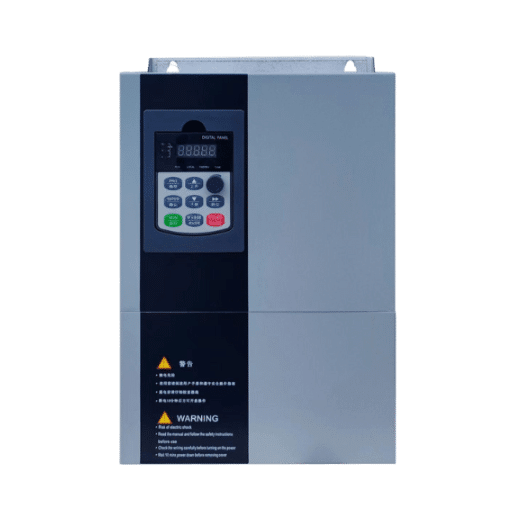
Ready to Get Your VFD Solution?
Whether you need a single drive or a complete system, we have the VFD products and engineering support to ensure your project's success.


A VFD for oil and gas applications controls motor speed to match production demand, cutting energy consumption 25-35% on pump-jacks and enabling precise flow control for electrical submersible pumps and pipeline stations. Oil and gas production consumes roughly 2-4% of global primary energy, and much of that goes to rotating equipment that runs at fixed speed regardless of actual demand.
In 2024, a production engineer in the Permian Basin was reviewing the oilfield’s electricity bills when one figure caught his eye: 40 pumping units running at full speed consumed $560,000 in electricity annually, while well production had decreased by $30.38 million. Furthermore, the number of sucker rod pump failures, requiring weekly maintenance, had decreased by nearly half. The $180,000 in annual electricity savings recouped the entire investment in the variable frequency drive in just 14 months.
This guide covers what makes oil field VFD applications different from standard industrial use, including explosion-proof requirements, long-distance motor cable challenges, and the cyclical torque profiles of beam pumps. Whether you are evaluating pump-jack retrofits, ESP installations, or pipeline pump station upgrades, the sections below provide the technical foundation to make the right specification decisions. For a broader overview of VFD uses across all industries, see our complete guide to VFD applications.
Key Takeaways
- Pump-jack VFD retrofits save 25-35% electricity by matching motor speed to well production rate
- Electrical submersible pumps (ESPs) require VFDs for soft start and variable flow control in deep wells
- Pipeline pump stations use VFDs for pressure/flow coordination, reducing energy use 20-30%
- Oil field VFDs must meet explosion-proof standards (ATEX/IECEx Zone 1/2) and harsh environment specifications
- Long motor cable runs (500m-2km) require sine wave filters or dV/dt filters to protect motor insulation
- Cyclical torque loads on beam pumps require vector control with torque compensation settings

Oil and gas production environments impose requirements that standard industrial VFD installations rarely encounter. Understanding these differences is essential before specifying equipment for any upstream, midstream, or downstream application.
Oil field equipment operates where flammable gases may be present. A VFD for oil and gas installations must carry appropriate hazardous area certification. The ATEX Directive 2014/34/EU and IECEx scheme define equipment suitability for explosive atmospheres. Zones are classified by risk level:
Temperature classifications (T1 through T6) limit maximum surface temperature. T6-rated equipment stays below 85C, while T4 allows up to 135C. Most oil field VFDs are T4-rated. The certification adds cost: explosion-proof VFDs typically cost 2-4 times more than standard industrial equivalents. However, using standard VFDs in Zone 1 locations violates safety regulations and creates liability exposure.
Beyond explosion risk, oil field VFDs face environmental stress that standard drives cannot handle. Ambient temperatures range from -40C in arctic fields to +55C in desert operations. IP54 is the minimum enclosure rating, with IP66 preferred for dusty or wet locations. Offshore platforms add salt fog corrosion requirements per IEC 60068-2-11. Vibration resistance matters too: beam pump installations experience continuous mechanical vibration that can loosen connections in poorly designed equipment. These harsh environment requirements are similar to those in VFD for mining industry applications, where dust, heat, and heavy vibration are equally demanding.
Standard VFD installations place the drive within 50-100 meters of the motor. Oil field applications routinely exceed this. Pump-jack motors may sit 500-2,000 meters from the VFD cabinet. At these distances, voltage reflection creates dV/dt spikes at the motor terminals that can destroy insulation.
The solution is a sine wave filter or dV/dt reactor installed at the VFD output. Sine wave filters reconstruct a near-sinusoidal voltage waveform, eliminating spikes. dV/dt reactors are simpler and cheaper but only slow the voltage rise rather than eliminating it. For cable runs over 1,000 meters, sine wave filters are the safer choice. Cable sizing must also account for voltage drop: a 480V system with 1,000 meters of cable may see a 20-40V drop, requiring a larger conductor size than the motor’s full-load current alone would suggest.
Upstream oil field VFD applications include wellhead equipment, artificial lift systems, and gathering facilities. This is where a VFD for oil and gas delivers the strongest and most quantified energy savings. The U.S. Department of Energy estimates that variable speed drives can reduce pumping energy consumption 20-40% in oil field applications.
Beam pumps are the most common artificial lift method worldwide, and they are also the most energy-inefficient when operated at fixed speed. The crank mechanism creates a highly cyclical torque profile: peak torque reaches 150-200% of average torque at specific crank angles. A fixed-speed motor must be sized for this peak, meaning it runs underloaded for most of the rotation cycle.
A VFD for pump jack applications solves this by matching motor speed to the well’s production capacity. This is the most common VFD for oil and gas retrofit because beam pumps outnumber all other artificial lift types combined. When reservoir pressure declines and the well produces less fluid, the VFD reduces speed rather than letting the pump cycle against a closed valve or run partially empty. Energy savings of 25-35% are typical. The soft-start capability also eliminates the mechanical shock of across-the-line starting, which is a major cause of rod breakage and gearbox wear.
Vector control is essential for beam pump applications. Standard V/F control cannot respond quickly enough to the cyclical torque variations. Sensorless vector control with torque compensation settings maintains stable speed through the torque peaks and valleys. Anti-reverse functionality prevents the pump from spinning backward when the rod string unloads, which can unscrew downhole connections.
Electrical submersible pumps are the most common VFD downhole pump type, operating in deep wells sometimes 1,000-3,000 meters below surface. The motor and pump are a single unit suspended on production tubing, with power supplied through a dedicated cable alongside the tubing. ESP power ratings range from 50 kW to 2,000 kW.
Starting a large ESP across-the-line creates severe problems. The inrush current causes voltage sag across the field’s electrical distribution system. The mechanical shock of instant full-speed rotation damages pump stages and thrust bearings. The cable itself experiences thermal and mechanical stress. For these reasons, ESPs almost always require VFDs for soft start.
Beyond soft start, VFD control enables speed adjustment as reservoir conditions change. When a well initially comes online, reservoir pressure is high and the ESP may need to run at 50-60 Hz. As the reservoir depletes, the same pump running at full speed may draw down the well too aggressively, causing gas lock or pump-off conditions. The VFD allows gradual speed reduction to maintain stable production. For ESP applications, our guide on how to size a VFD for your motor covers the specific overload and cable derating requirements.
Progressive cavity pumps are positive displacement pumps used for heavy oil production where viscosity exceeds what centrifugal pumps can handle efficiently. The rotor turns inside an elastomer stator, creating a progressive cavity that moves fluid upward.
VFD control provides two critical benefits for PCP applications. First, precise speed control matches pump displacement to well inflow rate, preventing pump-off and gas locking. Second, torque limiting protects the stator from damage if the pump encounters solids or high-viscosity slugs. Without torque limiting, a stalled PCP can generate enough torque to tear the stator from its housing. Backspin protection is also important: when the pump stops, fluid column weight can spin the drive string backward at dangerous speeds. The VFD can apply controlled braking to manage backspin.

Midstream operations move crude oil and natural gas from production fields to refineries and processing plants. Pipeline pump stations are the primary VFD for oil and gas application in this sector.
Long-distance pipelines use multiple pump stations spaced along the route to maintain flow and pressure. A typical crude oil pipeline might have stations every 50-100 kilometers, each with one or more pumps rated from 1,000 kW to 5,000 kW. Traditionally, these pumps run at fixed speed with a control valve throttling excess flow.
This arrangement wastes enormous energy. The pump produces full head and flow, then the control valve artificially restricts it. A VFD pipeline pump station eliminates this waste by running the pump at exactly the speed needed to maintain the desired flow rate and discharge pressure. This is one of the highest-ROI VFD for oil and gas applications because the energy waste from throttle control is immediate and continuous. Energy savings of 20-30% are typical compared to throttle control.
Multi-station coordination adds another layer of optimization for any VFD for oil and gas pipeline system. When multiple VFD-controlled stations operate along a pipeline, a SCADA system can coordinate their setpoints to minimize total energy consumption while maintaining pressure within operational limits. During periods of reduced throughput, downstream stations can reduce speed rather than running at full capacity and throttling. For large pipeline applications, high voltage VFD systems in the 3.3kV-6.6kV range are typically required.
Tank farms and loading terminals use smaller pumps for transfer, blending, and loading operations. While individual pump power is lower (typically 10-200 kW), the number of pumps makes the cumulative energy significant. VFD control enables level-based speed adjustment: as a tank fills, the transfer pump gradually slows to prevent turbulence and splashing. Loading pumps can ramp speed to match tanker truck or rail car capacity, reducing recirculation through overflow lines. These fluid-handling principles are similar to those in VFD in water treatment applications, where level and flow control are equally critical.
Downstream operations refine crude oil and process natural gas. While VFD for oil and gas downstream applications are more conventional than upstream, the scale and reliability requirements are equally demanding.
Refineries and petrochemical plants use large cooling tower fans, air-cooled heat exchangers, and process ventilation systems. Cooling tower fans are classic variable-torque loads where the affinity laws apply: a 20% reduction in speed yields nearly 50% reduction in power. A VFD for oil and gas cooling applications typically saves 30-40% energy compared to fixed-speed fans with damper control.
Process air compressors in refineries differ from the industrial air compressors covered in our VFD for compressors guide. Refinery process compressors handle hydrocarbon gases and require hermetically sealed motors and explosion-proof enclosures. The control principles are similar, but the mechanical and safety specifications are more stringent.
Refinery VFD for oil and gas applications include hundreds of pumps handling crude oil, intermediates, and finished products. Many of these pumps operate at partial load because they were oversized for future capacity expansion or because process conditions differ from design assumptions. VFD retrofits on refinery pumps save 15-25% energy while improving process control. In distillation columns, for example, reflux pump speed can be tied to column temperature or composition analyzers for tighter control than valve throttling provides.
Specifying the correct explosion-proof VFD for oil and gas applications requires understanding certification standards, enclosure types, and temperature classifications.
Three major certification systems govern explosion-proof electrical equipment. ATEX is mandatory in the European Union and widely accepted globally. IECEx is the international certification scheme based on IEC standards. In North America, the NEC and CEC use a Division-based system (Class I Division 1/2) rather than the Zone system, though Zone classification is increasingly adopted.
An explosion-proof VFD oil gas installation must carry certification from the relevant authority for the jurisdiction where it operates. Specifying the correct protection method is a critical step in any VFD for an oil and gas project. For global suppliers, dual ATEX/IECEx certification covers most markets. Equipment protection level (EPL) markings indicate suitability: Ga for Zone 0, Gb for Zone 1, Gc for Zone 2.
The protection method determines the enclosure construction. Ex d (flameproof) enclosures contain any internal explosion and cool escaping gases below ignition temperature. They are heavy, bolted castings that can withstand internal pressure. Ex e (increased safety) prevents arcs or sparks from occurring and limits surface temperatures. Ex p (pressurized) maintains positive internal air pressure to prevent gas ingress. Ex n (non-sparking) is a simplified standard for Zone 2 only.
For pump-jack VFDs in Zone 1, Ex d or Ex p are the most common choices. Ex d is mechanically robust but heavy. Ex p allows lighter enclosures but requires an air purge system. For Zone 2 tank farm applications, Ex n or Ex e may be sufficient at a lower cost.
The T-rating limits maximum surface temperature. T6 (85 °C) provides the highest safety margin but may require oversized enclosures or forced cooling to keep the VFD heat sink below the limit. T4 (135 °C) is more practical for most oil field VFDs. The VFD’s switching losses and heat dissipation must be calculated at worst-case ambient temperature to verify the surface temperature stays within the T-rating.

Properly sizing a VFD for oil and gas applications ensures reliable operation in demanding field conditions. The selection process differs from standard industrial use in several important ways.
Most pump-jack and ESP applications use low voltage VFD systems at 480V or 690V. Power ranges from 5 kW for small pump-jacks to 400 kW for large ESPs. Pipeline pump stations and large refinery pumps often require medium voltage drives at 3.3kV, 4.16kV, or 6.6kV, with power ratings from 500 kW to 5,000+ kW.
Oil field loads demand heavy-duty overload capacity. Beam pumps need 150-200% overload for 60 seconds to handle the torque peaks. ESP starting requires 150% current for 30-60 seconds during acceleration. Specifying a standard-duty VFD rated for 110% overload will result in nuisance tripping and premature failure.
Remote well sites often operate unmanned, so a VFD for oil and gas must integrate with the field SCADA system via Modbus, DNP3, or proprietary protocols. Pressure transducers at the wellhead provide feedback for closed-loop control: the VFD adjusts pump speed to maintain constant bottom-hole pressure or constant production rate. For wells with declining production, the setpoint can be programmed to step down automatically over time.
Theory is valuable, but real-world results prove the case. These three examples, drawn from Society of Petroleum Engineers field studies and industry reports, show how VFDs solve specific challenges across different oil and gas applications.
A field operator in West Texas managed 40 beam pumps ranging from 15 kW to 45 kW. The field had been in production for eight years, and reservoir pressure decline meant the pumps were producing 30% below their nameplate capacity. Yet every motor ran at full speed, with pump-off controllers cycling the wells on and off to prevent fluid pound.
The operator retrofitted all 40 units with VFDs and vector control as part of a comprehensive VFD for oil and gas field upgrade. Each VFD was programmed with a minimum speed of 25 Hz to maintain rod string motion, and a maximum of 60 Hz for high-production wells. The pump-off controllers were reconfigured to send a 4-20 mA signal to the VFD speed reference rather than cycling the motor contactor.
Energy consumption dropped 32%, saving 180,000annuallyat180,000annuallyat0.10/kWh. More surprisingly, rod pump failures fell 45%. The soft acceleration and controlled reversal at the top and bottom of each stroke eliminated the shock loading that had been damaging rods and couplings. Gearbox overhauls, previously required every 18 months, were extended to 30-month intervals. The total VFD investment of $210,000 was recovered in 14 months through electricity savings alone.
An offshore platform in the North Sea operated a 1,500 kW electrical submersible pump at a depth of 1,200 meters. The ESP had been installed with an across-the-line starter because the original design assumed a constant production rate. When reservoir pressure declined after four years of production, the fixed-speed pump began drawing down the well too aggressively. Gas lock episodes increased from one per month to several per week. Each gas lock required a shutdown and restart, stressing the cable and motor.
Replacing the starter with a medium voltage VFD enabled variable speed operation from 15 Hz to 60 Hz. As reservoir pressure declined, operators reduced speed in 2 Hz increments, matching pump capacity to inflow. The soft-start capability eliminated the voltage sag that had been dimming platform lights during every ESP start. Cable failures, previously averaging two per year, dropped to zero in the first 18 months after VFD installation. ESP run life extended from 18 months to 28 months, saving $450,000 per replacement.Atoffshoreelectricityratesof450,000perreplacement.At offshore electricity rates of 0.25/kWh, the 20% energy reduction also saved $650,000 annually.
An 800-kilometer crude oil pipeline crossing Siberia operated three main pump stations, each with two 2,500 kW pumps running in parallel. The pipeline capacity was designed for 500,000 barrels per day, but actual throughput had declined to 350,000 barrels as nearby fields matured. The pumps ran at full speed with control valves throttling 30% of the flow back through recirculation lines.
Installing medium voltage VFDs on one pump at each station transformed the operation. A SCADA-based coordination system adjusted each station’s speed setpoint to maintain 20 bar discharge pressure while minimizing total power consumption. The lead pump at each station ran on VFD speed control, while the lag pump remained as fixed-speed backup.
Energy consumption fell 24%, equivalent to $2.1 million annually at local industrial electricity rates. The elimination of recirculation also reduced heating requirements: less energy wasted in the pumps meant less heat to dissipate, which matters when winter temperatures reach -40C. Mechanical seal life on the VFD-controlled pumps improved because they no longer ran at full pressure against a closed valve during low-flow periods.
Contact our oil and gas application engineering team → to discuss VFD specifications for pump-jack, ESP, or pipeline applications.
Yes, but they must carry the appropriate explosion-proof certification. ATEX or IECEx certified VFDs in flameproof (Ex d) or pressurized (Ex p) enclosures are standard for Zone 1 oil field applications. Zone 2 areas may use Ex n or Ex e VFDs at a lower cost. Standard industrial VFDs without hazardous area certification cannot be installed where flammable gases may be present.
Pump-jack VFD retrofits typically save 25-35% electricity. The savings come from three sources: eliminating energy waste when well production declines below pump capacity, reducing peak demand charges through soft start, and improving motor efficiency at partial load. Wells with high water cut or significant production decline deliver the strongest ROI.
Standard VFDs can drive motors up to approximately 100 meters without issues. For oil field distances of 500-2,000 meters, a sine wave filter or dV/dt filter is required to protect motor insulation from voltage reflection. Sine wave filters are recommended for cable runs over 1,000 meters. Cable sizing must also account for voltage drop over long distances.
Yes, and ESPs almost always require VFDs for soft start. Starting a large ESP across-the-line creates voltage sags and mechanical stress that damages the pump, motor, and cable. VFDs allow controlled acceleration and enable speed adjustment as reservoir conditions change. Most ESP installations would not be economically viable without VFD control.
Explosion-proof VFDs have certified enclosures that prevent any internal ignition and prevent it from igniting the surrounding atmosphere. They carry ATEX/IECEx markings, have restricted maximum surface temperatures, and cost 2-4 times more than standard industrial VFDs. Standard VFDs cannot be used in Zone 0 or Zone 1 hazardous areas.
Generally no. Each pump-jack has a unique well profile and requires individual speed control. However, in rare cases where multiple identical wells have matched production rates, a single larger VFD with contactor switching can service 2-3 pumps (not simultaneously). The more common and cost-effective approach is one VFD per pump-jack.
A VFD for oil and gas applications delivers value through energy savings, equipment protection, and production optimization. The 25-35% electricity savings on pump-jacks make VFD retrofits one of the fastest-payback investments in upstream production. Electrical submersible pumps rely on VFD soft-start to protect downhole equipment and extend run life. Pipeline pump stations use multi-station coordination to eliminate the energy waste of throttle control.
The key differentiators for oil field VFD selection are explosion-proof certification, long-distance motor cable protection, and vector control tuned for cyclical torque loads. These requirements add complexity and cost compared to standard industrial applications, but the energy savings and reliability improvements justify the investment across virtually all oil and gas rotating equipment.
If you are evaluating a VFD for oil and gas production, the right approach starts with understanding your well profile, pipeline configuration, and hazardous area classification. Every successful VFD for oil and gas installation begins with a clear understanding of the specific application requirements. Our engineering team has supported VFD installations across pump-jack fields, offshore platforms, and pipeline systems worldwide.
Contact our oil and gas application engineering team → for explosion-proof VFD specifications, long-cable system design, and multi-station coordination strategies tailored to your specific requirements.