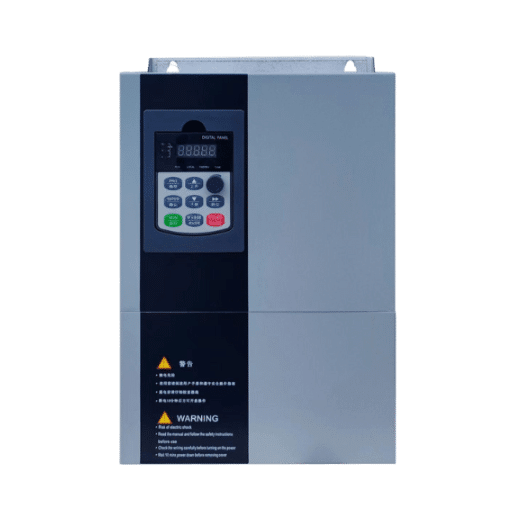
Ready to Get Your VFD Solution?
Whether you need a single drive or a complete system, we have the VFD products and engineering support to ensure your project's success.

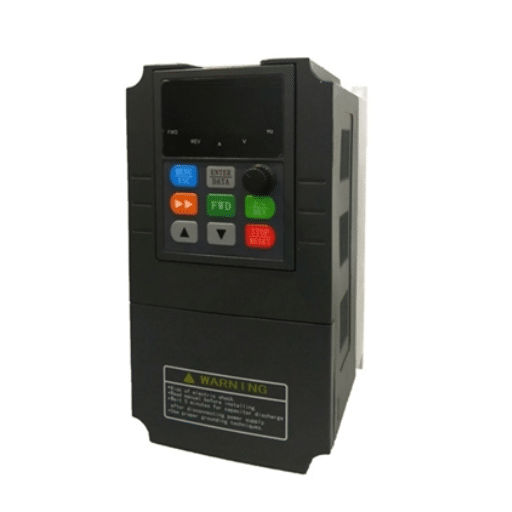
The best VFD for 3 phase motor control depends on your application, budget, and performance needs. For heavy industry, the ABB ACS880 or Siemens SINAMICS G120 deliver precision and reliability. For most factory and HVAC applications, the Delta MS300 or Inovance MD Series offer the best value. For hobbyists and small shops, a quality Hitachi WJ200 or KB Electronics drive gets the job done for under $250.
Here is the truth most manufacturer blogs will not tell you: the most expensive drive is not always the right drive. A 2,000ABBunitrunningaworkshopfanisoverkill.A2,000ABBunitrunningaworkshopfanisoverkill.A90 generic drive on a 10 HP compressor is a fire hazard waiting to happen. The best VFD for 3 phase motor control is the one that matches your motor’s full load amps, your load type, and your environment — not the one with the flashiest brochure.
You already know VFDs cut energy costs and extend motor life. What you need is an honest breakdown of which drive to buy, why, and what you should actually budget. This guide compares real VFD brands and model families across three price tiers. You will learn how to size by current instead of horsepower, when vector control matters, and how to avoid the most common buying mistakes that cost buyers thousands in failed drives and damaged motors.
Key Takeaways
- Size by FLA, not horsepower: Motor horsepower ratings mislead; full load amps (FLA) is the only number that matters when matching a VFD.
- Premium tier ($800+): ABB ACS880 and Siemens SINAMICS G120 dominate for heavy industry, smart factories, and energy management.
- Mid-range (150−150−800): Delta MS300 and Inovance MD Series offer the best balance of features, reliability, and price for most industrial applications.
- Budget tier (50−50−250): Hitachi WJ200 and KB Electronics are proven choices for hobbyists, lathes, and light-duty machinery.
- Load type determines control mode: Variable torque (pumps, fans) needs V/F control. Constant torque (conveyors, compressors) needs sensorless vector control with 150% overload capacity.
For a deeper dive on single-phase input configurations, (see our guide to single phase vfd guide)

A selection framework should be established before brands and prices are compared. There is a mistake commonly committed by a large number of buyers resulting from the sequence in which they proceed. They choose first the brand and then try to squeeze it into the totality of purpose. True sequence: motor specs first, application second, budget third.
Motor nameplates list horsepower, but that number does not tell you what VFD current rating you need. The critical number is full load amps (FLA). Your VFD’s output current rating must meet or exceed your motor’s FLA.
For variable torque loads like pumps and fans, size the VFD current at 120% of motor FLA. For constant torque loads like conveyors and compressors, size at 150% of motor FLA to handle startup torque and overload events.
Need help sizing a VFD correctly? Our VFD sizing guide walks you through FLA matching, load-type derating, and the single-phase input 2x rule.
Voltage matching is equally critical. A 380V VFD feeding a 220V motor will underflux the motor and overheat it. A 220V VFD on a 380V motor will not produce enough torque. Match supply voltage, VFD voltage rating, and motor voltage exactly.
Load type determines control method, overload requirements, and whether you need a braking resistor.
Variable torque loads — centrifugal pumps, fans, blowers — need less starting torque and run at reduced load at lower speeds. V/F control is usually sufficient. Overload capacity of 120% for 1 minute is adequate.
Constant torque loads — conveyors, mixers, hoists, compressors — need full torque even at low speeds. These require sensorless vector control (SVC) and 150% overload capacity for 1 minute. Without vector control, the motor will stall under load.
V/F control is the simplest and oldest one. The VFD keeps a fixed frequency to voltage ratio. It results in a good design for pump and fan drives and simple speed control applications requiring low to moderate torque.
Sensorless vector control uses the motor flux and estimates torque perhaps without an encoder. It will give the motor a starting torque of 150% and the capability to give the speed holding mechanism. This is useful for conveyors, machine tools, and any application that has large changes of load suddenly.
In closed-loop vector control, otherwise called field-oriented control (FOC), an encoder is placed on the motor shaft. It is used to achieve high precision in position and speed control in CNC spindles, winding applications, and high-performance machinery. In 90% of industrial applications, unless you are moving to a very high-performance machine or position application, SVC is sufficient.
New-age VFDs are packed with Modbus RTU RS485 onboard, ready for PLC and SCADA integration. For good measure, see if there are Ethernet options on offer like PROFINET, EtherNet/IP, EtherCAT, or Modbus TCP. Meanwhile, those among us aiming at a smart factory or a business model inspired by Industry 4.0 shall prefer to enjoy IoT connectivity and cloud management in their dependent drives.
Instead of IP20 drives, fancy IP55 drives should be preferably installed in clean electric enclosures. They can even handle dust and water jets from outdoors in a harsh industrial environment. In applications from an altitude of 1000 meters or at 40 degrees Celsius and beyond, you need to consider derating of the VFD current rating by 10-15%.
Budget class drives (50-50-250) generally come with one-year warranties, phone support being very limited. Mid-range drives (150-150-800) feature two-year warranties and regional service networks. The top range drives ($800 and up) usually come in 3- to 5-year guarantees, incorporated global services, and an application engineering support. Pertaining to a big product line, the cost of a single unplanned maintenance event exceeds the price difference between a budget drive and a mid-range.
If you are specifically looking to add speed control to an existing single-phase motor rather than replace it, see our dedicated guide on the VFD for single phase motor application, including which motor types are compatible and which are not.
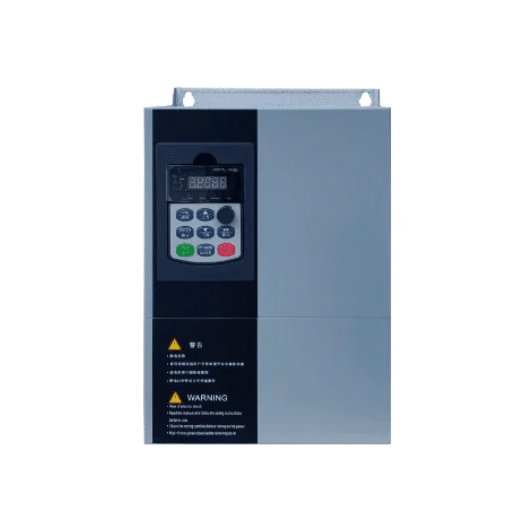
These drives are built for mission-critical applications where failure costs more than the drive itself. They offer advanced diagnostics, predictive maintenance, regenerative braking, and deep integration with industrial automation networks.
| Brand | Series | Best For | Key Feature | Price Range |
|---|---|---|---|---|
| ABB | ACS880 / ACS580 | Heavy industry, energy management | Direct Torque Control (DTC), 98%+ efficiency, predictive maintenance | 800−800−4,000+ |
| Siemens | SINAMICS G120 | Smart factories, process automation | Modular design, PROFINET, integrated Safe Torque Off (STO) | 700−700−3,500+ |
| Schneider Electric | Altivar Process | Water/wastewater, harsh environments | Real-time energy monitoring, digital twin ready, ruggedized | 600−600−3,000+ |
| Yaskawa | GA800 | Manufacturing, automation integration | Built-in 24VDC aux supply, fast networking, motion control heritage | 700−700−3,500+ |
| Rockwell | PowerFlex 755 | Integrated Allen-Bradley systems | TotalFORCE technology, predictive maintenance, Logix integration | 900−900−4,500+ |
When to buy premium: You are running a 24/7 production line, need regenerative energy feedback, require safety-certified STO functionality, or need global parts availability with same-day service response.
When Marcus took over maintenance at a food processing plant in Ohio, he inherited 14 conveyors running on direct-on-line starters. Motor failures happened every 4-6 months.
In March 2024, he replaced the starters with Siemens SINAMICS G120 drives. The soft-start capability cut mechanical stress on couplings and bearings. Motor maintenance intervals stretched to 14 months. Energy consumption dropped 28%. The drives paid for themselves in 11 months through energy savings and reduced maintenance labor.
This tier hits the sweet spot for most buyers. You get sensorless vector control, built-in PLC functions, industrial Ethernet options, and overload capacity that handles real factory conditions. These drives lack the predictive maintenance and global service networks of premium brands, but they perform the same core motor control tasks at a fraction of the cost.
| Brand | Series | Best For | Key Feature | Price Range |
|---|---|---|---|---|
| Delta | MS300 / C2000+ | OEM machinery, cost-sensitive projects | Compact, built-in PLC, 150% overload, brake chopper included | 200−200−600 |
| Inovance | MD / AC Series | Metal/plastic manufacturing, OEM | All-in-one PLC+Servo+VFD platform, modular I/O cards | 250−250−700 |
| Danfoss | VLT AQUA / FC | HVAC, pumps, space-constrained | Load-matching algorithms, compact footprint, strong energy pedigree | 300−300−800 |
| Mitsubishi | FR-F800 | HVAC, long-life building systems | Energy-saving algorithms for quadratic torque, durable design | 350−350−900 |
| Fuji Electric | FRENIC-Ace | General industrial, tight spaces | Robust performance, broad communication compatibility | 280−280−750 |
When to buy mid-range: You need reliable industrial performance without the premium price tag. You have in-house electrical staff who can handle commissioning and parameter setup. Your application is important but not so critical that 4 hours of downtime shuts down the plant.
Budget drives get a bad reputation because buyers misuse them. A quality Chinese OEM drive with CE certification, running within its rated current on a pump or fan, will last years. The problem arises when buyers install a $90 drive on a 10 HP compressor and wonder why it smokes in three months.
| Brand | Series | Best For | Key Feature | Price Range |
|---|---|---|---|---|
| Hitachi | WJ200 | Lathes, medium-duty machine tools | Easy keypad programming, reliable power electronics | 150−150−250 |
| KB Electronics | KBVF / KBAC | Hobby machinists, light-duty | USA-made, integrated NEMA 1 enclosure, straightforward | 180−180−300 |
| Teco | N3 / FM50 | General-purpose motor control | Simple operation, proven reliability, wide distribution | 100−100−200 |
| Quality OEM | XFC500-class | Basic pump/fan, single-motor | Sensorless vector, wide power range (0.75-450 kW), expandable I/O | 50−50−150 |
| HY Huanyang | Various | Hobby CNC, tight budgets | 220V single-phase input, basic V/F control | 80−80−180 |
When to buy budget: You are wiring a home shop lathe, running a small irrigation pump, or controlling a single fan. Your motor is under 5 HP. You do not need PLC integration, IoT monitoring, or predictive diagnostics.
You understand that support means forum posts and PDF manuals, not a phone number.
David runs a one-man machine shop in rural Kentucky. In 2023 he bought a used 2 HP Baldor motor for 60onCraigslistandpaireditwithaHitachiWJ200for60onCraigslistandpaireditwithaHitachiWJ200for190. Total cost: $250.
He wired the single-phase 220V input to the drive, connected the motor to the U/V/W output, and set the Volts/Hz curve to match the motor nameplate. The lathe now runs smoothly from 30 Hz to 150 Hz. Two years later, the drive still performs without a single fault. David’s setup cost less than a single premium VFD — and it does exactly what he needs.
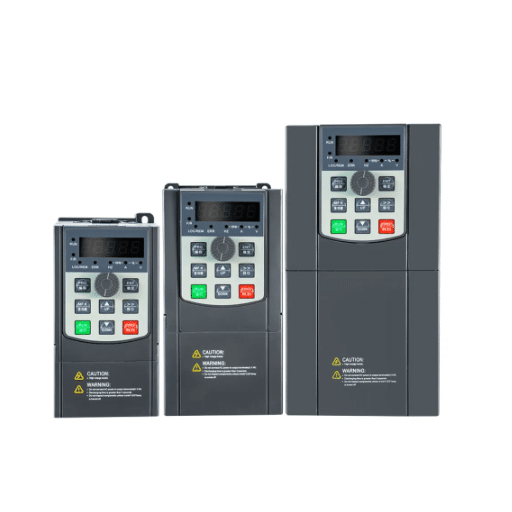
Pumps and fans are the easiest applications to spec. V/F control is sufficient. Energy-saving algorithms matter more than torque precision. You need a drive with built-in PID control if you are modulating pressure or flow.
Top picks: Danfoss VLT AQUA, Delta MS300, Mitsubishi FR-F800, Canroon CV900N
Control mode: V/F with energy optimization
Critical spec: Built-in PID function for closed-loop pressure/flow control
Braking resistor: Usually not needed unless fast deceleration is required
Conveyors need high starting torque. A fully loaded conveyor belt can demand 150% of rated torque at startup. Mixers see sudden load changes as material consistency shifts. These applications need sensorless vector control and robust overload capacity.
Top picks: Siemens SINAMICS G120, Schneider Altivar Process, Inovance MD Series, Delta C2000+
Control mode: Sensorless vector (SVC)
Critical spec: 150% overload for 60 seconds minimum
Braking resistor: Needed only for emergency stops or downhill conveyors
CNC spindles need precise speed holding under varying cutting loads. Positioning applications like tool changers need closed-loop control. Standard sensorless vector is adequate for most spindles; only high-end machining centers need closed-loop vector or servo drives.
Top picks: Yaskawa GA800, Siemens S120 (servo-integrated), Inovance servo+VFD platform
Control mode: Sensorless vector for most; closed-loop vector for positioning
Critical spec: Speed regulation accuracy of 0.5% or better
Braking resistor: Recommended for fast spindle deceleration
Hoists demand 150-200% starting torque and precise control at zero speed. You need a drive with torque proving, mechanical brake control logic, and regenerative braking or a braking resistor to handle overhauling loads.
Top picks: ABB ACS880, Yaskawa GA800, Schneider Altivar Process
Control mode: Closed-loop vector or direct torque control
Critical spec: Torque at zero speed, integrated brake control
Braking resistor: Required for all hoist and crane applications
The hobby machinist market is enormous and almost entirely ignored by industrial VFD manufacturers. Most hobbyists have 220V single-phase power in their garage and need to run a used 3-phase motor.
Top picks: Hitachi WJ200, KB Electronics, HY Huanyang (budget), quality OEM with 220V single-phase input
Control mode: V/F control is sufficient
Critical spec: Single-phase input rated for the motor’s 3-phase current (apply 2x derating rule)
Braking resistor: Optional for fast spindle stops
Wiring a single-phase input VFD? Our single phase VFD wiring guide covers terminal connections, wire sizing, grounding, and a pre-power safety checklist.
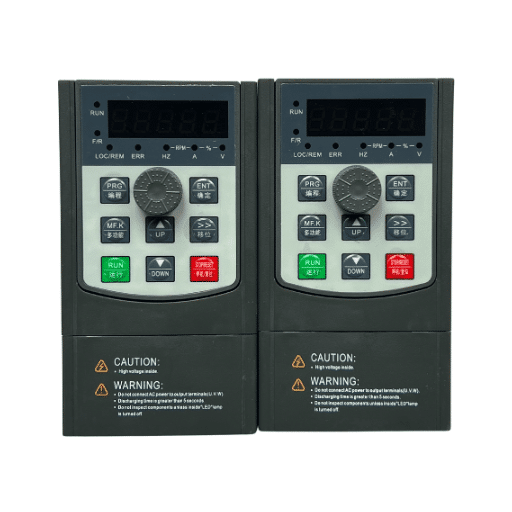
Here is the rule that will save you from the most common buying mistake: size by FLA, not horsepower.
A 5 HP motor might draw 15 amps at 230V or 7.5 amps at 460V. The horsepower number does not tell you the current. The VFD cares about current. Always use the motor nameplate FLA as your starting point.
| Motor Power | 230V FLA (approx) | 460V FLA (approx) | VFD Current Rating (Variable Torque) | VFD Current Rating (Constant Torque) |
|---|---|---|---|---|
| 1 HP / 0.75 kW | 4.8 A | 2.4 A | 5.5 A | 7.2 A |
| 2 HP / 1.5 kW | 7.5 A | 3.7 A | 9 A | 11 A |
| 3 HP / 2.2 kW | 10.5 A | 5.3 A | 12.5 A | 16 A |
| 5 HP / 3.7 kW | 15.5 A | 7.8 A | 18.5 A | 23 A |
| 7.5 HP / 5.5 kW | 22 A | 11 A | 26 A | 33 A |
| 10 HP / 7.5 kW | 28 A | 14 A | 33 A | 42 A |
| 15 HP / 11 kW | 42 A | 21 A | 50 A | 63 A |
| 20 HP / 15 kW | 54 A | 27 A | 65 A | 81 A |
Single-phase input derating: If you have single-phase 220 V power-fed 3-phase VFD, multiply its required current rating by two. However, a 2.2 kW motor that would normally feature a 4 kW VFD should preferably be equipped with higher current capacity, such as 5.5 kW or 7.5 kW VFD, when powered by single-phase input.
Most first-time buyers ignore braking resistors until their drive throws an overvoltage fault on deceleration. Here is the simple decision tree.
You NEED a braking resistor if:
You DO NOT need a braking resistor if:
For designing a braking resistor, one has to calculate the braking power and the duty cycle. Usually, there are online software programs offered by most of the manufacturers. As a thumb rule, the resistance value should be to the drive manufacturer’s spec, while the power rating should be valid for your application’s braking duty cycle.
Buying by horsepower alone. Motor horsepower is a mechanical output rating. VFDs are sized by electrical current. A 5 HP 230V motor draws twice the current of a 5 HP 460V motor. The same “5 HP” label means two completely different VFD sizes.
Choosing V/F control for a high-torque application. A conveyor loaded with gravel needs 150% starting torque. V/F control might deliver 110%. The motor stalls, overheats, and fails. Vector control costs nothing extra on most modern drives — use it when torque matters.
Ignoring the IP rating. An IP20 drive mounted in a dusty grain mill will fail in months. Either install it in a sealed enclosure with filtered ventilation or buy an IP55 drive rated for the environment.
Skipping the line reactor. If your supply transformer is more than 10 times the VFD kVA rating, or if multiple drives share a bus, install a 3% line reactor or DC choke. This reduces harmonic distortion, protects the drive rectifier, and prevents nuisance tripping.
Buying unbranded drives for critical applications. A no-name VFD from an e-commerce marketplace might work fine for a shop fan. When it drives the main feed conveyor in your production line, you are gambling with uptime. For critical applications, buy from manufacturers with traceable quality control and replaceable parts.
In 2024, a packaging plant in Michigan purchased six generic VFDs for $95 apiece to revamp their bottle conveyors. After eight months, three have proven defective, two from an overload capacity that was too weak and the other from a rectifier having been damaged by voltage spikes.
The survivor siblings were replaced with Delta MS300 drives by the Maintenance Manager, Jennifer, in an investment totaling $320 each. These drives are still running 18 months later without any issues. While Jennifer would consider an accumulated number of 320 in “savings”, the twin drives bought for $1,350 ended up costing her $2,800 in replacement drives, overtime labor, and lost production.
The best VFD is dependant upon your application and budget. Talking about performance and reliability, for heavy industry the ABB ACS880 and Siemens SINAMICS G120 are considered to be the best. However in most factory applications, the Delta MS300 and Inovance MD Series will give the best bang for the buck. But don’t forget that for the hobbyist and the small shop, there is always the Hitachi WJ200 or the KB Electronics.
No. The VFD must match your motor’s voltage and current rating. You also need the right control mode — V/F control for pumps and fans, sensorless vector control for conveyors and compressors. Using the wrong control mode or undersizing the drive will damage the motor or the VFD.
Follow these steps: match voltage and FLA, assign the load type (variable or constant torque), choose the proper mode, set the communicator, assess environmental and IP location factors, and reasonably simply budget for system support (jos) and warranty value.
A 5 HP motor, which consumes around 15.5 FLA at 230V, is likely good enough for the job. In the case of a pump or fan- the horse power for torque application- you need to size a VFD at 18.5 amps minimum rating. In the case of a conveyor-a constant torque application- the VFD must be sized for 23 amps plus 150% overloading. Multiply the size of the VFD if inputting single-phase 220V.
Vector control provides precise torque and speed control, especially at low speeds. It is better for applications with high starting torque, sudden load changes, or precise speed requirements. V/F control is simpler, cheaper, and perfectly adequate for pumps, fans, and basic speed control where torque demands are modest.
You need a braking resistor if your application requires fast deceleration, has high inertia, or overhauls (like a crane lowering a load). You do not need one for standard pumps and fans that coast to a stop over 10-30 seconds.
Budget VFDs for hobby and light-duty use range from 50to50to250. Mid-range industrial drives cost 150to150to800. Premium drives for mission-critical applications range from 800to800to5,000 or more. The right price depends on your motor size, application demands, and uptime requirements.
Yes, if improperly sized or configured. An undersized VFD will overcurrent and fail. Incorrect Volts/Hz settings can overflux or underflux the motor, causing overheating. Using V/F control on a high-torque application can cause stall and burnout. Proper sizing, correct parameter entry, and appropriate control mode selection prevent damage.
The best VFD for 3 phase motor control is not a single brand or model. It is the drive that matches your motor’s electrical specs, your application’s torque demands, and your budget realities. A 180HitachiWJ200runningahomeshoplatheistherightchoice.Soisa180HitachiWJ200runningahomeshoplatheistherightchoice.Soisa3,000 Siemens SINAMICS G120 running a smart factory conveyor line. Both are “best” — for their specific contexts.
What matters is following the right selection process. Size by FLA, not horsepower. Match control mode to load type. Respect your environment with the right IP rating. And buy from a manufacturer who will still exist when you need a replacement part in five years.
At Shandong Electric, we supply VFDs across the full spectrum — from compact low-voltage drives for workshop machines to high-power systems for heavy industry. More importantly, we provide the engineering support to help you select, size, wire, and commission the right drive for your application. If you are evaluating VFDs for a 3-phase motor and need application-specific guidance, browse our VFD product range or contact our engineering team. We will help you buy once and buy right.