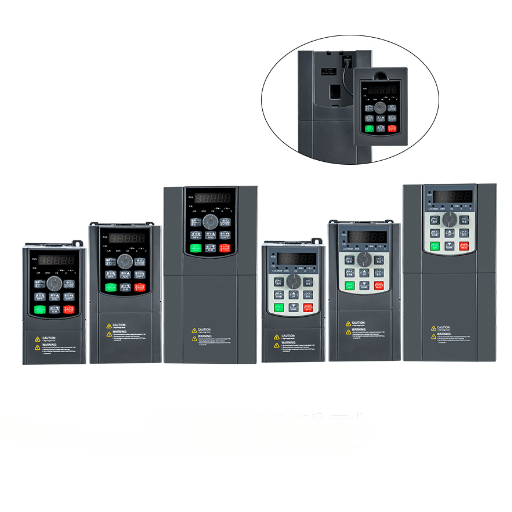
Ready to Get Your VFD Solution?
Whether you need a single drive or a complete system, we have the VFD products and engineering support to ensure your project's success.


To install the Variable Frequency Drive (VFD) in the correct size for a motor, match the drive’s continuous output current to the motor’s Full Load Amps (FLA); determine the load type (constant torque, variable torque, or constant horsepower); and apply additional derating factors due to varying environmental and application specifications. Staring on the horsepower or kilowatts ratings alone is not sufficient. Most users that assign horsepower directly to horsepower are overly surprised at drive trips on startup or costs some 30% more than necessary.
VFDs are better known for reducing energy consumption and improving process control. But what many do not realize is that the main reason for new drive installations to be delayed is the size selection. An oversized VFD waste capital and deteriorates motor insulation over time. An overly small one trips on the overcurrent, overheats, or simply will not engage the load.
In this guide, follows a 5-step procedure which you can follow to choose the motor drive consistently. We will acquaint you with the nomenclature on a motor nameplate, how to determine load types, take cognizance of de-rating factors,deliver correct connection methods,and How to Size a VFD for Motor Epoch-making numbers have been provided for each step which must be put into use. This sizing guide can be seen used in choosing the right drive size for a production line or even in the case of a single-engine modification.
Key Takeaways
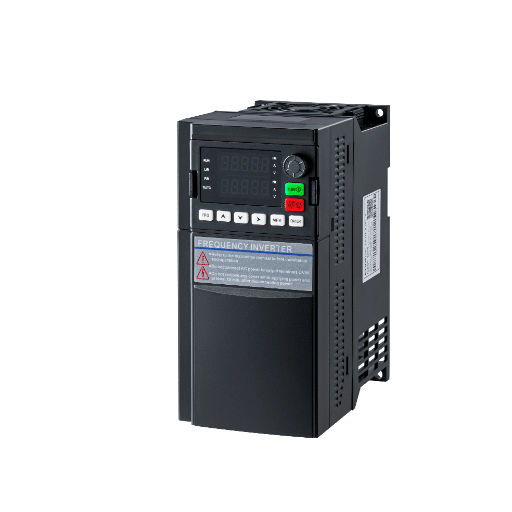
The main aim of designing a VFD layout between engine and load is to identify an efficient driver that makes sure that the current in the load exerts the operational parameters under the demands of the motor. The horsepower pertains to the mechanical output rating while it is the current that the drive actually provides to drive it.
Wherever the load characteristics, starting torque, or environmental conditions deviate from normal, the horsepower matching fails.
Most VFD manufacturers rate their drives in kilowatts and amps. The kW-rated one takes for granted standard, continuous-duty, three-phase operation at rated voltage and frequency.
Very few actual installations can strictly manage to satisfy all these assumptions. A 7.5 kW motor turning a high-inertia conveyor may draw much higher current during acceleration than a 7.5 kW motor turning a centrifugal pump. Again, the conveyor application, if sized by kW alone, will actually trip-fault.
The motor nameplate Full Load Amps (FLA) under the motor’s rated voltage and frequency. The VFD nameplate interprets both input current and output current. Concerning motor compatibility, it is characterized by output current that matters the most. Input current, on the other hand, varies with your incoming supply voltage, power factor, and harmonics.
The current of the input and output of a three-phase system is commonly near identical. The story changes the moment you switch to a single phase. That is, to some extent, a three-phase input VFD running on a single phase will take practically twice the input current per phase to deliver the same output power.
This is the reason for the 2× derating rule. Ignoring input current on single-phase supply generally paves the way for undersized conductors, fuses, and sometimes the drive apparatus itself.
Before you select any drive, record these values from the motor nameplate:
The FLA and service factor are the two most critical numbers for VFD sizing. Everything else determines compatibility, but current determines capacity.
Load type needs to be determined first while selecting an electric motor drive system. It determines how torque demand varies with speed, affecting how much current the motor draws at a given time and thus what overload capacity the VFD needs. There are three fundamental loading types in industrial applications.
Constant-torque loads are those which demand same amount of torque, regardless of the speed. Increase in speed results in increased power consumption in linear proportions. Examples of these are conveyors, cranes, crushers, running at a constant speed and positive displacement pumps.
These are a demanding applications for a VFD, as they require the highest amount of continuous power. At low speeds, the motor needs maximum torque, requiring maximum current still. The drive has to be properly sized to provide this amount of current continuously.
Many constant-torque applications further require high starting torque. Depending upon the load, the full torque cannot be less than 150% of the motor’s torque rating to get the conveyor moving. In some cases, select a drive with an overload capacity larger than the motor’s.
Variable torque loads require torque that changes with the square of speed, and power that changes with the cube of speed. Centrifugal pumps, fans, and blowers are the classic examples. At half speed, these loads need only 25% of rated torque and 12.5% of rated power.
This is why VFDs deliver such dramatic energy savings in pump and fan applications. According to the U. S. Department of Energy, VFDs can reduce energy consumption by 20–50% in these applications.
For VFD sizing, variable torque loads are forgiving. You can typically size the drive to match the motor’s base current without additional overhead, provided the starting torque requirement is modest.
Constant horsepower loads require torque that decreases as speed increases, keeping mechanical power roughly constant. Lathes, winders, and some machine tools fall into this category. At low speed, these loads need very high torque.
VFD sizing for constant horsepower loads demands careful attention to the base speed and field-weakening range. The drive must deliver high current at low frequencies, which tests both the drive’s overload capacity and the motor’s cooling capability. If the motor relies on a shaft-mounted fan, low-speed operation can cause overheating unless auxiliary cooling is added.
| Load Type | Torque vs. Speed | Power vs. Speed | Typical Applications | Sizing Priority |
|---|---|---|---|---|
| Constant Torque | Flat | Linear | Conveyors, hoists, crushers | Current + overload capacity |
| Variable Torque | Square of speed | Cube of speed | Pumps, fans, blowers | Base current match |
| Constant Horsepower | Inverse of speed | Flat | Lathes, winders | Low-speed torque + cooling |
Once you know your load type, the next step in any VFD sizing guide is current matching. The VFD’s rated output current must equal or exceed the motor’s FLA under the most demanding operating condition.
Not the average. Not the typical. The worst-case continuous demand.
Motor FLA is stamped on the nameplate and represents the current the motor draws at rated voltage, frequency, and load. If your motor has a service factor of 1.15, it can safely operate at 115% of rated load continuously. That means the actual maximum continuous current could be up to 15% higher than the nameplate FLA.
For conservative motor drive selection, size the VFD to handle at least 115% of motor FLA. This gives you headroom for voltage fluctuations, minor overloads, and measurement tolerance. If the motor service factor is 1.0, you can size closer to nameplate FLA, but a 10% margin is still good engineering practice.
Many industrial motors carry a 1.15 service factor. This is not a bonus for oversized drives. It is a safety margin built into the motor for temporary overloads.
When pairing a VFD, you have two choices. First, size the VFD for the motor’s base FLA and rely on the VFD’s overload protection to limit current to 100% during normal operation. Second, size the VFD for 115% of FLA and allow the system to use the full service factor continuously.
Option 2 is generally preferred for industrial applications where load variations are normal. It prevents nuisance tripping and extends drive life by reducing thermal stress.
When Marcus, a maintenance engineer at a packaging plant in Shenzhen, installed a 5.5 kW VFD on a conveyor motor, he matched horsepower one-to-one and ignored the 1.15 service factor. Two weeks later, the drive began tripping on overcurrent during morning startup when the conveyor was fully loaded.
After upgrading to a drive rated for the motor’s service factor current and enabling torque boost, the system started reliably every time. The upgrade cost 12% more upfront. It eliminated an hour of downtime every week.
There are several situations where current, not power, must drive your VFD selection:
After matching current, apply adjustments for the specific demands of your application. These adjustments separate a drive that works on paper from one that works in the field.
Some loads need more torque to start than to run. Crushers, ball mills, and loaded conveyors are notorious for this. Standard VFDs are rated for 110% overload for 60 seconds. High-torque applications may need 150% overload for 60 seconds, or 200% for a shorter burst.
If your application needs more starting torque than the standard overload class provides, you have three options:

A common and practical question in VFD selection is how to run a three-phase motor from a single-phase supply. The standard approach is to use a three-phase input VFD and connect it to a single-phase source, then derate appropriately.
The rule of thumb is simple but critical: derate the VFD by 50%. A 7.5 kW three-phase input VFD fed by single-phase power can reliably drive a motor up to approximately 3.7–4 kW. This is because the single-phase supply must deliver all input power through two lines instead of three, effectively doubling the current per conductor. The drive’s internal rectifier and DC bus must also handle higher ripple current.
For a deeper dive on single-phase input configurations, see our guide to single phase vfd guide
Loads with high inertia, large flywheels, centrifuges, or heavy rotating masses, require longer acceleration times. If you demand rapid acceleration, the VFD must deliver high torque for an extended period. This increases the effective thermal load on the drive.
The solution is usually to extend the acceleration ramp time in the VFD parameters. If process constraints prevent this, you will need a larger drive or an external braking resistor to dissipate regenerated energy during deceleration.
A VFD rated for 7.5 kW at 25°C and sea level is not a 7.5 kW drive at 45°C and 2,000 meters altitude. Environmental conditions reduce output capacity.
Ignoring this reality is a fast path to premature drive failure.
Most low-voltage VFDs are rated for full output current up to 40°C ambient. Above this threshold, output current typically derates by 2–3% per degree Celsius. At 50°C, a drive may deliver only 80% of its rated current. If your equipment room or enclosure runs hot, either improve ventilation or size up.
Water-cooled VFDs handle higher temperatures more gracefully, which is why they are preferred in confined spaces and hot climates. Shandong Electric’s water-cooled low voltage VFD solutions maintain stable output up to 45°C without forced-air ventilation.
Air density decreases with altitude, which reduces the cooling effectiveness of forced-air VFDs. The standard derating rule is 1% current reduction for every 100 meters above 1,000 meters. At 2,000 meters, a drive loses 10% of its output capacity. At 3,000 meters, 20% is gone.
If you are installing drives in high-altitude regions, mining operations in the Andes, water treatment in the Tibetan Plateau, or HVAC in Denver, you must either select a larger drive or choose a water-cooled system that is less sensitive to air density.
IP rating matters. A standard IP20 drive belongs in a clean electrical room. An IP54 or IP65 drive can survive dusty factory floors or outdoor installations.
If you install an unprotected drive in a harsh environment, dust will block heat sinks and humidity will corrode circuit boards. Both reduce effective current capacity and shorten lifespan.
The VFD itself is only part of the system. Proper accessory selection protects the drive, the motor, and the power supply. Getting the accessory sizing right is the final step in a complete VFD power calculation.
Line reactors (on the input side) and DC chokes (inside the DC bus) reduce harmonic current distortion and protect the drive’s rectifier from voltage spikes. IEEE 519 recommends line reactors when the ratio of source transformer kVA to VFD kVA exceeds certain limits, or when multiple drives share a single transformer.
As a practical rule, add a line reactor when:
When a motor decelerates a high-inertia load, it acts as a generator and feeds energy back into the VFD’s DC bus. If the bus voltage rises too high, the drive faults. A braking resistor dissipates this energy as heat.
This is where the sizing resistor is selected according to a formula provided by the VFD manufacturers that is related to the load inertia, brake time, and duty cycle.
Input fuses or circuit breakers protect the drive and upstream wiring from short circuits and ground faults. Size input protection at 1.5 to 2.0 times the drive’s input current rating. Use semiconductor fuses (not standard motor fuses) for proper arc suppression during internal drive faults.
A disconnect switch rated for motor duty is required for safe maintenance. It must be lockable and positioned within sight of the motor per IEC 60204 and NEC Article 430 standards.
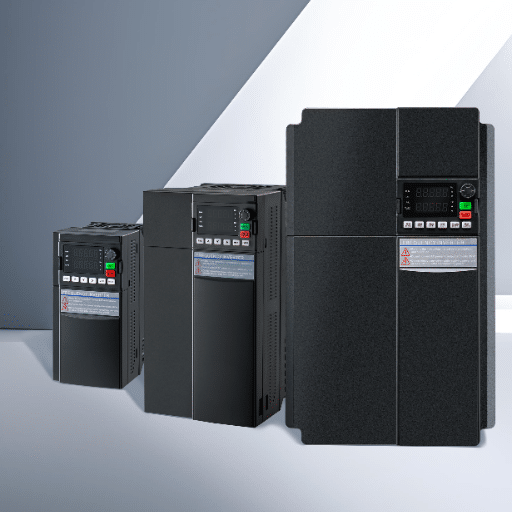
Theory is useful. Numbers are better. Here are three practical VFD sizing scenarios with actual calculations.
A water treatment plant needs to control a 7.5 kW, 400V, three-phase centrifugal pump. The motor nameplate FLA is 14.8 A.
The application runs 24/7 at variable flow rates. Ambient temperature is 30°C. Altitude is 500 meters.
The plant installed the correctly sized drive and reduced energy consumption by 35%. The drive paid for itself in 14 months through electricity savings alone.
A manufacturing facility needs to run a 5.5 kW conveyor with frequent starts under full load. Motor FLA is 11.5 A. Starting torque requirement is estimated at 150% of rated. Ambient temperature is 35°C.
The facility chose the upsized drive. It started reliably under full load. It also provided room for future production increases without another hardware change.
A small workshop has 220V single-phase power and wants to run a 2.2 kW, 380V three-phase motor on a lathe. Motor FLA is 5.2 A.
If you need to run a three-phase motor using a single-phase workshop power supply, read Single-Phase to 3-phase VFD for workshop The guide explains the differences in derating and wiring.
Even experienced engineers make these errors. Avoiding them saves time, money, and frustration.
Oversizing “just to be safe”
A drive oversized by one frame size can cost 15–30% more with no operational benefit. Worse, oversized drives run at low output current for long periods, which can actually reduce power factor and cause motor insulation stress from excessive voltage rise times.
Ignoring input current on single-phase supplies
Three-phase VFDs on single-phase power need input protection and wiring sized for double the normal current. Undersized breakers trip. Undersized cables overheat.
Neglecting altitude derating
A drive sized for sea level loses capacity in the mountains. At 2,000 meters, what looks like a 7.5 kW drive is effectively a 6.7 kW drive. Size up or accept reduced performance.
Forgetting overload class settings
VFDs ship with default overload parameters. If your application needs heavy-duty torque and the drive is set to normal duty, it will trip even if the hardware is technically large enough. Always configure the overload class to match the load.
Mismatching voltage
A 380V motor on a 220V drive (or vice versa) will not deliver rated torque. Voltage matching is just as important as current matching.
For more on avoiding pitfalls, read our VFD troubleshooting common issues guide.
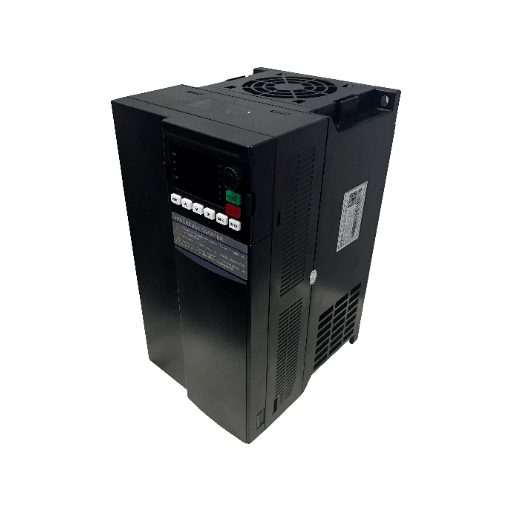
Print this checklist and use it for every motor drive selection project:
How do I select the right VFD?
Start by considering the motor nameplate information, specifically, Full Load Amps (FLA). Determine the type of load. Match the VFD output current with the motor requirement and apply the necessary environment and application-specific derate values. Finally, select the accessory items of either a line reactor or braking resistors based on personal power quality and load inertia requirements.
Should a VFD be oversized for a motor?
Not automatically. Oversizing by one frame size adds 15–30% to cost without improving performance.
Only oversize when the application demands high starting torque, rapid acceleration, or when environmental derating reduces effective capacity. For standard pump and fan applications, matching current is sufficient.
What happens if a VFD is undersized?
If a VFD is undersized, it will trip on overcurrent, overheat, or actually fail to start the motor under extreme load. Repeated overcurrent trips stress the IGBTs in the drive and profoundly harm the service life, and in the worst cases undersizing can result in permanent drive failure or motor damage as a result of insufficient torque.
Do I need a line reactor with my VFD?
Add line reactors when the rated capacity of the supply transformer is over 10 times the rating of the VFD or when power voltage is unstable or when several drives share a common bus or when IEEE 519 power quality standards apply. In small single-drive systems with a stable power supply, it is an option but still beneficial.
What is load type in VFD selection?
Load type describes how torque demand changes with speed. Constant torque loads need full torque at all speeds. Variable torque loads need torque that increases with the square of speed.
Constant horsepower loads need high torque at low speed and lower torque at high speed. Load type determines overload capacity, cooling requirements, and whether you need to oversize the drive.
Sizing a VFD correctly is not complicated, but it is specific. Horsepower gets you into the right neighborhood. Current, load type, and environment get you to the right door.
Make sure that the current rating of the VFD is the fattest approximation of the Motor FLA. Assume service factor. Determine which type of load is being powered constant torque, variable torque, or horsepower? Rain the engine by applying derating factors for temperature, altitude, and single-phase supplies. Protect your motor with some add-ons.
With all these steps done correctly, your VFD’s installation will reliably stand the test of time. Collapse them, and you will have more time to repair them than to run it.
Shandong electricity offers more than just VFDs; we work with the users right from selection to size, configuration, and commissioning so to avail better options for system performance from day one.
If you are evaluating a new project or upgrading existing equipment, contact our engineering team for application-specific VFD selection support. We will help you size it right, the first time.Ready to compare drives by price tier and application? See our buyer’s guide to 3-phase VFDs for budget, mid-range, and premium recommendations.