Ready to Get Your VFD Solution?
Whether you need a single drive or a complete system, we have the VFD products and engineering support to ensure your project's success.

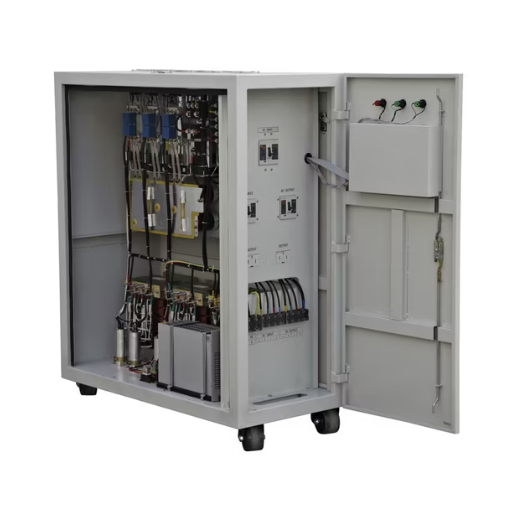
A 400Hz frequency converter takes 50 or 60 Hz mains power and produces 115 V, 400 Hz power for aircraft on the ground. Gates, hangars and avionics test benches all need it, because an aircraft parked with its engines off has no generator running.
Here is the part that catches buyers. The reason aircraft use 400 Hz is that higher frequency makes equipment smaller and lighter. That is true for transformers, motors and generators. It is not true for the converter that makes the power, which gets harder to build at 400 Hz and delivers less than its nameplate suggests.
Tomas Lindqvist found that out at a maintenance hangar in Gothenburg. He ordered a 30 kVA unit for a 25 kVA aircraft load, a comfortable margin by any normal reading. The first engine-start attempt tripped it.
The unit was rated 30 kVA at 50 Hz. At 400 Hz it was worth considerably less.
This guide covers what a 400Hz frequency converter does, why the frequency exists, what the 115/200 V standard means, and the sizing rules that follow from it.
Key Takeaways
- A 400Hz frequency converter produces 115/200 V, 400 Hz power from a 50 or 60 Hz supply for aircraft on the ground.
- The 400 Hz frequency exists to shrink aircraft transformers and motors. It makes the converter’s job harder, not easier.
- One vendor states plainly that at 400 Hz output, capacity drops to 50 percent of the rated figure. Size on the 400 Hz rating, never the nameplate.
- The aircraft bus is 115 V phase-to-neutral and 200 V phase-to-phase, three-phase four-wire, and the loads on it behave differently from industrial loads.
- Six questions separate two quotes that look identical on paper.
Specifying a 400 Hz unit? Send us the aircraft type and the load list, and our engineers will check the 400 Hz rating before you order. Send us the details.
A 400Hz frequency converter rectifies incoming AC to DC, holds it on a DC link, then inverts it back to AC at 400 Hz. An output filter turns the switched waveform into a sine wave. That chain is the same one every AC frequency converter uses. What changes at 400 Hz is how much work the filter has to do and how hard the switches run.
The filter point is worth dwelling on. The output filter removes the switching residue, and it has to work around a 400 Hz fundamental rather than a 50 Hz one. The gap between the switching frequency and the output frequency is narrower, so the filter has less room to work in. That is one reason 400 Hz units cost more per kVA than their 50 Hz equivalents.
A 400hz static frequency converter gets used in three places:
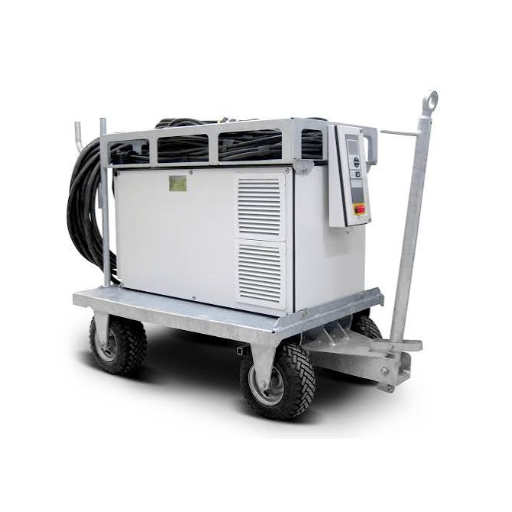
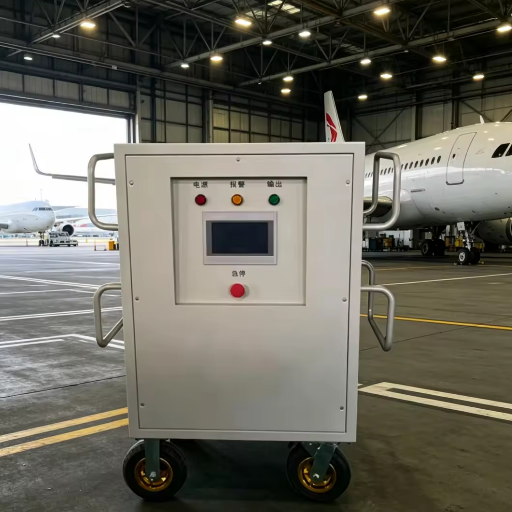
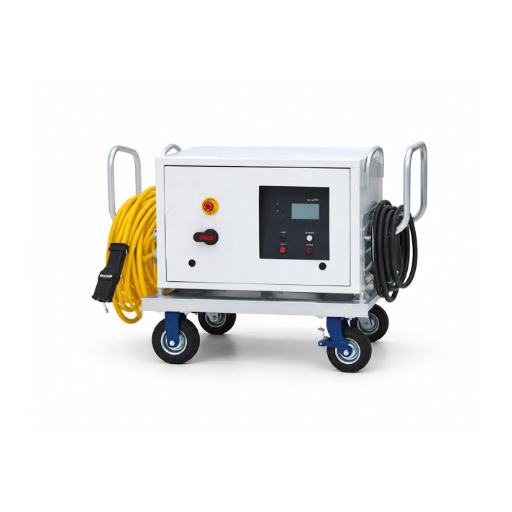
The distinction between a 400Hz frequency converter and a ground power unit is mostly about packaging. A GPU is a converter built into a mobile or fixed enclosure with the cable, the connector and the aircraft interlocks that a ramp needs. The power stage inside is the same.
That is also why an aircraft ground power frequency converter and a bench unit should not be bought on the same datasheet. The ramp unit has to survive being driven around, being rained on, and being plugged into an aircraft by someone in a hurry.
ITW GSE, one GPU maker, lists its 400 Hz range from 30 to 180 kVA. That is the envelope most ramp units are sold into, and it sets the scale of aircraft a fixed installation is meant to serve.

The physics is a single equation. A transformer’s induced voltage is E = 4.44 × f × N × Φ, where f is frequency, N is turns and Φ is peak flux. Hold the voltage and the turns fixed and raise the frequency, and the flux the core must carry falls in proportion.
Less flux means less iron. Less iron means less weight, and in an aircraft every kilogram costs fuel. GoHz puts it directly: “the higher hertz of the power supply system, the lesser of copper and steel materials of the generator and transformer being used, which lead to light weight and low cost.”
The same page is honest about the cost: “The disadvantages are the electrical equipment and wiring inductance increase, capacitances decrease, losses increase, reducing the power transmission efficiency.” It is a trade-off, and it is worth making because aircraft wiring is short, so the transmission loss barely matters.
A caution on the arithmetic. It is tempting to say a 400 Hz transformer is one-eighth the size of a 50 Hz unit, since 400 divided by 50 is eight. The physics points that way for an ideal transformer.
Fly Away Simulation notes the reduction “is not a simple eight-to-one comparison with 50 Hz equipment,” because real components are sized by cooling, insulation and mechanical strength as well as flux. Treat eight as an upper bound, not a specification.
Now the part that matters for buying.
A frequency converter is not a transformer. It is a switching device, and at 400 Hz its switches make more transitions per second than they would at 50 Hz. More transitions mean more switching loss, and more switching loss means less current available at the output.
One vendor states the consequence in its own datasheet. GoHz’s 5 kVA 400 Hz converter carries this note: “When the output is 400Hz, the load capacity can only reach 50% of the rated capacity; When the output is ≤120Hz, the load capacity can reach 100% of the rated value.”
Read that twice. A unit sold as 5 kVA delivers 2.5 kVA at 400 Hz. A buyer who reads the nameplate and sizes a 400 Hz load at 5 kVA is 100 percent short, and nothing on the front of the datasheet says so.
That is one vendor’s convention for a wide-range output model, and not every 400Hz frequency converter derates by half. But the direction is universal, and the lesson is not: the kVA figure you must use is the one quoted at 400 Hz, not the one in the product name.
What is 400 Hz power on an aircraft, in numbers? It is 115 V from each phase to neutral and 200 V between phases, three-phase, four-wire, at 400 Hz. The 115 V figure feeds instruments, avionics and lighting. The 200 V figure feeds the heavier loads, which is why both appear on the same nameplate.
This is where a 115 V 400 Hz frequency converter differs from a general-purpose supply. The output is not a single voltage you dial in. It is a relationship between two voltages that has to hold together, at the aircraft plug, into whatever the aircraft happens to be drawing.
That dual voltage is the detail buyers miss when comparing a 400Hz frequency converter against an industrial one. An industrial unit is usually specified at one voltage. A 400 Hz ground power supply has to hold both relationships at once, and it has to hold them at the aircraft plug rather than at its own terminals.
The loads on that bus are not industrial loads.
| Load on a 400 Hz bus | Example | What it demands of the converter |
|---|---|---|
| Avionics and instruments | Navigation, communications, flight computers | Low distortion and tight frequency; these are the loads that notice waveform quality |
| Motor loads | Fuel pumps, fans, actuators | Starting current; the converter must carry the inrush inside its overload window |
| Galley and cabin | Heaters, ovens, coffee makers | Large resistive current; low power factor is not the issue, raw kVA is |
| Transformer-rectifier units | 115 V AC to 28 V DC conversion | A rectifier front end, so the converter must tolerate a distorting load |
| Ground test equipment | Bench power for component testing | Adjustability; often variable voltage as well as frequency |
The transformer-rectifier row is the one that surprises people. Aircraft derive 28 V DC from the AC bus through a TRU, and a TRU presents a rectifier load to the converter. A converter that behaves perfectly into a resistive load can distort into a rectifier, which is why the specification has to name the load type rather than just the kVA.
Three numbers decide the unit: the kVA at 400 Hz, the load’s power factor, and the cable.
Start with the first. Take the load list, total it in kVA, and then check that total against the frequency converter’s rating at 400 Hz. If the datasheet only gives one figure, ask which frequency it was measured at. Tomas’s 30 kVA unit was sized on a figure that did not apply to his application.
Power factor comes next, and it matters more here than in most industrial work. Aircraft loads include motors and rectifiers, so the arithmetic kVA and the real power diverge. A converter rated in kVA can be limited by the current it can deliver, which is set by the power factor of what you connect.
The cable is the third number, and it is the one nobody puts in the enquiry. Inductive reactance rises with frequency, so a cable that is invisible at 50 Hz becomes significant at 400 Hz. That is why ground power cables are short and thick, and why the voltage at the aircraft plug is specified separately from the voltage at the frequency converter terminals. A unit that measures perfectly on the bench can deliver low voltage at the end of a long run.
For the duty side of sizing, including how long a peak may last, the frequency converter sizing guide covers the method. A 400 Hz converter inherits every one of those rules and adds the frequency derating on top.
The first is sizing on the nameplate. It is the most common error on this topic and the most expensive, because the unit arrives, passes a bench test, and fails on the aircraft.
The second is treating a 400 Hz load as an industrial load. The loads behave differently, the cable behaves differently, and the voltage that matters is at the far end.
Six questions separate two quotes that look the same. Each is answerable in writing, and each changes the unit rather than the price.
Marta Ferreira learned the value of question one the hard way. She ran procurement for an MRO in Lisbon and put three 400 Hz units out to tender, all specified at 60 kVA. The quotes came back 40 percent apart.
Two suppliers had quoted the 400 Hz rating; one had quoted the 50 Hz rating of the same box. Reissuing the tender with the question written into the form collapsed the spread to under 9 percent, and the cheapest original quote turned out to be the smallest unit.
Working on a 400 Hz specification now? Send us the load list and the cable run, and we will tell you which of the six answers is missing before you go to tender. Talk to our engineers.
It supplies 115/200 V, 400 Hz power to aircraft and aircraft equipment from a 50 or 60 Hz mains supply. The common uses are gate and stand power for parked aircraft, hangar and maintenance testing, and bench power for avionics and instruments.
Because higher frequency lets transformers, motors and generators be built smaller and lighter for the same power, and weight is critical in an aircraft. The trade is higher reactance and higher losses, which is acceptable because aircraft wiring runs are short.
Many can produce 400 Hz, but producing it is not the same as being rated for it. A wide-range unit may deliver only a fraction of its nameplate capacity at 400 Hz. Ask for the rating at 400 Hz specifically before treating a general-purpose converter as a 400 Hz unit.
A ground power unit is a 400Hz frequency converter packaged for ramp use, with the output cable, the aircraft connector and the interlocks an aircraft plug requires. The power stage is the same. A 400 Hz converter sold for bench or rack use usually lacks those ramp-specific features.
115 V phase-to-neutral and 200 V phase-to-phase, three-phase, four-wire, at 400 Hz. Instruments and avionics run from the 115 V relationship; heavier loads use the 200 V line-to-line figure.
No. A generator makes 400 Hz mechanically, by turning an alternator at a speed set by its pole count. A frequency converter makes it electronically from a 50 or 60 Hz supply. Converters are quieter and hold frequency more tightly; generators need fuel and engine maintenance.
A 400Hz frequency converter looks like an ordinary one with a different number in the specification. It is not. The frequency changes the rating, changes the cable behaviour, and changes what the loads demand.
Three things follow. Ask for the kVA at 400 Hz, not the nameplate. Check the voltage at the aircraft plug, not at the terminals. And match the unit to the load types on the bus rather than to a single total.
Do that, and the unit that arrives is the unit that was specified. Skip it, and the failure shows up on the first engine start, in front of the customer.
For the technology choice behind the unit, the static frequency converter guide covers how solid-state compares with rotary. Send us the aircraft type, the load list and the cable run. We will check the 400 Hz rating and come back with a capacity and the assumptions behind it. Start the conversation.