Ready to Get Your VFD Solution?
Whether you need a single drive or a complete system, we have the VFD products and engineering support to ensure your project's success.

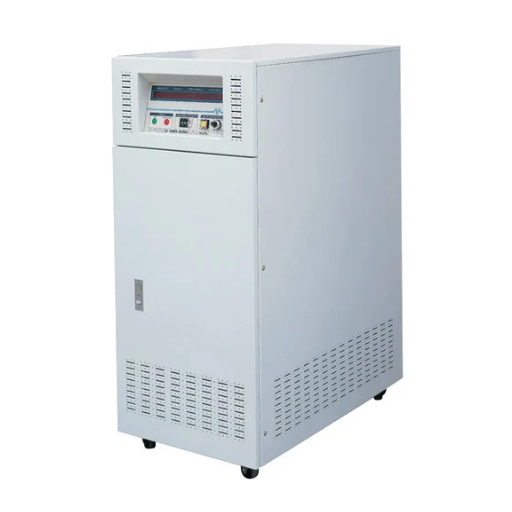
A static frequency converter is a power electronic device that takes an AC supply at one fixed frequency and delivers AC at another, using no rotating machinery. It rectifies incoming power to DC, holds it on a link, and inverts it back at the frequency the load expects.
That definition is accurate and incomplete, because the phrase describes at least three different products.
Priya Raman learned this the expensive way. In March she specified a 60 kVA solid state unit for a packaging line moving from a 50 Hz plasolid-stateHz site, at 40% below the rotary set her predecessor had used. Eight weeks after commissioning, the line tripped whenever a 30 kW spot welder on the same panel fired. The converter was not faulty; it was the wrong device for a load that pushes distortion back into the supply.
Key Takeaways
- “Static frequency converter” names at least three devices: 50/60 Hz grid interconnection, synchronous motor starting (LCI), and 400 Hz ground power. They share a topology and little else.
- Static units run at roughly 96% efficiency against below 85% for rotary, per Riviera Maritime. On a 275 kW continuous load at 0.10/kWh,thatgapisworthabout0.10/kWh,thatgapisworthabout32,500 a year.
- Visicomm, which sells both technologies, says rotary is cheaper to buy above 12 kVA, and matching a rotary’s motor-starting surge with solid state costs about twice as much.
- Solid state units are not suitable for loads dominated by SCRs, triacs, dimmers or welders unless the distortion is isolated and filtered.
- If the load is a motor whose speed must vary, you need a VFD, and oversizing a static converter will not fix the mismatch.
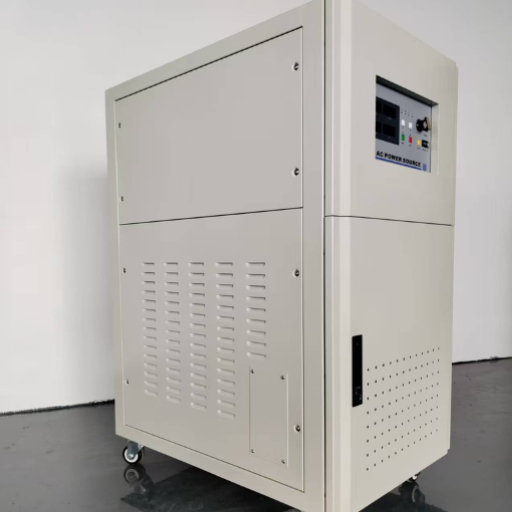
A static frequency converter changes one fixed AC frequency to another using semiconductors only. Nothing in it turns. That absence of a rotating shaft is the entire meaning of “static”, and it separates the device from the motor generator sets that did the same job for most of the twentieth century.
The word “static” describes the conversion method, not the product’s quality. Where a rotary set couples a motor to an alternator and lets physics do the frequency change, a static unit rebuilds the waveform electronically. That is also why vendors call the same product a solid state frequency converter; the two terms are interchangeable.
Not sure what you need? Tell us the supply frequency and what the equipment expects and we will point you at the right device.
The confusion starts here. Three unrelated applications use the same name, and each implies a different specification.
| Job | What the unit does | Frequency pair | Example supplier |
|---|---|---|---|
| Grid interconnection | Bridges a supply mismatch for a facility, vessel or shore connection | 50 Hz and 60 Hz | ABB SureWave, Visicomm |
| Synchronous motor starting | Ramps a very large synchronous motor to speed | Variable, tied to the motor | NR Electric PCS-9575 |
| Aerospace ground power | Produces 400 Hz from a local 50 or 60 Hz supply | 50/60 Hz to 400 Hz | ITW GSE, acsoonpower |
The first is the one most buyers mean. Equipment built for a 60 Hz grid does not run correctly on a 50 Hz supply, and the reverse. A static unit sits between the site supply and the equipment and hands over the frequency the equipment was designed for.
The second is a different machine wearing the same label. NR Electric states it directly on its product page: “The static frequency converter (also named as Load Commutated Inverter, LCI) is a speed governing equipment for providing startup and rotation speed control for large synchronous motor.” It appears in pumped storage and gas turbine plants. The drive-side topology belongs to our medium voltage VFD topologies guide, so this article names the meaning and stops.
The third is the 400hz static frequency converter market. Airports, maintenance hangars and test benches need 400 Hz, and a static unit produces it from the local grid. ITW GSE builds solid state ground power units from 30 to 180 kVA; acsoonpower’s AF400M range runs from 1 to 300 kVA.
If you arrived here searching for pumped storage or 400 Hz, the hardware discussion still applies, but the selection criteria differ. Read the sizing section, then follow the medium voltage VFD link above for motor starting, or the 400 Hz notes below.
Not a VFD. A variable frequency drive varies its output frequency to follow a motor. A static converter holds a fixed output for a load that is not a motor. That single question, does this box follow a motor, sorts most specification decisions before you reach the datasheet. If your answer is yes, read how to select a VFD instead.
Not a transformer. A transformer changes voltage and leaves frequency untouched. Buyers sometimes assume a transformer will solve a frequency mismatch, and it will not. Our guide to converting equipment between 50 Hz and 60 Hz explains why.
Not a UPS, though the two share a topology. Both rectify, store DC and invert, but they answer different questions. A UPS is built for transfer time and battery autonomy; a static converter is built for continuous output frequency and waveform quality. A UPS is not rated for continuous full-load duty at an arbitrary output frequency, and a static converter has no battery for an outage.
The static frequency converter working principle is the same chain every double conversion device uses. Incoming AC is rectified to DC, the DC link smooths it, and an inverter switches it back into AC at the target frequency. That is what frequency converter double conversion means, and it is why a static unit has permanent losses even at no load.
Our guide to AC frequency converter types walks the rectifier, DC link and inverter stage by stage. This article takes that chain as given and asks a different question: what does it cost to run for twenty years?
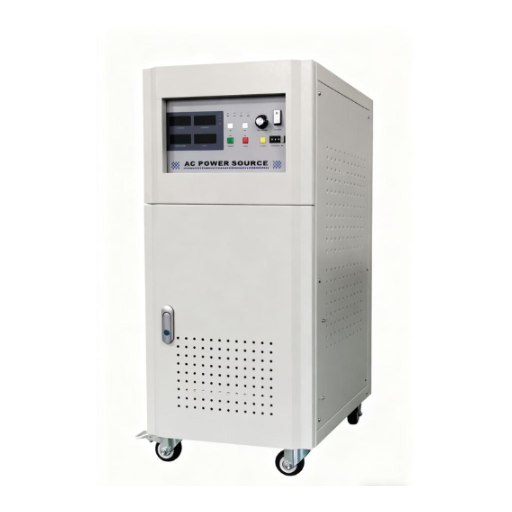
Two technologies do the same job and the choice is genuinely close. The static vs rotary frequency converter decision turns on four things: purchase price, running cost, distortion tolerance, and the physical constraints of the site.
Start with efficiency, because it is the only one of the four with a published number behind it.
Riviera Maritime puts rotary conversion at “a conversion efficiency of less than 85 per cent”, attributing the loss to fixed losses “inherent in any electromechanical system”. The same article gives static conversion at “96 per cent”, from “lower losses from this purely electrical system”. That is an eleven-point gap, and it never switches off.
An “11 percentage point” difference may sound abstract, but the picture changes when you translate it into monetary terms. With efficiency levels of 85% versus 96%, the former requires approximately 0.135 kW more input power for every 1 kW of output power. Based on a continuous load of 275 kW and an electricity cost of $0.10 per kWh, this translates to an additional annual expense of roughly $32,500—amounting to a total of $487,000 over a 15-year period.
That last figure should look familiar. ABB claims savings of “around $487,000 USD over the lifetime of the product which is 15 years” for its SureWave units against “standard, less efficient Rotary Frequency Converter systems”, plus 76 tonnes of CO2. ABB does not publish the load and tariff behind the number.
A worked illustration, not ABB’s basis. The arithmetic above is mine, not ABB’s. It shows that a claim of that size is reachable on a mid-size continuous load at a typical industrial tariff, and it gives you a method: multiply your continuous output in kW by 0.135, then by your annual hours and your tariff. If your number lands far below $487,000, the lifetime-cost argument is weaker for your site than ABB’s headline suggests. Run it before you accept either vendor’s framing.
Visicomm Industries sells both technologies, which makes its cost argument unusually credible. Its page states that “Rotary Design is inherently less expensive for 3 phase units 12KVA or larger” and that “a similarly rated unit would be about 50% higher in price.”
It goes further on surge. Because of “the comparatively limited motor starting capability of solid-state designs, a unit with the same motor starting surge rating would be about twice as expensive.”
Three claims, all pointing the same way, from a company that would profit from the opposite answer.
The distortion limitation is the one that catches buyers. Visicomm states that “Solid state design is not suitable for loads that in large part consist of devices (SCRs, triacs, IGBTs, high capacity dimmers, welders etc.) that feed distortion back into the line.” It adds the qualifier that matters: “unless steps can be, or have been taken to isolate and filter that distortion.” A rotary set handles those loads natively and often isolates them from the rest of the plant.
Power Systems & Controls draws a harder line, positioning the rotary unit as “a harsh environment industrial machine” and the static unit as built “for non-industrial and less harsh applications”. That is positioning rather than a measured claim. It still points at a real difference: static electronics and cooling are sensitive to heat, dust and vibration in a way a rotating machine on a skid is not.
Beyond running cost, static units win on the practical constraints that decide a lot of real installations.
Noise is the clearest. Visicomm rates its solid state units at “less than 60DbA at 3ft”. A motor generator set is a motor and an alternator on a shared shaft, and it sounds like one.
Footprint follows from the same cause. A static unit is an enclosure. A rotary set needs floor space, a foundation and usually a dedicated room. If the installation has to fit into a container, a rooftop plant room or a vessel, that often settles the decision before cost enters it.
Output quality is the third. Static units hold frequency and voltage tightly and can switch output between 50 Hz, 60 Hz and 400 Hz without changing hardware. A rotary set produces the frequency its pole count and speed dictate, and changing it means changing the machine.
Attribute tables are common and not very useful when you are standing in front of a load list. This one is organised by the situation you are actually in.
| Your situation | Static | Rotary | Why |
|---|---|---|---|
| Continuous load above roughly 50 kVA | Yes | The efficiency gap pays back a purchase premium over a service life | |
| Load includes welders, dimmer banks or SCR heaters | Yes | Static cannot follow phase-angle distortion without isolation and filtering | |
| Motor starting surge must be matched | Yes | Matching it with solid state costs about twice as much, per Visicomm | |
| Noise or floor space is constrained | Yes | Under 60 dB(A) at 3 ft, and no foundation required | |
| Ambient is hot, dusty or vibration-heavy | Yes | PSC positions rotary as the harsh-environment machine | |
| Output must switch between 50, 60 and 400 Hz | Yes | Solid state switches frequency in the control software | |
| The site already runs and maintains rotary plant | Yes | Familiar maintenance has real operational value |
Still torn between the two? Send us the load list and annual running hours, and our engineers will run the fifteen-year figure with you before you commit to either technology.
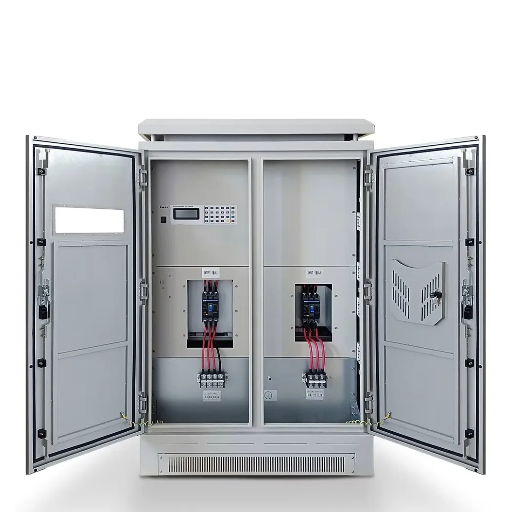
Sizing a static unit is not the same exercise as sizing a drive. The load-type multipliers, crest factor treatment and the twelve-field specification belong to our guide on how to select a frequency converter, which covers the general case. What follows is specific to static units.
Converters are rated in kVA because the output stage carries current, and current is set by apparent power. A 10 kW load at a power factor of 0.8 draws 12.5 kVA. Size on the kW and you will be undersized by a fifth.
Efficiency then compounds the problem in a way that surprises people. A unit rated 100 kVA at 96% efficiency draws roughly 104 kVA at its input to deliver 100 kVA at its output. At 85%, the same output needs about 118 kVA of input. If your supply, cabling or upstream protection was sized tightly around the output figure, the lower efficiency unit will trip it.
This is also why the input current rating on a datasheet deserves a second look. It is the number your electrician will size cable against, and on a low-efficiency unit it is meaningfully larger than the output rating implies.
Static units carry short overloads, not long ones. acsoonpower rates its AF400M at 125% for 30 seconds. ABB’s PCS100 publishes 120% for 10 minutes at 75% pre-load and 150% for 30 seconds. Those figures cover supply dips and brief load steps.
However, they are not motor-starting ratings, and treating them as such is the most common specification error in this category. A direct-on-line motor draws five to seven times its rated current for up to two seconds. A static unit sized to carry that would be enormous, which is why Visicomm says matching a rotary’s surge costs about twice as much.
If your load list is dominated by motor starting, the honest answer is usually a VFD rather than an oversized static converter. A drive controls the acceleration and never presents the surge at all.
Ratings are conditional. ABB publishes a derate of 2% of load per degree Celsius above 40 °C, with 50 °C as the maximum. State that as ABB’s rule for its own product, not as an industry standard, because other manufacturers publish different curves.
The practical consequence is straightforward. A unit specified at exactly the load kVA, installed in an unconditioned plant room that reaches 45 °C in summer, runs at 90% of rating for part of the year. Add altitude above roughly 1,000 m and the margin thins further. Specify the derated figure, not the nameplate.
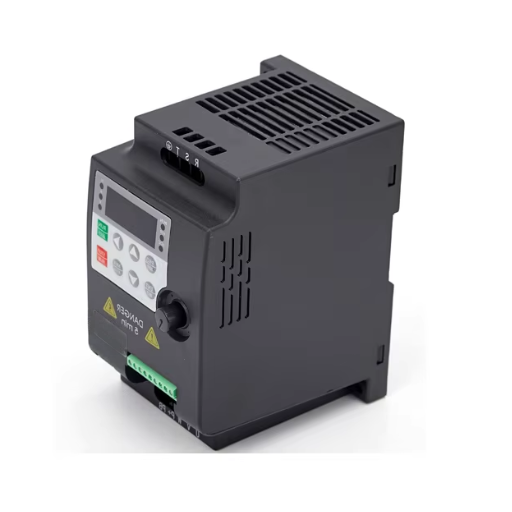
Every vendor page on this subject is a sales page. The fastest way to earn a reader’s trust is to say when not to buy.
Your load pushes distortion back into the line. Welders, SCR heater banks, triac dimmers and IGBT front ends draw current in sharp pulses rather than smooth sine waves. A static output stage cannot follow that waveform, and the result is nuisance tripping, overheating or both. The fix is a rotary set, an isolation transformer with filtering, or separating the offending load onto its own supply. Buying a larger static unit does not fix it.
Daniel Okonkwo ran into this at a port facility in Rotterdam. The shore connection was specified as a static unit on footprint grounds, correctly, but the vessel’s bow thruster drive fed distortion back during manoeuvring. It tripped on overcurrent three times in the first month. The fix was an isolation transformer ahead of the converter, not a bigger converter.
Your load is a motor and you need variable speed. This is not a static converter application at all. A static unit delivers a fixed frequency; a motor that needs to run at 40 Hz or 55 Hz needs a drive. Oversizing the static unit will not give you the variable output, and no amount of margin will.
You need to ride through a supply outage. A static converter has no stored energy beyond its DC link, which holds milliseconds, not minutes. If the requirement is to keep the load running when the grid drops, that is a UPS specification. The topologies look similar on a block diagram and the ratings are not interchangeable.
The load is small and single phase. Visicomm notes that single-phase units in the small size range are comparatively simple and cheap to service. Below roughly 12 kVA, the purchase price argument favours rotary outright, and the efficiency gap has too little load to work on.
It supplies equipment designed for one grid frequency from a supply at another. The common cases are 50 Hz equipment on a 60 Hz site and the reverse, plus shore power for vessels built for a different grid. Others include 400 Hz ground power for aircraft and starting very large synchronous motors in pumped storage and gas turbine plants.
It means the unit has no moving parts in the conversion path. Frequency is changed by rectifying to DC and inverting back to AC, rather than by coupling a motor to an alternator as a rotary frequency converter does. The word describes the conversion method, not the product’s quality or its price.
No. A VFD varies output frequency to control motor speed, while a static converter holds a fixed output for a load that is not a motor. They share a rectifier, DC link and inverter chain, which is why the names get confused, but a static frequency converter vs VFD comparison turns on different criteria entirely. For the drive case, see the VFD selection guide linked above.
Around 96% for a general 50/60 Hz unit, according to Riviera Maritime, against below 85% for a rotary set. Within the static category the figure moves with rating and output frequency. ABB rates its PCS100 at 95% typical across 125 to 2,000 kVA. acsoonpower rates a 1 to 300 kVA 400 Hz unit at 85% or better.
Both rectify, store DC and invert, so the block diagrams match. A UPS is built around transfer time and battery autonomy; a static converter is built around continuous output frequency and waveform quality. A UPS is not rated for continuous full-load duty at an arbitrary output frequency, and a static converter has no battery for an outage.
Two reasons, and neither is a defect. Small ratings carry proportionally higher fixed losses, and a 1 to 300 kVA range is small by grid interconnection standards. Higher output frequency also means more switching activity per unit of power.
One caution on the comparison: acsoonpower publishes 85% as a guaranteed floor (“>=85%”), which is a different kind of number from ABB’s 95% typical figure. Compare floors with floors and typicals with typicals.
The term static frequency converter covers three devices, and the buying decision is different for each. For grid interconnection, the question is static against rotary, and the answer usually turns on how many hours a year the unit runs at meaningful load. For synchronous motor starting, it is an LCI question, covered earlier. For 400 Hz, it is a ground power question with its own efficiency floor.
Lena Fischer, a facilities engineer at a German test house, put it in terms worth repeating. She had budgeted for a rotary set on the assumption that static was fragile. After costing the fifteen-year energy figure on a 200 kW continuous load, she found the static premium paid back in under two years and the noise requirement made the decision for her anyway. The assumption was twenty years out of date.
Before you specify, run three numbers: your continuous load in kW, your annual running hours, and your electricity tariff. Multiply the first by 0.135 and you have the annual cost of choosing rotary over static. If that number is large against the purchase premium, static wins on lifetime cost. If your load includes welders, dimmers or heavy motor starting, the answer may be rotary regardless of the arithmetic.
Not sure which side of the line your load falls on? Send us the load list, the supply frequency and the frequency the equipment expects, and our engineers will tell you whether you need a static converter, a rotary set, or a drive. Talk to our team before you specify.