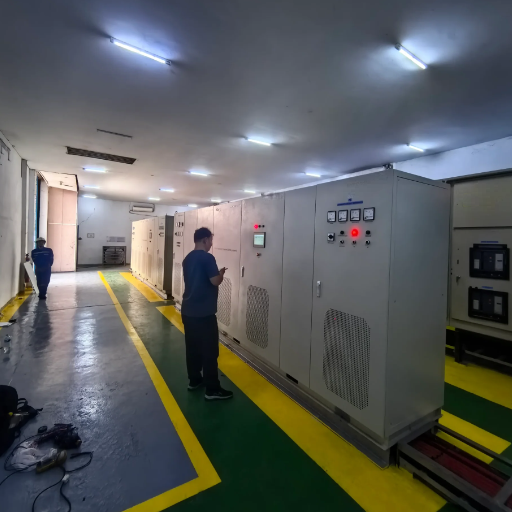
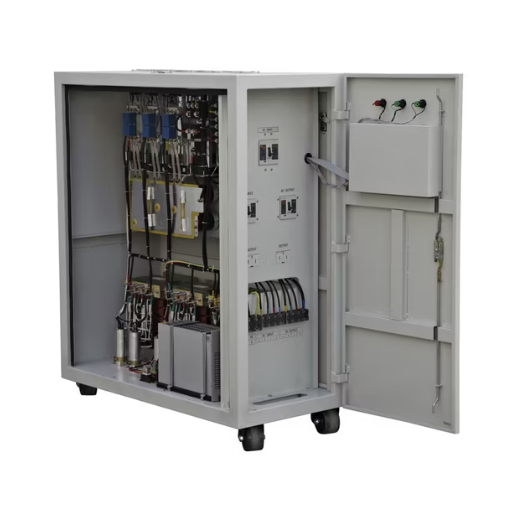
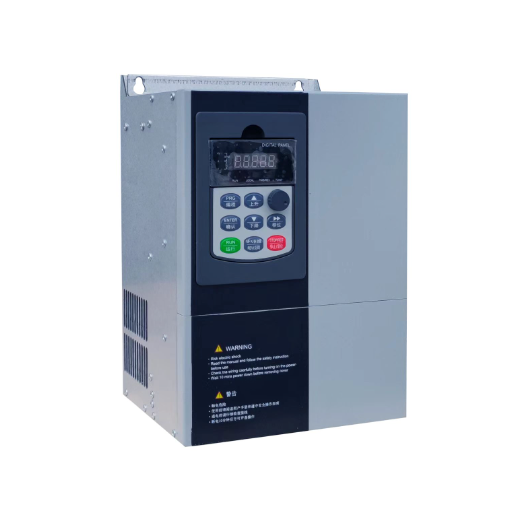
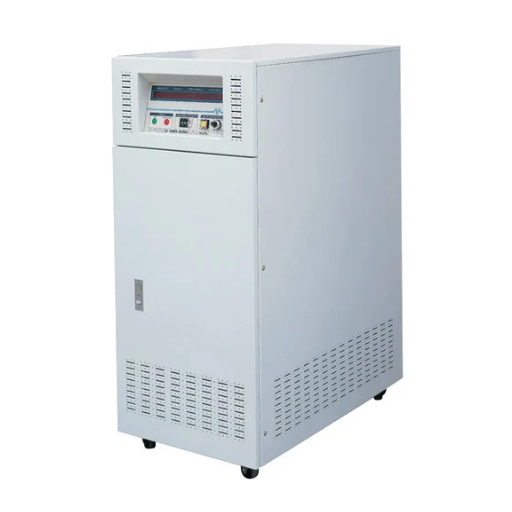
Ready to Get Your VFD Solution?
Whether you need a single drive or a complete system, we have the VFD products and engineering support to ensure your project's success.

Frequency converter sizing takes two inputs, not one: how large the load is, and how long it runs in each cycle. Most sizing guides cover only the first. That is why a converter specified at exactly the right kVA can still trip on the third shift.
Priya Raghunathan had that problem at a stamping plant outside Pune. The press drew 45 kVA at peak, so the specification asked for 50 kVA and the supplier delivered it. The press ran 24 seconds, rested 36, and repeated. On the third shift, when the line ran flat out, the converter tripped on over-temperature roughly every ninety minutes.
Nothing was wrong with the arithmetic. Everything was wrong with the time.
This article covers the half of sizing that the kVA tables leave out. You will learn what a duty cycle actually commits you to, how to convert an intermittent load into a continuous rating, and the five questions that settle a specification before you order.
Key Takeaways
- Every overload rating is three numbers, not one: a percentage, a duration, and the pre-load condition it assumes.
- Four duty classes cover almost every load, and each one changes the rating you should specify.
- An intermittent load converts to an equivalent continuous kVA by RMS. A 45 kVA peak at 40 percent duty works out to about 28.5 kVA.
- The same 45 kVA peak lasting 45 seconds instead of 24 needs 50 percent more capacity, because the 30-second overload window no longer covers it.
- Ask five questions about duty before you accept a quote. The answers change the unit, not just the price.
Magnitude is the input everyone knows. Convert the load to kVA, apply the rule for its type, add margin, and check the result against the ambient. That method is well documented, and how to select a frequency converter sets it out step by step.
Time is the input that gets dropped. It asks how often the load reaches its peak, how long the peak lasts, and how much of the cycle the frequency converter spends at rest.
| Magnitude asks | Time asks |
|---|---|
| How many kVA at peak? | For how many seconds? |
| What is the worst-case current? | How often does the worst case recur? |
| What margin does the load type need? | How much of the cycle is spent at rest? |
| What ambient does the rating assume? | What pre-load does the overload assume? |
A specification that answers the left column and not the right is not wrong. It is incomplete in a way that only appears under a particular load pattern, which is why the error survives commissioning and surfaces months later.
The rest of this article is the right column. For a load that runs continuously, the right column is empty and the standard method is complete. For anything else, it decides the frequency converter.
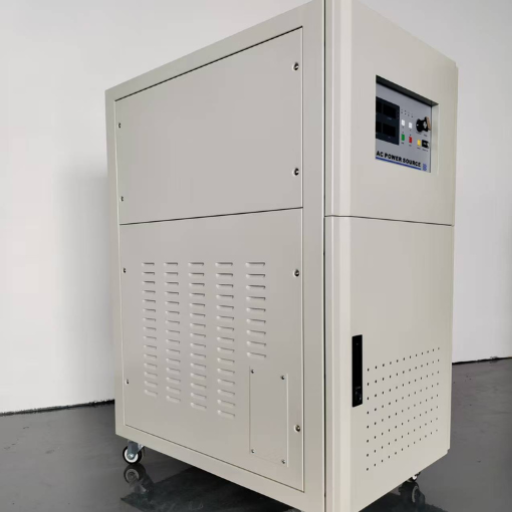
Overload is quoted as three numbers, and buyers usually read only the first.
Take the ABB PCS100 static frequency converter, whose technical data states 120 percent for 10 minutes at 75 percent pre-load, and 150 percent for 30 seconds on the output. It also lists a short-circuit limit of 200 percent for 2 seconds. Read as a single figure, “150 percent” sounds like headroom available whenever the load spikes.
The duration is what makes it a commitment. The 150 percent is available for 30 seconds. Ask for the same figure over five minutes and the answer is no. The frequency converter overload rating describes a thermal budget, not a reserve of power.
The pre-load is the part most often skipped. “At 75 percent pre-load” states the load the frequency converter was already carrying when the overload began. Consequently, a rating assumed from 75 percent does not automatically hold from 95 percent, because part of the thermal budget has already been spent.
IEC 60034-1 numbers the standard duty types, and three of them cover most industrial loads. KEB America’s summary puts the distinction in thermal terms. Continuous duty runs “long enough to reach thermal equilibrium.” Short-time duty is “shut off before it reaches thermal equilibrium.” Intermittent duty “never reaches ambient temperature during its rest period.”
That difference in heat behaviour is the whole sizing consequence. It gives three standard classes directly, plus a fourth that IEC handles separately as varying load but which behaves the same way for sizing.
| Duty class | What the load does | What it means for sizing | Example |
|---|---|---|---|
| Continuous | Rated load, indefinitely; temperature settles | Size at or above the continuous rating; there is no time credit | Pump, fan, conveyor |
| Short-time | Rated load for a defined period, then rest to ambient | May exceed the continuous rating if the rest lets heat dissipate | Hoist, press ram |
| Intermittent | Repeating load and rest cycles; never settles | Size on equivalent continuous kVA, not the peak | Welder, press, mixer |
| Cyclic | Load varies through a repeating pattern | Size on RMS over the cycle, then check the peak | Extruder, centrifuge |
Short-time and intermittent are the pair buyers most often confuse, and the difference is whether the rest is long enough to cool. A hoist lifts for two minutes and then sits idle for twenty, which returns it to ambient between lifts. That is short-time duty, and the rest is genuine recovery.
A press that runs 24 seconds and rests 36 never gets back to ambient, so every cycle starts warmer than the last until it plateaus. That is intermittent duty.
The distinction changes what you can claim. Short-time duty lets you use the overload window repeatedly, because each use starts from a cooled unit. Intermittent duty does not, because the overload arrives on top of residual heat.
Heat builds in a frequency converter more slowly than load changes. The semiconductors and the heatsink have thermal mass, so a short overload barely moves the junction temperature before it ends. A long overload at the same percentage reaches a new equilibrium instead.
This is why a datasheet quotes two overload figures rather than one, and why the longer window carries the lower percentage. The 150 percent for 30 seconds and the 120 percent for 10 minutes are not arbitrary numbers. They are two points on the same thermal curve, and the curve is set by the time constant of the hardware.
The practical consequence is blunt. A load whose peak lasts 24 seconds can be carried by an overload rating that lasts 30 seconds. A load whose peak lasts 45 seconds cannot, no matter how large the percentage looks on the datasheet.
Therefore the duration in a datasheet is not a formality. It is the boundary that decides whether the peak fits at all.
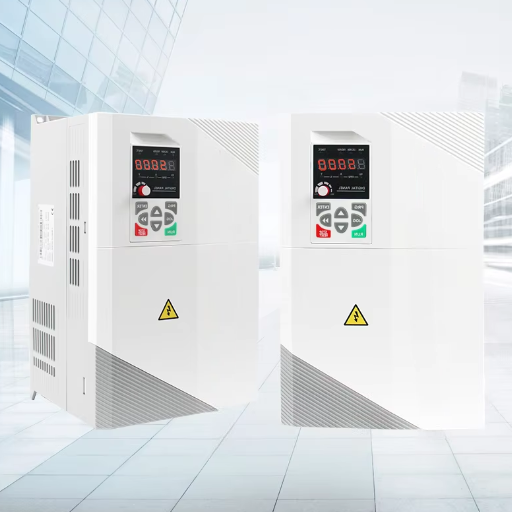
The method is root-mean-square, and it is the only frequency converter kVA calculation that takes a time input. Convert every level in the load profile to its equivalent continuous value, weighting each by the time spent there, and take the square root.
equivalent kVA = √( (kVA₁² × t₁ + kVA₂² × t₂ + … ) / T )where each t is the time at that level and T is the full cycle time. A level of zero counts, which is why rest periods matter: they pull the average down.
Return to Priya’s press. The peak is 45 kVA, held for 24 seconds, followed by 36 seconds at rest. The cycle is 60 seconds, so the cyclic duration factor is 40 percent.
√( (45² × 24 + 0² × 36) / 60 ) = √810 ≈ 28.5 kVAThe naive approach multiplies the peak by a margin: 45 kVA times 1.1 gives 49.5 kVA, and a 50 kVA unit is ordered. The RMS method says the press needs 28.5 kVA continuously, a 43 percent difference on the same load.
However, 28.5 kVA is not the answer either, because the peak still has to be carried. At 28.5 kVA the 45 kVA peak is 158 percent of rating, above the 150 percent the unit can hold. Dividing 45 by 1.5 gives 30 kVA, and at 30 kVA the peak lands exactly on the 150 percent line while the RMS load sits at 95 percent of rating. Specify 30 kVA, not 50.
The RMS method assumes the thermal time constant is short relative to the cycle. When that holds, the average is what the hardware sees, and the arithmetic above is sound. When it does not, the method understates the requirement.
Two cases break it. The first is a peak that outlasts the overload window. Stretch Priya’s 24-second peak to 45 seconds and the 150 percent for 30 seconds no longer covers it, so the frequency converter must carry 45 kVA continuously. Same load magnitude, same average, 50 percent more capacity, because the time changed.
The second case is a load that cycles faster than the thermal time constant. Very short, very frequent peaks do not average out the way a slow cycle does. In that case the safe move is to ask the supplier for the I²t curve rather than calculate from an average.
There is a third trap worth naming: the pre-load condition. If the frequency converter already sits at 95 percent when the peak arrives, it cannot also deliver 150 percent, because the rating was quoted from 75 percent. On a load that never fully rests, that assumption fails quietly.
Standard practice adds margin to a peak figure. A buyer who adds 10 percent to Priya’s 45 kVA gets 49.5 kVA and orders 50. The RMS method says 30 kVA covers the same load, so the margin is being applied to the wrong number entirely.
The margin belongs on the equivalent continuous figure, not the peak. Ten percent on 28.5 kVA gives 31.3 kVA, which rounds to the next standard size. The peak is then checked separately against the overload window, and that check either passes or forces a larger unit. Margin covers uncertainty in the load data; it is not a substitute for the peak check.
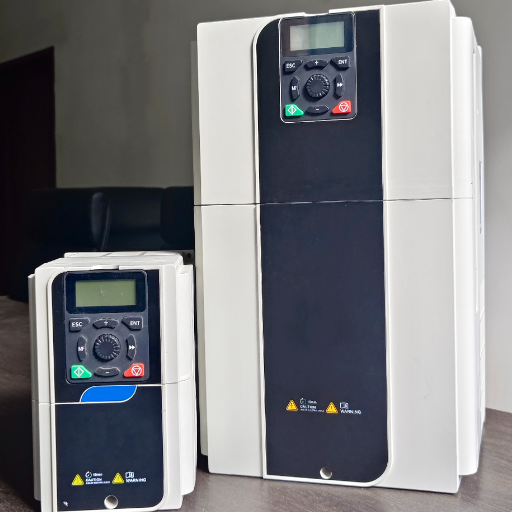
Five questions settle the time half of a specification. Each one is answerable by a supplier in writing, and each one changes the frequency converter rather than the price.
Marta Oliveira learned the cost of skipping the first question. She was procurement lead for a ceramics plant near Porto, and the tender she issued asked for “intermittent duty” converters without defining what that meant. Three suppliers quoted three different units, one sized to the peak and two sized to the average, and none of the quotes could be compared. Reissuing the tender with a duty table attached took three weeks and produced quotes that differed by less than 8 percent.
Working on a specification now? Send us the load profile and we will tell you which of the five answers is missing before you go to tender. Talk to our engineers.
Convert the load profile to an equivalent continuous kVA by RMS, then check the peak against the frequency converter’s short-duration overload rating. A 45 kVA peak at 40 percent duty works out to 28.5 kVA. The peak then sets a floor of its own: 45 kVA at 150 percent means at least 30 kVA. Specify the larger of the two figures.
It means the frequency converter can deliver 150 percent of rated output for up to 30 seconds, starting from the pre-load the datasheet states. It does not mean 150 percent whenever you need it. A peak lasting longer than 30 seconds has to be carried by the continuous rating instead, which usually means a larger unit.
No. The continuous rating is the load a frequency converter can hold indefinitely at its stated ambient. Anything above it draws on a time-limited thermal budget that the datasheet states separately. Running above the continuous rating without a rest period is exactly the failure the overload figures exist to prevent.
In continuous duty the load runs long enough for the frequency converter’s temperature to settle, and it stays there. In intermittent duty it runs and rests in repeating cycles without ever settling, so the average temperature stays below what the peak alone would produce. That gap is why intermittent duty allows a smaller frequency converter for the same peak.
Cyclic duration factor is the share of each cycle spent under load, expressed as a percentage. A press running 24 seconds in a 60-second cycle has a factor of 40 percent. Common nameplate values are 15, 25, 40 and 60 percent, and the factor is the number the RMS calculation uses.
Start and stop is intermittent duty, so size on the average rather than the peak, then check the peak against the short-duration overload. The trap is the start itself. A motor started direct-on-line draws several times its running current, and that surge has to fit inside the same short-duration window as the running peak.
The kVA figure on a specification is a magnitude. On its own it says nothing about whether the frequency converter will survive the shift, because it carries no information about time.
Two numbers fix that. The equivalent continuous kVA tells you what the load costs the hardware on average, and the peak against the short-duration rating tells you whether the worst moment fits. When the two agree, the specification is settled. When they disagree, the larger of the two wins, and the reason should be written down next to the number.
For the magnitude half, the AC frequency converter overview covers the device families, and the selection guide covers load type, capacity and environment. If the output frequency is fixed rather than variable, a static frequency converter is the device to size, and the same duty logic applies to it.
Send us the load profile and the cycle time. We will work the equivalent continuous kVA, check the peak against the overload window, and come back with a capacity and the duty assumption behind it. Start the conversation.