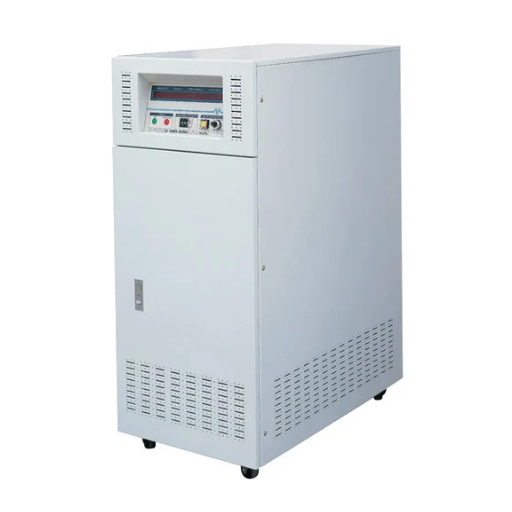
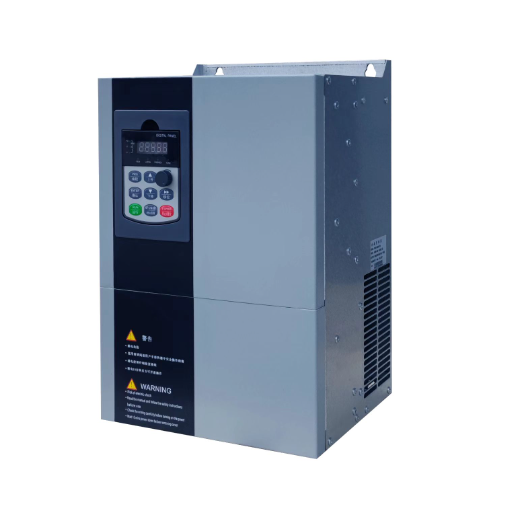
Ready to Get Your VFD Solution?
Whether you need a single drive or a complete system, we have the VFD products and engineering support to ensure your project's success.

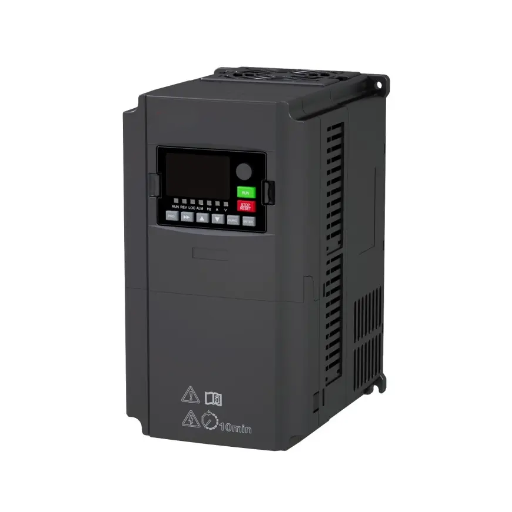
To select a frequency converter, start with the load rather than the datasheet. Identify what it will feed, apply the sizing rule for that load type, choose single or three phase, set capacity and overload, match the unit to the site, and write the result as a specification. Most bad purchases skip the first step entirely.
Mark Reyes ran maintenance at a stamping plant in Ohio that needed 60 Hz power for a press imported from Europe. The electrician totaled the connected load at 40 kVA and bought a 45 kVA solid-state converter, a sensible-looking 12 percent margin. The press tripped it on every start.
A hard-starting motor draws five to seven times rated current for up to two seconds; the converter’s overload covered milliseconds. Nobody had asked what the load was.
If you are still deciding which device family you need, the AC frequency converter types guide sets that out first. This article assumes you need a converter and must specify one.
Key Takeaways
- Load type sets the sizing rule. A resistive load needs about 10 percent margin; a hard-starting motor can need six times its rating.
- Rectifier and switch-mode loads are sized on crest factor, not average current. A unit sized on nameplate kVA will trip.
- Solid-state converters cannot tolerate loads that feed distortion back, such as welders and SCR heaters, unless the distortion is isolated.
- Capacity is quoted at 40 °C. Above that, expect roughly 2 percent of load lost per degree.
- The output of selection is a specification, not a product choice. Twelve fields settle most enquiries.
Not sure what your load draws? Our engineers review load lists and motor nameplates routinely. Send us the details and we will check the sizing before you order.
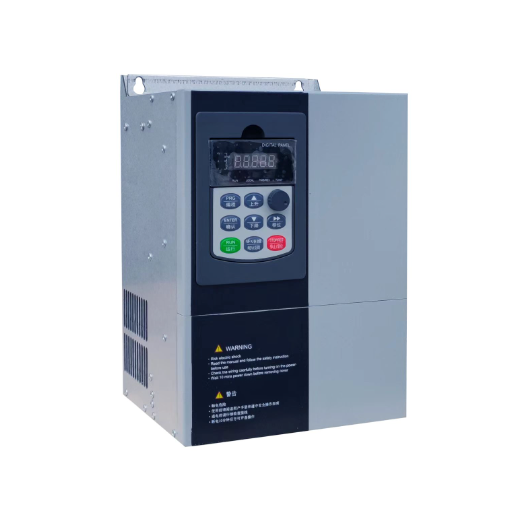
Work through these in order. Each narrows the field before the next.
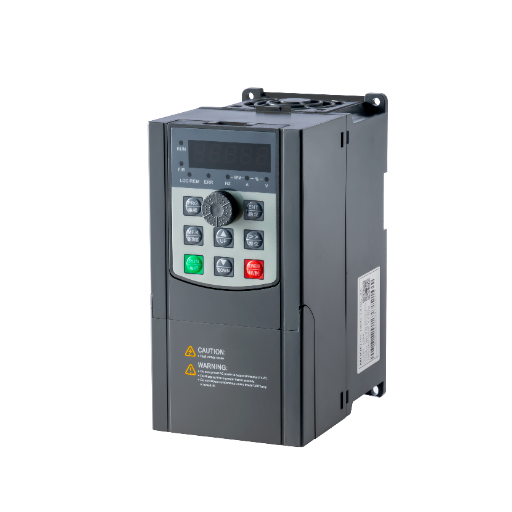
Frequency converter load types behave differently enough that no single rule covers them. The table is the short version; the subsections explain why each rule exists.
| Load type | Sizing rule | Why |
|---|---|---|
| Resistive | 1.1 × load power | Current and voltage stay in phase; almost no surge |
| Capacitive / RC | 1.1 × load apparent power | Charging current leads the voltage, so VA exceeds W |
| Motor (hard start) | About 6 × motor power, or fit a soft starter | Starting current is 5-7 × rated for up to 2 seconds |
| Rectifier / switch-mode | Crest factor ÷ 2 × apparent power, when crest factor exceeds 2 | Pulsed current peaks far above its average |
| Regenerative | Standard sizing, but declared at order | Back EMF can damage the output stage |
| Mixed | Each load’s share of total power, then sum | The dominant load sets the behaviour |
These are manufacturer rules of thumb, not standard requirements. GoHz publishes the set most other vendors repeat.
Heaters, incandescent lighting and resistive test banks draw current in phase with voltage. There is no inrush and no distortion to manage. A 10 percent margin covers supply variation and the fact that a converter’s rating is measured on a resistive load anyway. Plants routinely buy two or three times the capacity they need because the rule they learned came from motors.
A capacitive load draws current that leads the voltage, so apparent power in volt-amperes exceeds real power in watts. Size on the VA figure, not the nameplate wattage. A load rated 10 kW at a power factor of 0.8 presents 12.5 kVA, and the converter must carry all of it.
A motor started direct-on-line draws five to seven times its rated current, typically for under two seconds. A converter’s overload capability is usually around 200 percent, lasting milliseconds before protection trips. Those two facts do not meet, so a converter sized at the motor’s running kVA trips on every start.
However, you have three options, and only one involves buying a bigger converter:
The third is usually the cheapest, and the one buyers overlook.
This load type most often produces a converter that trips for no visible reason.
A rectifier front end with a capacitor bank draws current in short, tall pulses near the voltage peaks. Without soft-start upstream, closing the input looks like a short circuit and the converter’s overcurrent protection operates at once. The pulses also mean peak current sits far above average. Crest factor is peak divided by RMS current, and a clean sine wave sits near 1.4 while a rectifier load typically reaches 3 to 3.5.
Converter output stages respond to peak current, not average. Therefore a unit sized on average kVA is undersized in the only dimension that matters:
Capacity = (crest factor ÷ 2) × load apparent power
A load at crest factor 3.2 drawing 20 kVA needs 32 kVA. Ask the equipment supplier for the crest factor. If they cannot provide it, measure the input waveform before ordering.
Reversing motors, overhauling loads and anything pushing energy back toward the supply generate a back EMF that can damage a converter’s output stage. The fix is not a sizing rule but disclosure. Tell the supplier at the enquiry stage that the load regenerates, and let them specify a unit that absorbs or blocks it. A converter chosen without that information may work for months and fail the first time the load overhauls hard.
Real panels are rarely one load type. A machine might carry a motor, a heater, a switch-mode supply and a control transformer. Total each load’s share of the power, size the dominant load by its own rule, and add the rest. The dominant load sets the behaviour: a motor means inrush governs, a rectifier means crest factor governs.
Every rule above assumes the converter can supply the load. Some loads it cannot, at any size.
Solid-state converters are not suitable for loads that feed distortion back into the line: silicon-controlled rectifiers, triacs, IGBT front ends, phase-angle dimmers and welders. The output stage assumes it is driving the waveform, and these loads fight it. Visicomm states the limitation directly, noting such loads are acceptable only where distortion can be isolated.
Two honest answers exist. Isolation and filtering, if the distortion is bounded and the budget allows. Alternatively, a rotary converter, a motor driving a generator, is indifferent to the load because the generator’s inertia absorbs it. Rotary sets also isolate the load from the rest of the plant supply.
This is where Aisha Karim, who ran the electrical workshop at a fabrication shop in Sheffield, lost three months. The shop bought a 30 kVA solid-state converter for an imported resistance welder rated 28 kVA, so 30 kVA looked correct. It tripped on almost every weld, because a resistance welder is a phase-angle load whose current waveform is nothing like a sine wave.
The fix was a rotary set, at roughly twice the price and eight weeks of lead time. The nameplate figure was accurate; it was also the wrong number.
To spot one before you specify, ask three questions. Does the load switch its current within a cycle rather than following the voltage waveform, as dimmers, welders and SCR heaters do? Does it have a rectifier and capacitor bank at its input, as most modern electronics do? Does it ever push energy back toward the supply, as reversing drives and overhauling hoists do?
A yes to the first or third puts you in rotary or isolated territory. A yes to the second means you need the crest factor, not a rotary set.
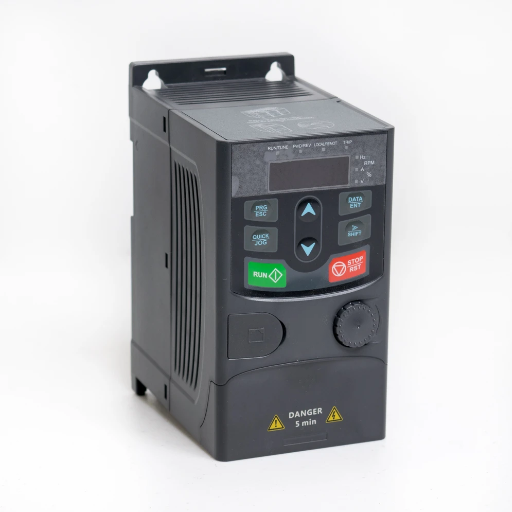
Choosing a frequency converter with the wrong phase is rarely fatal, but it constrains capacity in ways worth knowing.
Single-phase units suit light loads, test benches and sites without three-phase power. They are simple and cheap at low ratings. The constraint is current: a single-phase unit carries three times the current per conductor for the same power, which drives cable size, terminal ratings and losses. In practice most top out in the low tens of kVA.
Above roughly 20 to 30 kVA, three-phase stops being a preference. It also matters for balance, since a large single-phase load on one phase creates voltage unbalance that affects every other load on the board. Piller’s published range shows the pattern: static units 30 kVA to 500 kVA, rotary sets 125 kVA to 2,300 kVA, all three-phase products.
If your load is above about 30 kVA and the site has three-phase power, specify three-phase and move on.
A converter rated for its capacity at 40 °C in a clean electrical room is not the same product in a foundry at 48 °C. Datasheet figures are conditional, and the conditions are stated.
ABB’s PCS100 is rated 0 °C to 40 °C, with derating of 2 percent of load per degree above 40 °C up to a 50 °C maximum. That shape is typical, though the slope varies by product. A 100 kVA unit in a 45 °C plant room delivers about 90 kVA. Consequently, a unit installed at nameplate in a hot room runs at its thermal limit continuously, shortening capacitor and fan life whether or not it trips.
Tomás Ferreira inherited exactly this at a Portuguese ceramics plant. A 60 kVA converter had been installed at nameplate in a room peaking at 46 °C. It failed twice in fourteen months, both times in August.
The replacement was specified at 75 kVA with the derate applied, and has run for three years. The failure was never a manufacturing defect; the specification ignored the room.
Air thins with altitude, so convective cooling degrades. Above about 1,000 m most manufacturers require derating, and the slope varies enough that you should ask rather than assume. A plant at 2,000 m may need 10 percent more capacity.
Match the enclosure to the room, not to the catalogue’s cheapest option.
| Environment | Typical rating | Notes |
|---|---|---|
| Clean, climate-controlled electrical room | IP20 | Open-frame or cabinet, forced air |
| General factory floor | IP54 | Dust-tight and splash-resistant |
| Washdown, food, outdoor sheltered | IP65 | Sealed; check the cooling path |
| Corrosive or coastal | IP65 plus conformal coating | Ask specifically about coating |
A sealed enclosure solves ingress and creates a thermal problem at once. An IP65 unit in a hot room may need an air-conditioned cabinet or heat exchanger, which changes installation cost. Raise it at specification, not commissioning.
Overload is quoted as a percentage for a duration, and both parts matter. ABB’s PCS100 offers 120 percent for 10 minutes at 75 percent pre-load, and 150 percent for 30 seconds. The 10-minute figure covers a sustained overload; the 30-second figure covers a start. Neither covers a hard-starting motor at 600 percent for two seconds, which is why motor loads need the sizing treatment above rather than a bigger overload number.
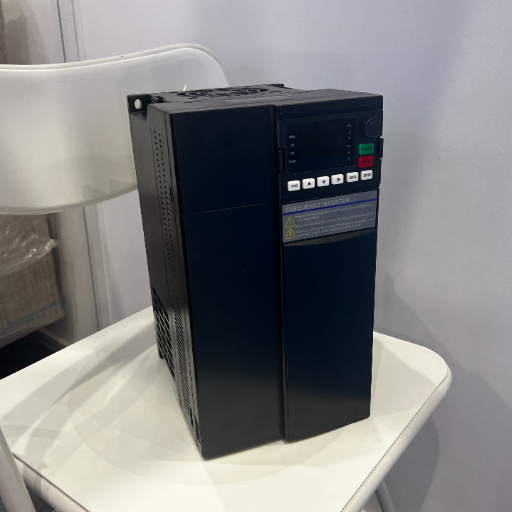
Frequency converter selection ends with a document, not a decision. A supplier with all twelve fields below can price without guessing.
Field four is the one buyers most often omit. A unit rated 100 kVA at 50 Hz may be rated considerably lower at 400 Hz, so put the per-frequency rating in the enquiry and answers come back comparable.
Decide what the converter must do besides convert. Remote start and stop, status reporting, alarm contacts and metering all change the specification and the price. Protocol matters if the unit joins a plant network: Modbus is close to universal, while Profinet and EtherNet/IP are common in European and North American plants. If it will be monitored from SCADA, say so; that changes the option cards.
Four questions separate a comparable quote from a cheap one:
A quote that answers all four is a specification. One that answers none is a price. For the drive-side equivalent, our VFD specification template sets out the same field list. If the application needs conversion between grids rather than a fixed output, converting equipment between 50 Hz and 60 Hz covers that case directly.
Size at roughly six times the motor’s rated power if it starts direct-on-line, because starting current runs five to seven times rated for up to two seconds while the converter’s overload lasts milliseconds. Better, fit a soft starter or a variable frequency drive so the inrush never reaches the converter.
Convert the load to kVA, then apply its rule: about 1.1 times for resistive loads, 1.1 times apparent power for capacitive loads, and crest factor divided by two times apparent power for rectifier loads. Then derate for site temperature and altitude.
Usually not a solid-state one. Welders are phase-angle loads that feed distortion back into the line, and solid-state converters cannot handle them unless the distortion is isolated and filtered. A rotary set takes the load without difficulty.
Crest factor is peak current divided by RMS current. A sine wave sits near 1.4; a rectifier load typically reaches 3 to 3.5. Converter output stages respond to peak current, so a unit sized on average kVA is undersized for a high-crest-factor load.
Manufacturers commonly suggest 20 to 30 percent above steady-state load to cover supply variation and startup surge. That assumes the load type has already been handled by its own rule.
A settable frequency is one the unit can be configured to produce. A rated frequency is one at which it delivers full power continuously. Many converters offer roughly 10 to 400 Hz adjustable, but the kVA rating at the top of that range is usually lower than at 50 or 60 Hz.
Frequency converter selection comes down to six decisions, and the first carries most of the weight. A clear set of frequency converter selection criteria makes the rest mechanical.
The expensive mistakes come from starting at the datasheet, where every unit looks capable of every job.
If your project involves motors on a converted or controlled supply, the drive side matters as much as the converter. Shandong Electric builds variable frequency drives from compact low voltage units to high voltage systems for heavy industry, with engineering support from selection through commissioning. Where the load turns out to be a speed-controlled motor, the frequency converter types guide explains which device that changes. Tell us about your load and we will help you match the right equipment to the application.