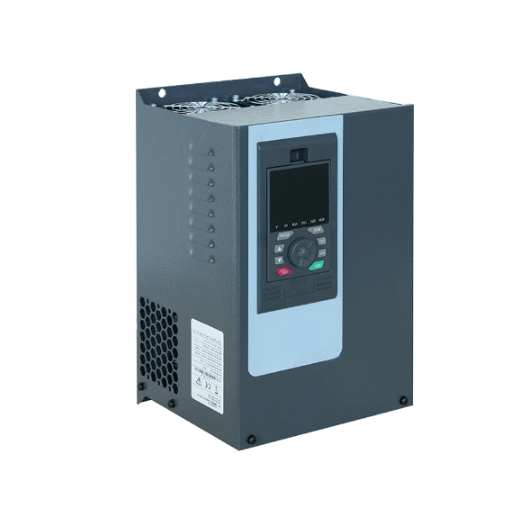
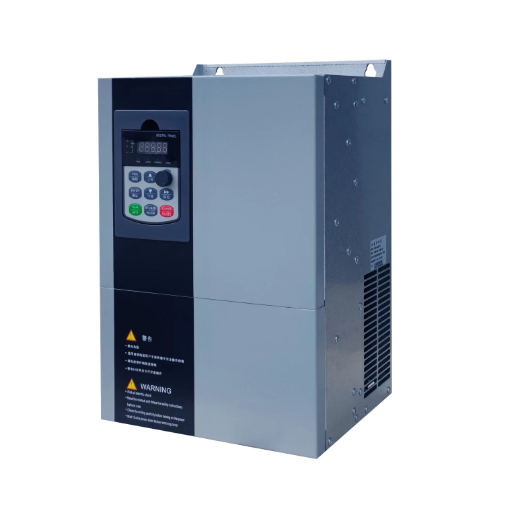
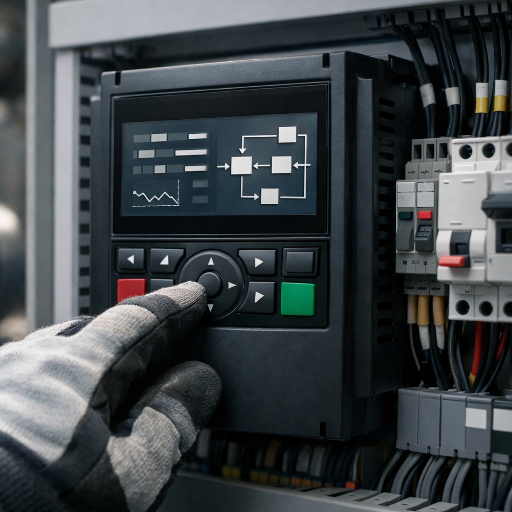
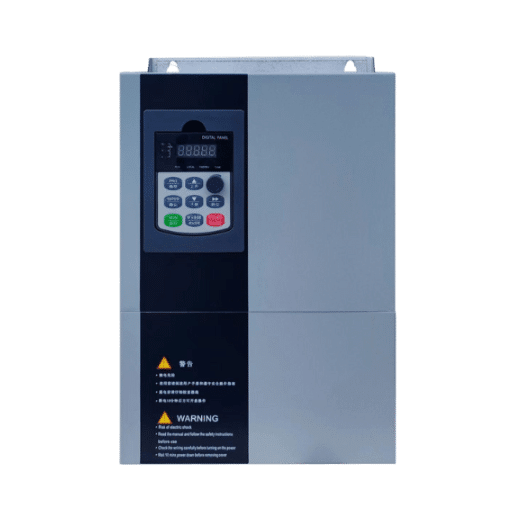
Ready to Get Your VFD Solution?
Whether you need a single drive or a complete system, we have the VFD products and engineering support to ensure your project's success.

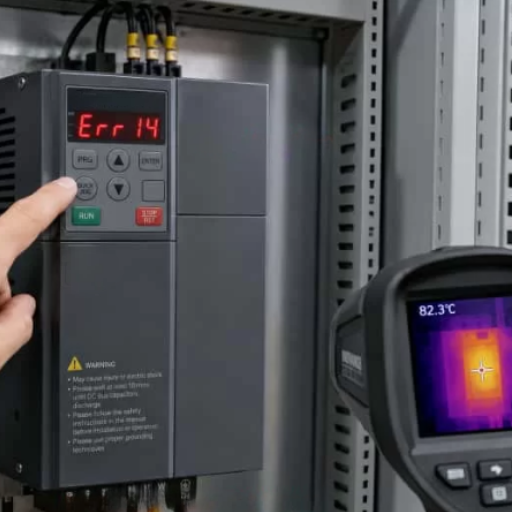
VFD motor overheating at low speed happens because the cooling fan is bolted to the shaft. As the shaft slows, the fan moves less air, but a constant-torque load keeps asking for the same current. Heat production stays roughly flat while heat removal collapses. The drive isn’t at fault, and buying a larger one won’t fix it.
Here is the part that catches people out. The overload relay usually never trips.
Ravi learned that on a bottling line in Nashik. The line ran its infeed conveyor at about a quarter speed for eight-hour shifts. Every four to six months, a motor failed. The electricians checked the overload setting, found it correct, and fitted another motor.
When someone finally put a clamp meter on the motor and a thermocouple on the frame, the answer was obvious. The current sat comfortably under the nameplate value. The winding temperature did not. The relay was doing its job, and the job was the wrong one.
This guide covers the motor side of that pair. It shows you how to tell motor heat from drive heat, why your protection may be blind to this fault, how the load type decides whether you have a problem at all, and the three fixes in order of cost. For the drive side, our VFD overheating fault guide covers heatsink, fan and cabinet causes.
Key Takeaways
- A standard motor cools itself from a fan on its own shaft, so cooling falls with speed while a constant-torque load keeps heat production flat.
- A thermal overload relay measures current, and this fault can develop below rated current. The relay may never trip before the insulation is damaged.
- Load type decides the risk. Centrifugal fans and pumps usually need nothing; conveyors, extruders and positive-displacement pumps usually do.
- There is no universal minimum speed. The limit belongs to your motor, and the maker’s derating curve is where you read it.
- The three fixes, cheapest first, are a higher minimum speed, a separately powered cooling blower, and an inverter-duty motor.
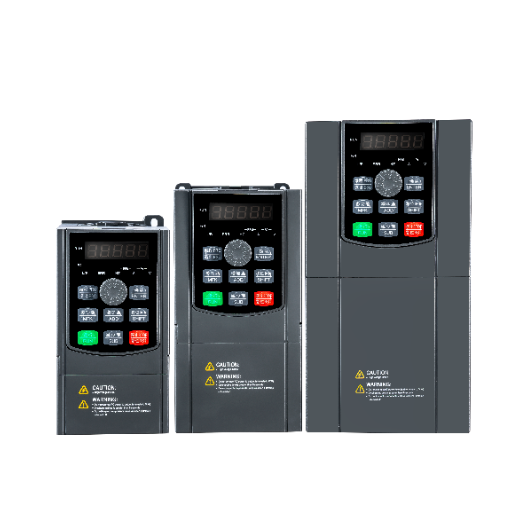
The first question is not why something is hot. It is what is hot. A drive-side overheating fault and a motor-side overheating problem share a symptom and almost nothing else.
If the drive trips on its own overtemperature fault, you have a drive problem: a blocked heatsink, a failed cooling fan, a hot cabinet, or a carrier frequency set higher than the application needs. That path is covered in our VFD overheating fault guide.
If the motor frame is hot while the drive stays cool, you have a motor problem, and you are in the right place. Three quick checks separate the two cases.
One case can fool you. An undersized drive distorts the current it feeds the motor, and that added harmonic content heats the winding. But the drive will usually show its own stress first, so start with the two checks above.
Not sure which half of the pair is hot? Send us the frame temperature, the motor current, and the speed at which it climbs. That’s usually enough to tell. Talk to our engineering team.
Most general-purpose industrial motors are TEFC, or totally enclosed fan-cooled. The last word is the mechanism. A fan sits on the outside of the non-drive end, and it is bolted directly to the rotor shaft.
That single design decision creates the whole problem. Fan speed and motor speed are the same number. Slow the motor and you slow the cooling with it.
The relationship isn’t gentle. Fan and airflow behaviour means cooling falls away faster than speed does, though the exact steepness depends on the fan and the motor’s internal air path. Every major manufacturer publishes this as a derating curve rather than a formula, because it is specific to the machine.
Now add the load. On a constant-torque load, the motor draws close to the same current at low speed as it does at full speed. The torque is what moves the material, and it doesn’t care how fast the belt is moving.
So the two curves cross. Heat generation stays roughly flat. Heat removal falls. The winding temperature rises until it reaches the limit its insulation can take.
That limit is a real number, not a rule of thumb. Winding insulation is rated by thermal class: Class B is good for 130 °C total, Class F for 155 °C, and Class H for 180 °C. Those are absolute temperatures, not rises above ambient. A motor running at Class F can be sitting well inside its rating at full speed and outside it at quarter speed, on the same load.
This is the part that costs people the most, and it is the reason the Nashik line kept eating motors.
A thermal overload relay is a current-measuring device. It models motor heating from current, and it is calibrated to trip when current exceeds a threshold for long enough. That model is sound at full speed, where cooling is at its design point.
At low speed, however, it breaks down. Rating agencies accept a motor’s continuous rating on the assumption that its own fan is working. Take the fan away by slowing the shaft, and the motor can exceed its insulation limit while drawing less than its nameplate current.
So the relay sees a safe number. The motor cooks. Nothing is faulty. The protection is simply answering a different question from the one that matters.
Direct temperature sensing does. If the winding temperature is what you need to know, measure the winding.
| Protection | What it measures | Catches low-speed overheating? |
|---|---|---|
| Thermal overload relay | Current | No, when current stays below the set threshold |
Drive electronic overload, using L1-01 / L1-02 and correct motor data |
A thermal model built from current and speed | Partly, if the motor data is entered correctly |
| PTC thermistor embedded in the winding | Winding temperature | Yes |
| PT100 / RTD embedded in the winding | Winding temperature | Yes |
Yaskawa names exactly these settings in its guidance for a hot motor. It points to L1-01 (Motor Overload Protection), L1-02 (Motor Overload Protection Time) and E2-01 (Motor Rated Current) and tells the reader to check them before blaming the motor.
So the first practical step is unglamorous. Enter the motor nameplate data accurately, and check whether the drive’s electronic overload is actually using it. A drive protecting against a default motor is not protecting yours.
If the application is one where a hot stop is expensive, fit a thermistor or an RTD. That’s the only protection that measures the quantity you care about.
Before quoting any hardware, work out which of these two you have. It decides whether you have a problem at all.
| Load type | Examples | Torque as speed falls | Low-speed overheating risk |
|---|---|---|---|
| Variable torque | Centrifugal fans, centrifugal pumps | Falls with roughly the square of speed | Low, because heat falls with speed too |
| Constant torque | Conveyors, extruders, positive-displacement pumps, mixers, screw feeders | Stays broadly constant | High, because heat stays while cooling falls |
| Constant power | Machine-tool spindles, winders | Rises as speed falls | High |
Ingrid managed a ventilation retrofit in Gothenburg and initially expected trouble. Twelve supply and extract fans ran at reduced speed for most of the working week, some down to half speed. No motor needed anything.
The reason is in the table. A centrifugal fan at half speed needs roughly a quarter of the torque, so it produces a quarter of the heat. The airflow through its own cooling fan falls too, but heat generation fell faster. The two curves never crossed.
A conveyor is the opposite case. Halve the belt speed on a fully loaded conveyor and the motor still draws close to its full-load current to move the material. Heat production barely moves while cooling halves.
That mismatch is why conveyor applications dominate the failures.
If your load is variable torque, you may well be finished here. If it is constant torque, keep reading. Our guide to VFD selection based on load type covers the sizing consequences of the same split.
The fixes run in order of cost, and the cheapest one often works.
| Fix | Cost profile | Best when | Limitation |
|---|---|---|---|
| Raise the minimum speed | Nothing | The process tolerates a faster minimum | The machine sets the speed, not the drive |
| Separately powered cooling blower | Low, off-the-shelf hardware | Constant-torque duty at low speed, retrofit | Needs its own supply and an interlock |
| Inverter-duty motor, or oversize | Highest | A wide speed range is a permanent requirement | Frame size, foundation and lead time |
If the process can accept it, this is free. Set the drive’s minimum frequency above the point where the motor overheats, and the problem disappears with a parameter change.
The catch is that the process may not allow it. A conveyor moving a product that must not travel faster than a set line speed cannot simply be sped up. Where the speed is set by the machine rather than by preference, this option is closed.
Published advice often quotes a fixed floor, such as 30% of rated speed. Treat those numbers as a starting point for a conversation with your motor’s documentation, not as a rule. They differ between sources because the underlying fans differ too.
This is the standard field fix and the one most applications end up using. A blower is mounted on the motor frame and runs at constant speed from its own supply, so it delivers full-rated airflow no matter what the shaft is doing. This is an IC416 arrangement where the original was IC411.
The single most common installation error is wiring the blower to the drive output. A blower on the VFD output varies with the motor, which recreates the exact problem you bought it to solve. Supply it from a separate fixed-frequency source, typically single-phase, and interlock it so it starts before the motor and runs on after it stops.
The blower also solves the standstill case. A motor holding a load at zero speed draws magnetising current to maintain flux while the shaft fan delivers nothing at all. On a long dwell, that alone can overheat a winding.
Choosing a blower means matching airflow to the frame, not guessing at a size. Our engineers can work from your frame, duty and dwell time. Explore our VFD product range or send us the motor details.
If the application is genuinely wide-speed and constant-torque, the honest answer is a motor built for it. Inverter-duty and vector-duty motors are defined by NEMA MG1 Parts 30 and 31, and they add the insulation, bearings and cooling provision that variable-speed duty demands.
Alternatively, oversize a standard motor so that the reduced cooling at low speed still leaves enough thermal margin. This works, but it costs frame size and a larger foundation, and it does not fix the cooling itself.
For the wider consequences of these choices on insulation and bearing life, see our guide to motor compatibility with VFDs.
Three settings turn a manageable thermal margin into a failure.
A minimum frequency set too low. If the drive is allowed to run the motor below the speed where the motor can cool itself, no amount of correct wiring will save it. Set the floor deliberately.
Excessive torque boost. Voltage boost raises the low-frequency voltage to give the motor more starting torque. Past a point it saturates the magnetic circuit, and a saturated core means sharply higher current and sharply higher heat.
Marek, a maintenance engineer in Kraków, raised the manual boost on a lathe spindle drive because it stalled on heavy cuts. The stall went away and the heating got worse, because the extra voltage was buying torque the iron could no longer usefully carry. The correct answer on that machine was sensorless vector control, not more boost.
The wrong control mode. V/f control is simple and it is fine for many applications. Where the motor must produce torque at low speed without excessive current, sensorless vector does the job with far less heat. The VFD parameter settings guide covers the commissioning sequence, including the boost and minimum-frequency values that matter here.
Work through these in order. The first three cost nothing.
If the motor is replacing itself every few months, step 7 is overdue rather than optional.
Because the cooling fan is on the shaft. At full speed it moves its design airflow and the relay sees normal current. At low speed it moves far less air while a constant-torque load keeps the current and the heat where they were. The change is in the cooling, not in the load.
There’s no universal number. Read it from your motor manufacturer’s derating curve, which shows the torque the motor can produce continuously at each speed. A fixed percentage quoted online doesn’t know your motor, your load or your ambient temperature.
Only if the application needs continuous low-speed torque. Inverter-duty motors, defined by NEMA MG1 Parts 30 and 31, cope with wide speed ranges and constant-torque duty. A fan or centrifugal pump at reduced speed is usually fine on a standard motor.
Within limits, yes, and most drives are running standard motors that way today. The limit is thermal, so it depends on the load type, the duty, ambient temperature and how low the speed goes. Where the answer matters, protect the winding with a thermistor rather than relying on a current-based relay.
A thermal overload relay models motor temperature from current. At low speed the cooling falls but the current may not rise, so the model understates the winding temperature. Add a thermistor or RTD if the application needs protection that matches reality.
No. Low-speed overheating is a motor thermal problem. A larger drive supplies current the motor can’t use and heat it can’t shed. Spend the money on cooling, duty, or a motor rated for the speed range.
VFD motor overheating at low speed is a cooling problem that variable speed exposes, not a fault the drive creates. The fan is on the shaft, the load does not slow down with it, and the two curves cross at a temperature your insulation cannot survive.
Start by confirming which half of the pair is hot and which load type you are running. That single answer decides whether you need a parameter change, a blower, or a different motor entirely. Then close the protection gap, because a current-based relay cannot see this fault coming.
Whichever fix you choose, check the one setting people get wrong: the cooling blower belongs on its own supply, never on the drive output. Get that right and a wide-speed constant-torque application becomes a reliable one.
If you want a second opinion on a motor that keeps running hot, contact our engineering team with the load type, the duty cycle and the frame temperature. We will tell you when the answer is a parameter and when it is hardware.