Ready to Get Your VFD Solution?
Whether you need a single drive or a complete system, we have the VFD products and engineering support to ensure your project's success.


A VFD for power plants and heavy industry reduces motor energy consumption by 20–40% on pumps, fans, compressors, and mills while improving process control and equipment life. These drives operate at 2.3–13.8 kV and power ratings from 400 kW to over 25 MW. They’re the standard choice for large auxiliary systems in thermal power plants, cement kilns, steel rolling mills, and oil-and-gas facilities.
What if your plant could cut auxiliary power use by nearly one-third without adding new generation capacity? At a 350 MW coal unit in China, engineers retrofitted the boiler feed pump with a high-voltage variable frequency drive. Electric pump power dropped from 8,260 kW to 5,792 kW at 280 MW load, a 29% reduction. That single change lowered the plant’s auxiliary power rate by approximately one percentage point.
If you manage power plant auxiliaries or heavy industrial motor systems, you already know the challenge: constant-speed motors waste energy at partial load, mechanical throttling wears equipment, and voltage sags from direct-on-line starting can disrupt operations. This guide shows where VFDs deliver the biggest impact, how to choose the right topology, and what ROI to expect.
In the sections ahead, you’ll learn the difference between high voltage and medium voltage drives. You’ll also explore applications in thermal power plants and heavy industry, compare VFD topologies, review key standards, and see real payback numbers.
High voltage VFD systems reduce auxiliary power and improve process control in power plants and heavy industry.
Key Takeaways
- High voltage VFDs (2.3–13.8 kV) cut power plant auxiliary consumption by 20–40% on pumps, fans, and compressors.
- Thermal power plants use VFDs on boiler feed pumps, ID/FD fans, condensate pumps, cooling water pumps, and gas turbine starters.
- Heavy industry applications include cement kiln fans, steel rolling mills, blast furnace blowers, and oil-and-gas compressors.
- Modern medium voltage drives reach 96–98.5% efficiency and often meet IEEE 519 / IEC 61800-3 without external filters.
- Typical payback periods range from 8 months to 3 years depending on load profile, operating hours, and electricity cost.

Before specifying a VFD for power plants and heavy industry, it helps to understand how the industry classifies voltage. Strictly speaking, low voltage (LV) covers ratings below 1 kV. Medium voltage (MV) spans 1 kV to 35 kV, and high voltage (HV) is above 35 kV.
In everyday procurement, however, plant engineers and equipment suppliers often call drives in the 2.3–13.8 kV range “high voltage VFDs.” These are technically medium voltage drives, but the label has stuck because they operate far above standard 380 V or 690 V motor supplies.
For this article, “high voltage VFD” refers to adjustable speed drives rated from roughly 2.3 kV to 13.8 kV and from about 400 kW to 25 MW or more. They’re used when low voltage would require impractical current levels. A 2,500 kW motor at 690 V, for example, draws well over 2,500 A. At 6.6 kV, the same motor draws approximately 260 A. The higher voltage allows smaller cables, smaller buswork, and direct connection to plant distribution systems.
When Lin, a senior electrical engineer at a Southeast Asian cement plant, sized a drive for a new 2,500 kW kiln exhaust fan, he faced a choice. He could install a 690 V LV drive with parallel cables and a larger transformer, or a 6.6 kV MV drive that connected directly to the plant’s existing MV switchgear. He chose the MV drive, saved floor space, and avoided a dedicated step-down transformer.
If you need a refresher on voltage classes, topologies, and selection criteria, see our high voltage VFD selection guide.
Large industrial facilities rely on rotating equipment that rarely runs at full load. Pumps, fans, and compressors are typically sized for peak demand but spend most of their lives at 60–80% of rated output. Without a variable speed drive (VSD) or VFD, the only way to reduce flow is to throttle valves, adjust dampers, or bypass excess fluid. Each method wastes energy.
VFDs solve the problem by matching motor speed to actual demand. In centrifugal fans and pumps, power follows the affinity laws: a 20% reduction in speed cuts power demand by roughly 50%. That’s why VFD retrofits on variable-torque loads commonly deliver 20–40% savings, and sometimes more.
The three core benefits apply across power generation and heavy industry:
| Energy Waste Mechanism | Industry | Typical Loss | VFD Alternative |
|---|---|---|---|
| Outlet valve throttling | Boiler feed pumps | 15–30% at partial load | Speed control |
| Inlet vane / damper control | ID/FD fans | 20–40% at partial load | Speed control |
| Hydraulic coupling slip | Cement kiln fans | 5–8% plus cooling water | Direct VSD |
| Load/unload compressor control | Air and process compressors | 20–35% | Variable speed compression |
The global VFD market reached approximately $27.31 billion in 2025 and is projected to grow at a CAGR of about 5.3%. Demand for a reliable VFD for power plants and heavy industry is a key driver behind this expansion, since the high-power segment above 200 kW is growing fastest, fueled by retrofit projects in power generation, cement, steel, and oil and gas.
Want to see how VFDs cut energy costs in another heavy industry? Explore our industrial high voltage drives for mining guide.

Thermal power plants, coal, gas, nuclear, and biomass, use VFDs on the large motor-driven auxiliary systems that keep the unit running. These drives improve efficiency, reduce auxiliary power consumption, and provide controlled acceleration for high-inertia loads.
A VFD boiler feed pump retrofit is often the largest single energy-saving opportunity in a thermal plant. A single 600 MW unit may have BFPs rated 15–25 MW. Traditionally, flow is controlled by throttling a feedwater valve while the pump runs at fixed speed. A VFD varies pump speed instead, eliminating throttle loss and improving drum level control.
A documented 350 MW unit retrofit replaced the fixed-speed BFP with a 6.6 kV VFD. At 280 MW unit load, electric pump power fell from 8,260 kW to 5,792 kW, a 29% reduction. The plant’s auxiliary power consumption rate dropped by roughly one percentage point, and payback was achieved in about two years.
ID and FD fans move combustion air and flue gas through the boiler. Damper control is common but inefficient at partial load. VFDs provide the most precise and energy-efficient method of airflow control. Benefits include better combustion efficiency, lower noise, reduced vibration, and faster response to load changes.
A university cogeneration plant retrofitted a 500 HP forced draft fan with a VFD and reported 43% electricity savings. During unit turndown, VFDs on fans and pumps can reduce plant auxiliary power by 30–60% compared with damper or valve control.
Condensate extraction pumps and circulating water pumps also run at variable load. In one documented case, a high-voltage VFD retrofit on a 100 MW unit’s condensate pumps saved 47–78% of pump power across different load points. Cooling tower fans and circulating water pumps show similar gains because their demand tracks unit output and ambient conditions.
Air compressors, instrument air compressors, and fuel gas compressors in gas turbine plants benefit from variable speed control. For gas turbine starting, load-commutated inverters (LCIs), a specialized class of high-power VFD, use the generator as a synchronous motor. They ramp the turbine from turning gear to ignition speed. LCI systems can exceed 10–100 MW and reach converter efficiencies of about 99%. Across every stage of generation, a high voltage VFD power plant strategy reduces auxiliary load and improves reliability.
| Power Plant Application | Typical Power | VFD Energy Savings | Key Benefit |
|---|---|---|---|
| Boiler feed pump | 5–25 MW | 20–30% | Eliminates throttle control |
| ID/FD fan | 1–10 MW | 30–60% during turndown | Precise airflow control |
| Condensate pump | 0.5–3 MW | 47–78% | Matches feedwater demand |
| Cooling water pump | 1–5 MW | 20–40% | Tracks unit load and ambient |
| Gas turbine starter (LCI) | 10–100+ MW | N/A (start function) | Soft start, grid stability |
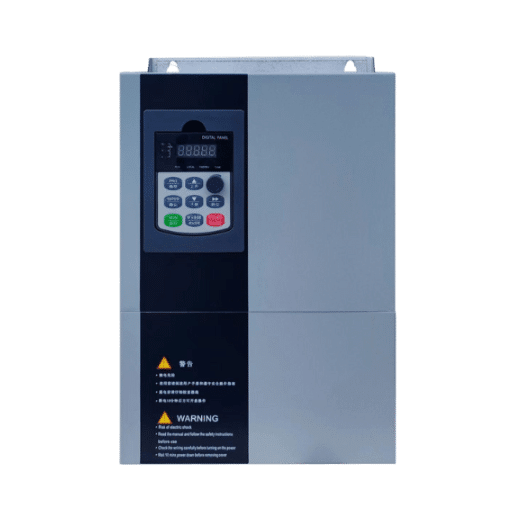
| Common VFD applications include boiler feed pumps, ID/FD fans, cement kiln fans, and steel rolling mills. |

Outside power generation, high power VFD systems serve cement, steel, metals, oil and gas, and other process industries. The same principles, match speed to load, recover braking energy, and reduce mechanical stress, apply, but the equipment and duty cycles differ.
Cement plants use large fans, mills, and conveyors. A VFD cement kiln fan retrofit is one of the fastest-payback projects in cement manufacturing. Kiln-induced-draft fans, raw-mill fans, coal-mill fans, and clinker cooler fans are prime candidates for VFD retrofits because they traditionally use damper or hydraulic coupling control.
At a Shenzhen cement plant with two 5,000-tonne-per-day clinker lines, operators replaced hydraulic couplers with medium-voltage variable-speed drives. The retrofits covered high-temperature fans, coal-mill fans, and circulating fans. Power input on the 2,500 kW high-temperature fans fell from 2,221 kW to 1,777 kW on one line and from 2,420 kW to 1,866 kW on the other. That’s roughly 20–29% savings. Power factor improved from about 0.85 to above 0.95.
| Cement Application | Typical Power | VFD Savings | Payback |
|---|---|---|---|
| Kiln ID fan | 500–4,000 HP | 25–45% | 8–18 months |
| Raw mill fan | 400–3,000 HP | 15–30% | 12–24 months |
| Coal mill fan | 200–800 HP | 20–40% | 6–14 months |
| Clinker cooler fan | 100–500 HP | 15–35% | 8–16 months |
| Cement mill drive | 2,000–6,000 HP | 10–20% | 18–36 months |
A VFD steel rolling mill installation gives steel plants the precise torque and speed control they need for rolling stands, blast furnace blowers, sintering fans, and electric arc furnace auxiliaries. Rolling mill stands experience shock loads during bite-in and require high starting torque, often 200–250% of rated torque for 60 seconds. Vector control and direct torque control (DTC) VFDs handle these cycles.
Regenerative active front end (AFE) drives are valuable in steel because they return braking energy to the grid instead of dissipating it as heat. One retrofit at a hot rolling mill replaced aging DC drives with regenerative AFE VFDs. The system recovered more than 95% of braking energy and reduced overall rolling mill energy use by about 18%.
In refineries and pipelines, VFDs control pumps, compressors, and extruders. A refinery case documented by TMEIC replaced a gas turbine driving a 30,000 hp compressor with an electric motor plus an LCI adjustable-speed drive. The change eliminated NOx emissions from the turbine starter and improved reliability. For more sector-specific guidance, see our VFD applications in oil and gas overview.
Need deeper guidance on compressor VFDs? Read our VFD for compressors guide for control strategies and sizing.
Selecting the right topology for a VFD for power plants and heavy industry depends on motor type, power rating, regeneration needs, harmonic limits, and physical constraints.
| Topology | Typical Voltage | Typical Power | Best For | Notes |
|---|---|---|---|---|
| 2-level voltage source inverter (VSI) | 2.3–4.16 kV | 400 kW–5 MW | General purpose, retrofit | Simple, mature, may need output filter |
| 3-level NPC / ANPC | 3.3–6.6 kV | 500 kW–8 MW | Pumps, fans, compressors | Better waveform, lower harmonics |
| Cascaded H-bridge | 6–13.8 kV | 1–25+ MW | High-voltage motors, fans | Multi-level output, low harmonics |
| LCI (load-commutated inverter) | 3.3–13.8 kV | 10–100+ MW | Synchronous motors, gas turbine starters | Thyristor-based, ~99% efficiency |
Air-cooled drives are simpler to maintain and lower in first cost. They work well in clean electrical rooms with adequate ventilation. Water-cooled drives are smaller, quieter, and better suited to hot, dusty, or space-constrained plants such as cement kilns and steel mills.
Non-regenerative drives use a diode or thyristor rectifier and dissipate braking energy in resistors. They’re sufficient for fans, pumps, and most compressors. Regenerative AFE drives return braking energy to the grid and are ideal for applications with frequent deceleration, such as rolling mills, downhill conveyors, and test stands.

A medium voltage VFD power generation installation must meet strict standards and survive harsh industrial conditions. The most important specifications include:
For harsh environments, specify appropriate enclosure ratings to protect plant power quality and equipment. IP54 or NEMA 12 enclosures protect against dust in cement plants. Filtered air intakes prevent clogging. Water- or liquid-cooled designs handle high ambient temperatures. Vibration-resistant mounting and conformal-coated boards improve reliability near crushers, mills, and rolling stands.
The business case for a VFD for power plants and heavy industry retrofit depends on three factors: baseline energy use, operating hours, and electricity price. Most VFD projects are retrofits of existing fixed-speed motors, so the main driver is energy efficiency on partial-load motors. For variable-torque loads, the affinity laws provide a quick estimate. A fan running at 80% speed for half the year uses roughly half the power of a damper-controlled fan at the same duty point.
Consider Ana, a cement plant manager who wanted to retrofit a 1,600 kW kiln ID fan. The fan ran 8,000 hours per year at an average 75% speed. With damper control, it consumed 1,400 kW. After installing a VFD, average power dropped to 720 kW. At 0.08perkWh,annualsavingsreached0.08perkWh,annualsavingsreached435,000. The retrofit cost $520,000, giving a 14-month payback.
| Application | Energy Savings | Typical Payback | Main Value Driver |
|---|---|---|---|
| Power plant BFP | 20–30% | 18–36 months | Throttle loss elimination |
| Power plant ID/FD fan | 30–60% during turndown | 12–24 months | Damper replacement |
| Cement kiln ID fan | 25–45% | 8–18 months | Hydraulic coupling replacement |
| Steel rolling mill | 15–25% | 24–48 months | Regenerative braking |
| Compressor | 15–35% | 12–30 months | Load/unload elimination |
Modern drives add only 2–4 percentage points of loss, so net savings remain large. Efficiency for medium voltage VFDs typically ranges from 96% to 98.5%. LCI systems can reach about 99% converter efficiency. Evaluate any drive on life cycle cost, not just first purchase price.
To understand where these losses come from and how to compare drives on a like-for-like basis, our deep dive into high voltage VFD efficiency breaks down each loss source and how topology choices affect the total.
A high voltage variable frequency drive (VFD) is a power-electronics system that controls the speed and torque of large AC motors by varying voltage and frequency. In industrial practice, “high voltage” usually means 2.3–13.8 kV and 400 kW to 25 MW or more.
Power plants should consider VFDs on large auxiliary motors with variable load profiles, especially boiler feed pumps, ID/FD fans, condensate pumps, cooling water pumps, and compressors. The biggest returns occur on equipment that runs at partial load for long hours.
Yes. VFDs eliminate the 5–8% slip loss of hydraulic couplers, improve speed accuracy, reduce cooling-water needs, and raise power factor. Many cement plants retrofit kiln and raw mill fans with medium voltage drives for exactly these reasons.
Many modern MV drives meet IEEE 519 and IEC 61800-3 without external filters. Cascaded H-bridge, 3-level NPC, and active front-end designs produce low harmonic distortion. Older 6-pulse drives or plants with weak grids may still require passive or active filters.
Payback typically ranges from 12 months to 3 years. Boiler feed pump and fan retrofits often pay back in 1–2 years because they run continuously and offer large throttle or damper savings.
A well-chosen VFD for power plants and heavy industry pays for itself through lower auxiliary power, better process control, and longer equipment life. The best opportunities are large motors with variable loads: boiler feed pumps, ID/FD fans, cement kiln fans, steel rolling mills, and compressors.
Key takeaways to remember:
Shandong Electric designs and supplies solutions for the high voltage VFD power plant and heavy industry markets, serving power generation, cement, steel, mining, and oil and gas. Contact our engineering team to discuss your application, request a quotation, or get support selecting the right drive for your plant.