Ready to Get Your VFD Solution?
Whether you need a single drive or a complete system, we have the VFD products and engineering support to ensure your project's success.


A VFD overcurrent fault means the drive detected output current above its protection limit, usually 150-200% of rated current, and shut down to protect itself and the motor. The fix depends on when the trip happens: immediately at startup, during acceleration, at constant speed, or during deceleration.
Last Thursday at 6:15 a.m., the main conveyor at a food packaging plant in Ohio refused to start. The operator saw “E. OC1” flashing on the drive keypad. He pressed reset. The drive ran for four minutes and tripped again.
By noon, the maintenance team had swapped in a spare drive, only to watch it fault the same way. The real problem wasn’t the drive at all. A seized roller was demanding more torque than the motor could deliver. The team wasted half a day because they treated the fault code as the diagnosis.
This guide covers the most common VFD overcurrent fault causes and solutions, giving you a repeatable method for diagnosing and fixing the trip. It explains what the code really means, how to separate mechanical from electrical causes, and what to check at each operating stage.
Key Takeaways
- A VFD overcurrent fault is a symptom, not a root cause. The code tells you current exceeded a threshold; you must find out why.
- About 35-45% of all VFD trips are overcurrent faults, making this the most common fault category.
- Trips at startup usually mean a shorted motor, cable, or failed IGBT. Trips during acceleration point to ramp settings or load inertia.
- Trips at constant speed often indicate mechanical overload, voltage imbalance, or an encoder problem in vector control.
- Trips during deceleration are usually caused by regenerative energy, not a true overcurrent condition.
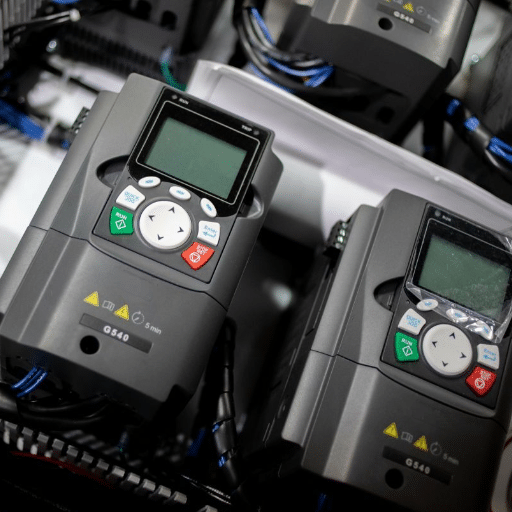
An overcurrent fault occurs when current drawn from the drive’s output stage exceeds the programmed or hardware protection threshold. Most VFDs trip at 150-200% of their rated output current. VFD overcurrent protection disables the IGBT output pulses to prevent thermal damage to the power module and the motor. This behavior aligns with the overcurrent protection principles outlined in the NEMA MG1 motors and generators standard.
The drive measures current using Hall-effect sensors or shunt resistors. When the measured value crosses the limit, the firmware logs a fault code and stops modulation. Some drives distinguish between a VFD overcurrent fault during acceleration, deceleration, and steady run. Others group all three under a single OC code.
Overcurrent protection is fast. It reacts in microseconds for hardware limits and milliseconds for software limits. That speed protects the drive, but it also means the trip can look violent even when the underlying problem is simple.
Many technicians use these terms interchangeably, but they are different protections.
Overcurrent (OC) is an instantaneous or near-instantaneous trip caused by a current spike. It protects against shorts, severe overloads, and sudden mechanical jams. The trip time is typically less than one second.
Overload (OL) is a thermal model trip. The drive calculates motor heating based on current over time. A motor running at 110% of rated current for thirty minutes may trigger an overload without ever hitting the overcurrent threshold.
OL protects the motor from sustained overheating. OC protects the drive and motor from sudden destructive currents.
If your drive displays “OL” or “motor overload,” you are looking at a thermal problem, not a short or spike. The diagnostic path is different. This article focuses on the VFD overcurrent fault specifically.
Fault codes vary by brand, but the condition is universal. Here is how major manufacturers label overcurrent faults.
| Manufacturer | Overcurrent Fault Code | Notes |
|---|---|---|
| ABB | 2310 | Overcurrent trip, often with current value logged |
| Siemens | F0001 | Overcurrent fault |
| Mitsubishi | E. OC1 / E. OC2 / E. OC3 | OC1 = accel, OC2 = decel, OC3 = constant speed |
| Yaskawa | oC | Overcurrent; sub-codes may indicate phase |
| Danfoss | 4, 13 | Alarm 4 = overcurrent, 13 = overcurrent |
| Delta | oc | General overcurrent fault |
Mitsubishi’s three-code scheme is useful because it tells you exactly when the fault happened. If you see E. OC1, you can immediately focus on acceleration ramp, load inertia, or starting conditions.
E. OC2 points to deceleration and braking. E. OC3 points to steady-state load or motor problems.
For a broader view of fault codes across manufacturers, see our complete VFD troubleshooting guide.
Before you touch the drive, follow lockout/tagout procedures. Verify zero energy at the input terminals and the DC bus. Capacitors can hold a lethal charge for several minutes after power is removed. For broader power-quality context, refer to the IEEE 519 standard.
Take a photo of the display before you clear the fault. Note the exact code, the current value if shown, the output frequency, and the operating state at the moment of trip. Resetting erases this information.
Use the same framework from our VFD troubleshooting pillar to diagnose any VFD overcurrent fault:
The fastest way to narrow the cause is to match the fault to the operating state:
This framework prevents the random parts-swapping that wastes time and money.

A trip the moment the drive starts modulation is the most serious type of VFD short circuit fault. The drive sees a near-short-circuit condition before the motor even begins to turn.
First, disconnect the motor cable at the drive output terminals. Try to start the drive. If it still trips immediately with no load connected, the problem is inside the drive. Suspect a failed IGBT or current sensor.
If the drive starts with the motor disconnected, measure insulation resistance with a megger. Apply 500 V DC for low-voltage systems. Motor and cable insulation should read greater than 5 MΩ to ground.
Readings below 1 MΩ indicate damaged insulation. Between 1 MΩ and 5 MΩ is marginal; investigate further.
Next, measure phase-to-phase resistance at the motor terminals. The three readings should be balanced within a few percent. A very low or unbalanced reading points to a winding short.
Finally, inspect the IGBT module. With power off and the DC bus discharged, use a diode test function to measure from each output phase to the positive and negative DC bus terminals. A shorted IGBT will show near-zero resistance in both directions.
A maintenance team at a steel mill spent two days chasing an intermittent overcurrent trip on a 75 kW fan. The motor spun freely by hand. The cable insulation looked fine visually.
A megger test finally revealed a phase-to-ground fault that caused the VFD overcurrent fault only when the cable moved during operation. Vibration had worn through the insulation at a cable tray entry point. Replacing a ten-foot section of cable solved the problem. The drive was never at fault.
For ground-fault-specific diagnosis, see our guide to VFD ground fault diagnosis.
Acceleration trips are the most common overcurrent fault. The drive is trying to bring the motor from zero to running speed faster than the load allows.
Start by doubling the acceleration time. If the fault disappears, the original ramp was too aggressive for the load inertia. This is the easiest fix and the one most often overlooked.
If lengthening the ramp does not help, disconnect the mechanical load and run the motor uncoupled. If the motor accelerates cleanly without load, the problem is mechanical. Check bearings, couplings, belts, and the driven equipment for binding.
Verify that the drive’s motor parameters match the nameplate: rated voltage, rated current, base frequency, rated speed, and power factor. Entering a current rating lower than the motor actually draws will cause nuisance trips. Entering a higher rating removes protection and isn’t safe.
At the Ohio packaging plant, the 22 kW conveyor drive had been running fine for months. After a night shift changed some parameters, the drive began tripping on E. OC1 every morning.
The acceleration time had been set to 0.5 seconds. For a conveyor loaded with product, that ramp demanded more torque than the motor could produce. Lengthening the acceleration time to 4.5 seconds eliminated the VFD overcurrent fault completely. No parts were replaced.

A VFD motor overcurrent trip that occurs while the motor is already running usually points to a load change or a developing electrical problem.
Compare the drive’s displayed output current to a clamp-on ammeter reading. If the display shows high current but the clamp meter does not, suspect a current sensor or control board problem. This is rare but worth checking before replacing the motor.
Look for correlation between process events and trips. Does the drive trip when a valve opens, a gate closes, or another machine cycles? Those events often reveal the real mechanical cause.
Measure input voltage balance at the drive terminals. A voltage imbalance greater than 2-3% can cause excessive current in one phase. Imbalance often traces back to a loose input terminal, bad contactor, or utility issue.
If the drive uses closed-loop vector control, inspect the encoder cable and coupling. A lost encoder pulse can cause the drive to command excessive current while trying to maintain torque. Check for loose connections, broken wires, and coupling slippage.
A water treatment plant in Durban had a 30 kW pump drive that tripped on a VFD overcurrent fault every afternoon. The motor was sized correctly and the ramps were conservative.
After watching the process, an engineer noticed the trip happened when a downstream valve partially closed. The sudden pressure rise overloaded the pump. Adjusting the valve control logic and adding a small acceleration boost solved the issue.
Deceleration trips can be confusing because the motor is slowing down, not speeding up, yet the VFD overcurrent fault still appears. The cause is usually regenerative energy feeding back into the drive.
Lengthen the deceleration time and retest. If the fault disappears, the ramp was too short for the load inertia. High-inertia loads such as fans, flywheels, and large conveyors cannot stop quickly without dumping energy somewhere.
Measure the DC bus voltage during deceleration. If it rises above the drive’s overvoltage threshold, the drive may first try to limit current, then trip on overcurrent or overvoltage depending on firmware logic.
Check whether a braking resistor is installed and sized correctly. A missing or undersized resistor is a common cause of decel trips on high-inertia loads.
For detailed deceleration and braking guidance, see our VFD overvoltage fault guide.
Incorrect parameters cause roughly 60% of post-installation VFD overcurrent faults. A few specific mistakes are responsible for most trips. See our VFD parameter settings guide for the values to enter correctly.
If the drive thinks the motor is smaller than it is, it will trip at normal load current. Always enter the exact full-load current from the motor nameplate, not the drive rating.
A ramp that works for a small fan may be completely wrong for a loaded conveyor. Ramp time must be calculated from load inertia and required torque, not copied from the previous job.
Setting the voltage too high at low frequency increases magnetizing current and can cause saturation. This produces high current without useful torque.
Sensorless vector control requires the drive to know the motor’s electrical characteristics. Skipping auto-tune can cause instability, hunting, and current spikes.
Some drives have a separate current limit parameter. If this is set below the actual running current, the drive will trip even though everything else is correct.
Sometimes the VFD overcurrent fault is caused by the drive itself. Hardware failures usually show a clear pattern.
If an IGBT is shorted, the drive needs repair or replacement. Don’t keep resetting it. Repeated attempts to start into a short can damage upstream components.
If the drive display current doesn’t match an external clamp meter, the internal current sensor may be drifting. This can cause false overcurrent trips when the actual current is normal. Sensor replacement usually requires manufacturer service.
Repair the drive if the fault is isolated to a cooling fan, control board connector, or parameter corruption. Replace the drive if the power stage is damaged, repeated IGBT failures occur, or repair cost exceeds 50-60% of a new unit. Call the manufacturer if the drive is under warranty or if the fault is unexplained and keeps repeating.
The best troubleshooting call is the one you never make. A few preventive habits eliminate most overcurrent trips before they happen.
For a complete maintenance schedule, see our VFD preventive maintenance checklist.
A VFD overcurrent fault occurs when output current exceeds the drive’s protection threshold, typically 150-200% of rated current. The drive shuts down to protect its power stage and the motor.
Repeated overcurrent trips are usually caused by mechanical overload, shorted motor or cable, acceleration ramp too short, incorrect motor current setting, or a failed output IGBT.
Overcurrent is a fast trip caused by current spikes. Overload is a thermal model trip caused by sustained current above rated value.
Yes. Shorted windings, phase-to-ground faults, seized bearings, and insulation breakdown under load can all cause overcurrent trips.
With power off and the DC bus discharged, use a diode tester to measure resistance from each output phase to the positive and negative DC bus terminals. A shorted IGBT shows near-zero resistance in both directions.
Motor and cable insulation resistance should be greater than 5 MΩ at 500 V DC for reliable low-voltage VFD operation.
The acceleration ramp is probably too short for the load inertia, or the mechanical load is jammed. Lengthen the ramp and disconnect the load to isolate the cause.
Yes. Long cables create distributed capacitance and reflected waves that can produce current spikes. An output reactor or dV/dt filter usually solves this.
A VFD overcurrent fault is a warning, not a diagnosis. The fault code tells you that current exceeded a threshold. Your job is to find out whether the cause is mechanical, electrical, parameter-related, or inside the drive itself.
Start with safety. Record the code and operating state before resetting. Use the time-based framework to narrow the search for the VFD overcurrent fault: startup, acceleration, constant speed, or deceleration.
Measure insulation, verify parameters, and isolate the load before replacing hardware.
Most overcurrent trips don’t require a new drive. They require systematic diagnosis. If the problem is complex, repeated, or involves the drive’s power stage, contact the Shandong Electric engineering team. We can help you diagnose the fault, select the right protection or replacement, and get your line running again.
For a broader troubleshooting method, see our complete guide to VFD troubleshooting. For product and application support, visit our Shandong Electric VFD product range page.