Ready to Get Your VFD Solution?
Whether you need a single drive or a complete system, we have the VFD products and engineering support to ensure your project's success.


You can buy a reliable VFD from China. The catch is that “VFD manufacturer China” is a label claimed by genuine factories and trading companies alike, and the difference between them is something you can test in five questions.
Here’s the problem. Two suppliers send you the same-looking PDF, quote the same nameplate, and use the same words: “We are a professional VFD manufacturer in China.” One owns an SMT line and a test rig. The other rents a logo and buys drives from a factory it will never let you see.
On paper they are identical. In reality, one runs for a decade and the other dies quietly inside a year, and the only thing separating them is how much you asked before you paid.
If you’ve been pricing China VFD suppliers, you already feel the wall. The savings are real, often 30 to 50 percent below a Western major for the same spec. But the risk feels real too, because “China” hides a spectrum from world-class factories to rebranded resellers. This guide hands you a framework to sort them, and it’s the same framework we invite buyers to run on us.
By the end, you’ll be able to answer five questions about any China VFD supplier, demand the certifications that matter, and work out the true landed cost before a single container ships.
Key Takeaways
- “VFD manufacturer China” means genuine factory or reseller, depending on who is saying it; the five-question test tells them apart before you pay
- The 30-50% price gap vs Western majors comes from skipping the brand premium, not the quality, because China factories build on the same IGBT modules
- Demand the Declaration of Conformity, not just a “CE” sticker; verify UL, ISO 9001, and IEC 61800 in the registry, not in a PDF
- Normal MOQs, lead times, and payment terms are knowable, and anything far outside the norm is a red flag
- Landed cost, not FOB price, is the number that matters; a “cheap” quote often costs more after freight, duty, and a missing inspection clause

The answer is simple and quantifiable: a China-based VFD manufacturer buys the same core components, runs the same SMT placement and burn-in tests, and ships a drive that is typically 30 to 50 percent cheaper than an equivalent Western major at the same spec.
Where does that gap come from? Not from lower quality. It comes from the fact that a major-brand drive carries the cost of that brand’s R&D, its global sales force, and its marketing, and you pay for all three even if you use none of it.
The components tell the real story. A China VFD factory builds its power section on the same IGBT modules from Infineon, Mitsubishi, and Fuji that the majors use. The control algorithms are vector control (SVC and FVC) and V/F control, the same techniques used in any modern drive. What’s missing is the premium, not the performance.
That gap is the difference between a profitable line and a non-starter for an importer buying container quantities or for an OEM putting a drive into every machine it builds.
Sofia learned this from the good side of the fence. A machine builder in Milan, she was quoted 35 percent under her usual European line for a 22 kW drive and almost placed the order on the spot. Instead she ran a two-minute check on the supplier’s business license and found it said “trading company,” not “manufacturing.” She kept looking, found a genuine factory, and now buys direct at a margin her competitors can’t match.
Want the big picture before you go deep? Our VFD manufacturer guide maps the full global landscape, and our top VFD manufacturers survey shows where the China tier sits against the majors.
The single most important thing to understand about China VFD suppliers is that the word “manufacturer” is used loosely, especially on B2B platforms.
The supply chain in China runs in roughly four layers, and only the first is a true manufacturer:
Why does the layer matter? Because price, warranty, and support all attach to it. Buy factory-direct and you pay less but carry more of the sourcing work. Buy from a trading company and you get distributor pricing with factory-direct risk, and nobody who can actually fix the drive.
The anxiety around “China VFD manufacturers” is really anxiety about which layer you are buying from. The next section gives you the tool to find out.

Every genuine China VFD manufacturer passes the same five questions, and you don’t need to be an electrical engineer to run them.
A factory does this in an afternoon. A trader can’t because it doesn’t own the line.
Marco caught a trader with test number three. A distributor in São Paulo asked a “factory” for SMT-line photos with his company name in the frame. What came back was a set of glossy stock images, and in the corner of one sat a rival brand’s logo. He walked away and later found the same drive cheaper, factory-direct, from the plant that had actually built it.
Certifications are where buyers get fooled, because a sticker isn’t the same thing as a certificate. Here is what to demand and how to verify each one.
The pattern is the same across all four: ask for the number, then verify the number in an independent registry. A certificate you can’t verify is worth exactly what the PDF cost to make.
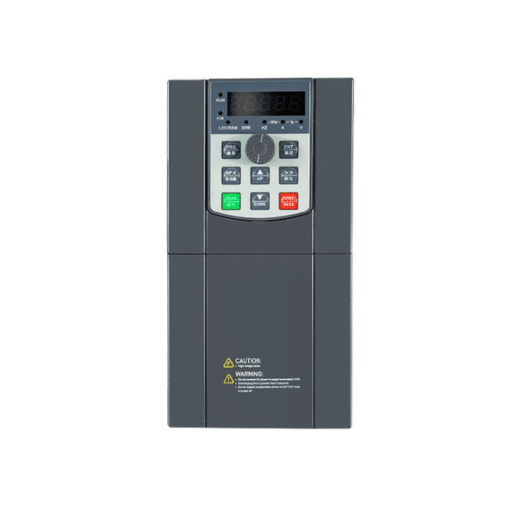
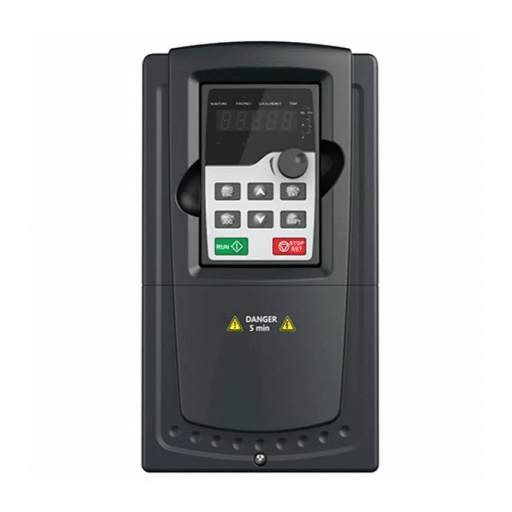
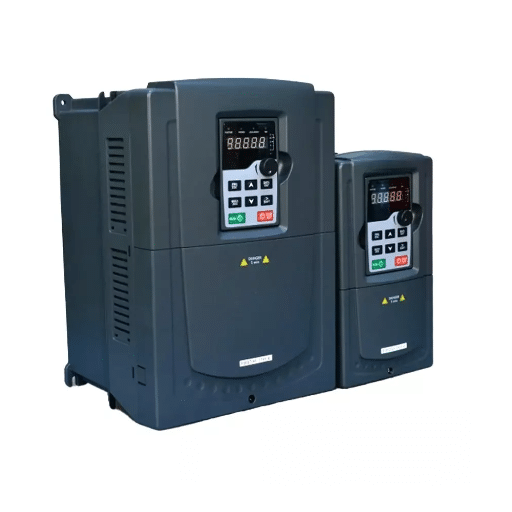
Here’s the drive you’re about to source, so you know what those tests are protecting:
Buyers overpay not because they get a bad price, but because they do not know what a normal China VFD import looks like, so they cannot spot an abnormal one.
MOQ norms. A genuine factory will usually sell you a sample run of one to five units to test. A trial order of ten to fifty is common before a full commitment. A supplier that refuses anything under a container is often a trader who can’t be bothered with a buyer who checks the goods.
Lead-time norms. An off-the-shelf low-voltage drive typically ships in two to four weeks. A custom or high-voltage drive runs for four to eight weeks or more. A supplier promising a custom drive in one week is either misrepresenting what “custom” means or planning to ship you whatever is on the shelf.
Payment red flags. The classic trap is 100 percent T/T upfront with no inspection clause. Safer structures are T/T with a deposit and balance against inspection, a letter of credit for larger orders, or escrow for trial runs. If a supplier insists on full payment before they will even show you the factory, that’s the end of the conversation.
For OEM buyers, these terms interact with customization. Our OEM VFD supplier guide covers sourcing terms, and our custom VFD manufacturer guide breaks down NRE cost and MOQ for made-to-spec drives.

The number that matters isn’t the FOB price on the quote. It’s the landed cost, the total price per drive sitting in your warehouse.
The three trade terms you will see are FOB (you own it from the factory gate), CIF (seller covers freight and insurance to your port), and DDP (seller delivers to your door, duties paid). Each shifts risk and cost, and each changes the real price.
A VFD falls under a specific HS code, and import duty varies by country and by whether your country has a trade agreement with China. You should get a duty estimate from a freight forwarder before you commit to any quote, because duty is where “cheap” quotes quietly stop being cheap.
Here is a worked landed-cost example for a mid-range 22 kW low-voltage drive:
| Cost line | Amount (per unit) |
|---|---|
| FOB price, factory-direct | $420 |
| Ocean freight (allocated) | $18 |
| Insurance | $5 |
| Import duty (5% on CIF value) | $22 |
| Customs brokerage + clearance | $15 |
| Landed cost per unit | $480 |
It is worth comparing the quotes from trading companies. A trader might offer an FOB price of 455—which may not seem like a huge difference at first glance—yet this is 40% higher than the factory cost of 325. Furthermore, such quotes often mask the fact that the drive comes with neither a test report nor a genuine warranty. Only by calculating the “landed cost” does the true difference between so-called “cheap” and “expensive” quotes become apparent.
Priya benchmarked exactly this. An importer in Mumbai, she was holding two quotes for a container of drives. The first, factory-direct, was higher on FOB but itemized every option and every test. The second, from a trader, was 15 percent lower and refused to itemize.
When she added freight, duty, and a missing-inspection clause, the “cheaper” quote came out 12 percent higher in landed cost. She bought directly.
Want the full pricing picture? Our VFD price guide walks through every cost driver and gives you a quote-request checklist so your RFQs come back comparable.
Here is the whole process, compressed into a list you can copy and run in order.
Run it from top to bottom and the chance of being burned drops to near zero. Skipping step one and every step after it becomes a gamble.

We told you at the top that this guide is the framework we invite buyers to run on us. Here is how that looks.
Shandong Electric Co., Ltd. is a Chinese VFD manufacturer with a range that spans 0.1 kW to 53,000 kW, from 220V-690V low-voltage drives to 6kV-10kV high-voltage systems. Our drives use vector control (SVC and FVC) and V/F control, deliver 150 percent overload capacity, and reach up to 98 percent efficiency. They speak Modbus and Profibus, so they drop into an existing line without a fight.
Against the high-end European brands, we compete on the three things that move a sourcing decision: price, customization speed, and lead time. And we pass the five questions by design, because we own the SMT line, the test rigs, and the factory we will gladly show you.
The honest caveat, because it matters: if you are running a continuous process where an hour of downtime costs more than our entire invoice, buy the major. Their service reach is real and worth paying for in that one scenario. For everything else, run the five questions on us and judge for yourself.
See what we actually build. Browse our full VFD range, our low-voltage drive systems, and our high-voltage drive systems.
Yes, if you buy from a genuine manufacturer and not a trading company. Run the five-question test, demand type-test reports, and verify CE, UL, ISO 9001, and IEC 61800 in independent registries. A real Chinese factory uses the same IGBT modules as the majors and saves you 30 to 50 percent.
Read the business license for a “manufacturing” scope, ask for the factory address and proof they occupy it, and request an SMT-line photo or video with your name and date in the frame. A factory does all three in an afternoon; a trader stalls.
The best ones are. A genuine China VFD manufacturer uses the same IGBT modules as the Western majors and runs the same SMT placement and burn-in tests. The reliability risk comes from buying a trading company’s drive with no test reports, not from the country of origin.
Typically 30 to 50 percent below an equivalent Western major at the same spec, because you skip the brand premium rather than the quality. The honest number is the landed cost, not the FOB price.
A genuine factory usually sells a sample run of one to five units, then a trial order of ten to fifty before a full commitment. A supplier that refuses anything under a container is often a trader.
CE with a Declaration of Conformity, UL or cUL for North America, ISO 9001 for the quality system, and IEC 61800 compliance backed by type-test reports. Ask for the certificate number and verify it in the registry, not just in the PDF.
Sourcing a VFD from China isn’t a gamble. It’s a verification problem, and you now hold the tool to solve it.
Ask who owns the factory, and read the business license. Demand the type-test reports and verify the certifications. Structure the payment so you’re not paying for a promise. And price the deal on landed cost, not on the FOB number that looks good in an email.
A genuine China VFD manufacturer passes every one of these checks and is happy to be tested. A trading company fails one of them and hopes you never ask. That single question, run early, is the difference between a decade of service and a container full of regret.
If you came here unsure whether to trust a Chinese supplier, you now have the framework that replaces hope with evidence. Run the five questions, verify the certificates, and do the landed-cost math, and you will source with confidence instead of luck.