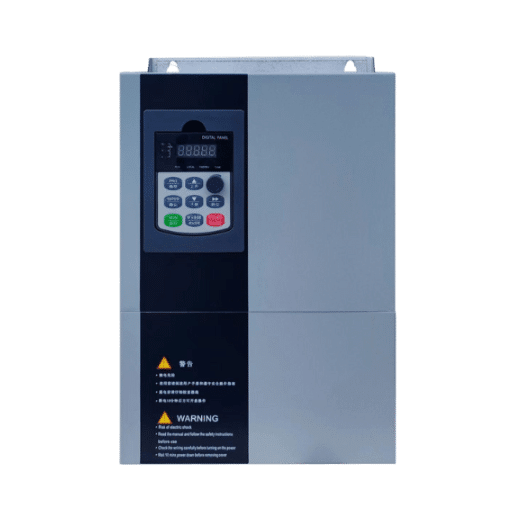
Ready to Get Your VFD Solution?
Whether you need a single drive or a complete system, we have the VFD products and engineering support to ensure your project's success.


A successful high-voltage VFD installation requires more than connecting input and output terminals. It demands correct site preparation, foundation work, cable selection, shield grounding, cooling design, protection coordination, and commissioning. Get one of these wrong and even the best drive will trip, overheat, or fail prematurely.
Many project teams treat the drive as a black box that simply needs power and a motor cable. In reality, the installation often determines whether a medium voltage drive reaches its rated lifespan. Poor grounding causes bearing damage. Inadequate cooling causes thermal shutdowns. Wrong cable shielding causes EMI that locks up PLCs.
This guide walks through the high-voltage VFD installation requirements that matter most for drives from 2.3 kV to 13.8 kV. It explains why each requirement exists, what can go wrong, and how to avoid the mistakes that turn a promising retrofit into a reliability problem.
Key Takeaways
- High voltage VFD installation covers site prep, foundation, cables, grounding, cooling, protection, and commissioning.
- MV motor cables need VFD-rated construction with proper shield grounding; one-end or both-end grounding depends on the drive topology and manufacturer.
- Foundation unevenness should be ≤5 mm, and electrical rooms need arc-flash clearances and segregated cable trenches.
- Cooling must be sized for total system losses, not just drive headline losses.
- Commissioning should include insulation testing, phasing checks, no-load tests, and thermal imaging before full load.

In industrial practice, high-voltage VFD usually refers to a medium-voltage adjustable-speed drive. These drives operate from roughly 2.3 kV to 13.8 kV and power motors from a few hundred kilowatts to tens of megawatts. True high voltage drives above 35 kV are rare outside utility or traction systems.
The installation differs from low-voltage work in several important ways:
Because the stakes are higher, the planning phase should start before equipment arrives on site.
When Carlos Mendez, a project manager at a Colombian cement plant, scheduled a 6.6 kV VFD retrofit, he assumed the existing electrical room could accept the new cabinets. Once the transformers arrived, the team discovered the doorway was too narrow and the floor loading was insufficient for the phase-shifting transformer. The delay cost three weeks. A proper site survey would have caught both issues in hours.
Want to make sure your site is ready? Start with our complete guide to high voltage VFDs for voltage class, topology, and application fundamentals.
The electrical room is the home of the drive system for the next 20 years. Design it for safety, access, cooling, and future maintenance.
Place the drive room as practical as possible. Shorter motor cables reduce dV/dt reflections, cable costs, and I²R losses. At the same time, keep the room clean, dry, and protected from process dust or corrosive atmospheres.
Plan clearances around every cabinet according to the manufacturer and local electrical code. Medium voltage equipment needs more working space than LV gear. Arc-flash boundaries are larger, and maintenance crews need room to open doors, remove panels, and withdraw modules.
Cabinets and transformers must sit on a level, rigid base. Foundation unevenness should typically be ≤5 mm across the installed footprint to ensure doors close properly and busbars align. For heavy transformers and water-cooled heat exchangers, verify that the floor can support the concentrated load.
A channel-steel or raised housekeeping pad is common. The VFD cabinet should be bonded to the facility ground through this base.
Install the drive line-up over or adjacent to a cable trench. Route these cable classes separately:
Mixing HV power with control wiring invites noise coupling and erratic drive behavior. Maintain separation distances specified by the manufacturer; 300 mm is a common minimum.
Most MV drives are rated for ambient temperatures from roughly -10 °C to +40 °C or -40 °C to +50 °C depending on design. Altitude derating typically starts above 1,000 meters. Humidity, dust, and corrosive gases must be controlled or the enclosure IP rating must match the environment.
After the site is ready, the equipment arrives. Mechanical installation sets the stage for every electrical connection that follows.
Inspect crates for shipping damage before unpacking. Check nameplate data against purchase specifications: voltage, current, power, frequency, and enclosure rating. Take photos of any damage and notify the carrier and manufacturer immediately.
Store sensitive components in a clean, dry space if they will not be installed within a few days.
Use lifting equipment rated for cabinet weight. Move units carefully to avoid stressing doors and panels. Anchor cabinets to the foundation according to the manufacturer’s torque schedule. Verify that cabinets are plumb and aligned so that busbar connections and doors operate freely.
Leave enough space for future work. At minimum, allow the manufacturer’s recommended front and rear access widths. For draw-out power modules or transformer removal, provide crane or forklift paths.
Cascaded H-bridge and other MV topologies use input transformers. These units are heavy and generate heat. Position them with proper ventilation and keep cable routes short to the drive input sections.

Cable selection is one of the most common sources of MV VFD problems. Standard power cable is not always suitable.
A good MV VFD motor cable typically includes:
Avoid PVC-insulated cable unless the manufacturer specifically allows it. The PWM output of voltage-source drives creates high-frequency components that stress insulation.
Current-source drives behave more like standard 60 Hz power and can often use conventional MV cable. Always confirm with the drive manufacturer.
Size conductors for rated full-load current plus harmonic heating. At medium voltage, voltage drop is usually small over typical distances, but it still must be checked. Account for cable losses in the overall efficiency calculation.
This is one of the most debated topics in VFD installation. The goal is to give common-mode currents a controlled return path without creating ground loops or circulating currents.
For voltage-source PWM drives, many manufacturers recommend grounding the motor cable shield at both ends. This provides a low-impedance path for high-frequency currents and reduces EMI in building steel. However, some manufacturers prefer grounding the shield only at the VFD end to avoid circulating currents at fundamental frequency.
If the manufacturer allows both-end grounding, keep the grounding pigtail as short as possible, ideally less than 60 cm. For long cables or sensitive environments, dV/dt filters or sinusoidal output filters may be required.
Long motor cables can create voltage reflections at the motor terminals. Reflections stress motor insulation and can cause premature failure. As a rule of thumb, consider output reactors or dV/dt filters for cable runs above roughly 100-150 meters. Some applications may need filters at shorter lengths depending on switching frequency and motor insulation class.
Grounding protects people and equipment. It also controls electromagnetic interference. MV VFD grounding has specific rules that differ from simple LV practice.
Bond the entire VFD line-up to the facility ground grid. The bonding conductor should be short and sized per local code. If the manufacturer recommends a single bonding point, locate it in the input cabinet because input ground-fault currents are usually larger than output faults.
If a grounding grid runs beneath the equipment, multiple bonding points to the grid may be acceptable. Follow the manufacturer’s grounding diagram exactly.
For phase-shifting input transformers, do not bond the transformer primary neutral or the MV output neutral point to ground unless the manufacturer requires it. Incorrect neutral grounding can create circulating currents and trips.
Bond the motor case to the facility ground with a dedicated conductor sized for fault current. Do not rely on conduit as the sole ground path. The motor cable shield does not replace the safety ground conductor.
PWM waveforms create common-mode voltages that can discharge through motor bearings, causing fluting and premature failure. For motors rated above roughly 100 kW or operated at variable speed for long periods, specify:
At a steel mill in South Korea, a 3.3 kV fan motor failed twice within 18 months after a VFD retrofit. The root cause was bearing fluting from common-mode voltage. After adding a shaft grounding ring and one insulated bearing, the motor ran without issue for more than five years.
MV drives convert a small percentage of input power into heat, but the absolute number can be large. A 10 MW drive at 97% efficiency still dissipates 300 kW.
Calculate total heat load including:
Size room ventilation or air conditioning accordingly. Provide filtered intake air and avoid recirculation of hot exhaust. Maintain positive pressure in the room to reduce dust infiltration.
Water-cooled drives move most heat out of the electrical room. The installation must include:
For more details on liquid-cooled systems, see our water-cooled VFD guide.

Control wiring is often the source of mysterious drive faults. Proper separation and shielding prevent most problems.
Run control cables at least 300 mm away from power cables. If they must cross, cross at 90 degrees. Never run control and power cables in the same conduit or cable tray over long distances.
Use shielded, twisted-pair cables for analog signals and encoder feedback. Ground the shield at one end, usually at the drive or control panel, to avoid ground loops. Digital communication cables such as Modbus or Profibus should follow the manufacturer’s shielding recommendations.
Verify that control voltage levels match the drive I/O cards. Test emergency stop circuits, interlocks, and feedback signals before energizing power.
Medium voltage installations must comply with national codes and industry standards. Safety planning is not optional.
At medium voltage, arc-flash incident energy can exceed 40 cal/cm². Perform an arc-flash study and label equipment accordingly. Specify arc-resistant switchgear where personnel must work near energized equipment.
Coordinate input circuit breakers, fuses, motor protection relays, and drive fault protection. The drive’s own protection will handle many faults, but upstream devices must clear faults safely without unnecessary outages.
Require qualified personnel to wear appropriate PPE for the voltage class and arc-flash category. Only trained electricians should work on energized MV equipment.
Commissioning turns installed equipment into a reliable system. Follow a structured sequence.
Use a megohmmeter to test motor and cable insulation before energizing. Record values for baseline comparison. Follow manufacturer limits; too high a test voltage can damage drive components, so disconnect the drive before testing motor cables.
Confirm correct phase sequence at the drive input and output. Run the motor at low speed briefly to verify rotation direction.
Start with no-load tests at low speed. Monitor output voltage, current, and temperature. Gradually increase speed and load while watching for abnormal vibration, heating, or noise.
After several hours of loaded operation, use thermal imaging to find loose connections or hot spots. Check motor vibration against ISO 10816 limits.

Learning from other projects prevents costly rework.
Standard MV power cable without metallic shields can allow high-frequency currents to flow unpredictably through building steel. Use VFD-rated cable.
Sizing HVAC for drive losses only and ignoring transformer losses is a common mistake. Always calculate total system losses.
Motor bearing fluting can appear months after startup. Specify protection during the initial design.
Control faults that appear random often trace back to power cable proximity. Separate cables from the start.
Medium voltage deserves a formal arc-flash study. Labels and PPE requirements protect workers and reduce liability.
A drive that cannot be maintained cannot be reliable. Plan for door swing, module withdrawal, and crane access.
Ready to review your installation plan? Contact the Shandong Electric engineering team for a site-readiness assessment and commissioning support.
Main requirements include site preparation, foundation work, electrical room layout, MV cable selection and shield grounding, grounding and bonding, cooling design, protection coordination, and commissioning.
Use MV VFD-rated cable with stranded copper conductors, XLPE or EPR insulation, and metallic shields. Voltage-source PWM drives need VFD-compatible cable; current-source drives may use standard MV cable if the manufacturer agrees.
For most voltage-source PWM drives, both-end grounding is recommended to control EMI. Some manufacturers prefer single-end grounding. Follow the drive manufacturer’s specific instructions and keep grounding pigtails short.
Foundation unevenness should typically be ≤5 mm across the installed footprint to ensure proper door operation and alignment.
PWM drives create common-mode voltages that can discharge through motor bearings, causing electrical pitting and fluting. Shaft grounding rings and insulated bearings reduce this risk.
Key standards include IEEE 1566, IEC 61800-5-1, NEC Article 430/450 or local codes, and NFPA 70E for electrical safety.
Consider dV/dt filters or output reactors for motor cable runs above roughly 100-150 meters, or when motor insulation is older or marginal.
High voltage VFD installation requirements cover far more than wiring diagrams. A reliable installation starts with a proper site survey, continues with correct foundation, cable, grounding, and cooling design, and finishes with methodical commissioning and protection coordination.
The most expensive mistake is treating installation as an afterthought. A few hours of planning can prevent weeks of downtime, equipment damage, and safety incidents.
When you are ready to specify a system, visit our high voltage VFD systems page or contact the Shandong Electric engineering team for installation and commissioning support.