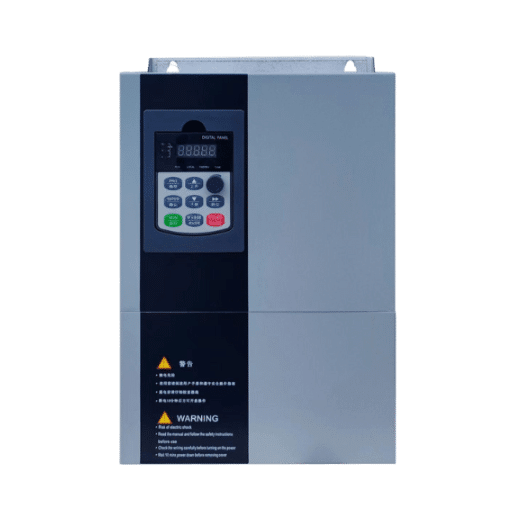
Ready to Get Your VFD Solution?
Whether you need a single drive or a complete system, we have the VFD products and engineering support to ensure your project's success.


A modern high voltage VFD typically reaches 96-98.5% efficiency at rated load. Yet a 5 MW drive running at 97% efficiency still converts roughly 150 kW of electricity into heat. The real question is not whether the drive is efficient, but whether the system around it is.
Engineers and plant managers evaluating large motor retrofits often fixate on the drive’s standalone efficiency number. That single figure misses transformer losses, cable losses, harmonic losses, cooling power, and part-load behavior. A lower-efficiency drive located next to the motor can beat a higher-efficiency drive fed through long cables and a step-up transformer.
This guide explains how high voltage VFD efficiency is rated, where the losses hide, and how to calculate genuine energy savings for motors from 2.3 kV to 13.8 kV. By the end, you will have a practical method for comparing topologies and building a defensible ROI case.
Key Takeaways
- Modern high voltage VFDs reach 96-98.5% efficiency at full load, but system-level losses determine real savings.
- Losses come from semiconductors, transformers, reactors, cooling, harmonics, and cables, not just the converter.
- Direct medium voltage drives often beat low voltage plus step-up transformer systems by 2-4% at the system level.
- Variable-torque loads (pumps, fans) can cut energy use by 20-50% using affinity laws.
- Always calculate savings using the actual load profile, not the nameplate rating.

In industrial procurement, high voltage VFD usually means a medium voltage drive: an adjustable-speed drive rated from roughly 2.3 kV to 13.8 kV and from a few hundred kilowatts to tens of megawatts. True high voltage drives above 35 kV exist only in utility or specialized traction applications. For most plant engineers, the practical range is medium voltage.
Efficiency is the ratio of output power delivered to the motor divided by input power drawn from the supply. A drive rated 98% efficient consumes 100 kW of electrical input for every 98 kW of mechanical power it delivers.
However, the published efficiency curve almost always refers to the converter cabinet at a specific voltage, load, and temperature. It rarely includes:
For a complete business case, you need system efficiency: motor output power divided by electrical power at the point of common coupling.
When Elena Vasquez, a senior electrical engineer at a Mexican cement plant, compared two retrofit options for a 3,300 kW kiln fan, she found the LV-plus-transformer package had a higher published drive efficiency. The direct 6.6 kV drive looked worse on paper until she added transformer, cable, and cooling losses. The medium voltage system ended up 2.3% more efficient overall and saved 76 kW continuously.
Want to understand how voltage class affects your total system? Read our complete guide to high voltage VFDs for selection principles across 2.3 kV to 13.8 kV applications.
Manufacturers publish efficiency curves, not single numbers. Still, it helps to know the typical ranges for common medium voltage topologies.
| Topology | Typical Full-Load Efficiency | Common Voltage Range | Notes |
|---|---|---|---|
| Cascaded H-Bridge (CHB) | 96-98% | 3.3-13.8 kV | Uses phase-shifting transformer; low harmonics; mature technology. |
| 3-Level NPC | 96-97.5% | 2.3-4.16 kV | Compact; common in lower MV ratings. |
| Modular Multilevel Converter (MMC) | 97-98.5% | 6.6-13.8 kV | High efficiency; excellent waveform quality. |
| Load Commutated Inverter (LCI) | 97-98% | Up to 13.8 kV+ | Used for very large synchronous motors. |
| Current Source Inverter (CSI) | 96-97.5% | 2.3-7.2 kV | Robust; handles short circuits well. |
These figures are approximate. The exact number depends on semiconductor type (IGBT, IGCT, IEGT), switching frequency, cooling design, and operating point. Always request the manufacturer’s efficiency curve at the load points your application actually uses.
Part-load efficiency matters because few industrial motors run at 100% speed 100% of the time. Most modern MV drives remain above 95% efficient down to 50% load, but the curve softens below that. Older or less optimized designs can drop below 90% at light loads.
The most relevant standard for drive-system energy efficiency is IEC 61800-9-2. It defines efficiency classes for complete drive modules (CDM) and power drive systems (PDS). The standard creates a common language for comparing drives, but the classes are still more widely applied in low voltage markets than in medium voltage.
In 2026, several trends are pushing efficiency higher:
For more background on medium voltage classes and ratings, see our medium voltage VFD selection guide.
Losses in a high voltage VFD system can be grouped into five categories. Understanding each one prevents the common mistake of comparing only the drive’s headline efficiency.
IGBTs, IGCTs, or IEGTs act as electronic switches. Every time they turn on or off, a small amount of energy is lost as heat. Conduction losses occur while the device is conducting current. Switching losses depend on switching frequency and voltage. Higher switching frequencies produce smoother motor waveforms but increase switching losses.
Many MV topologies use an input transformer with multiple secondary windings. Transformer losses typically range from 0.5% to 1.5% of throughput. Active front-end designs can eliminate the transformer, but they add reactor and filter losses. Output reactors or filters add another 0.2-0.5%.
Fans, pumps, control power supplies, and contactors consume energy. In air-cooled drives, fan power can reach 1-2% of drive rating. In water-cooled drives, pump power is usually lower but must still be counted. These losses are present even when the motor is lightly loaded.
PWM switching creates voltage and current harmonics. Harmonics increase heating in the motor stator and rotor, in supply transformers, and in power factor correction capacitors. A drive with total harmonic distortion (THD) below 3% will create far fewer downstream losses than one with 8-10% THD.
High voltage drives reduce current for a given power level. That is a major system-level advantage. A 5 MW motor at 400 V draws roughly 7,200 A; at 6.6 kV it draws only about 440 A. Because cable losses scale with the square of current, the high voltage installation can dramatically reduce I²R losses, especially over long distances.
At a mining site in Chile, the engineering team replaced a 690 V drive feeding a 2,500 kW SAG mill motor through 300 meters of cable with a direct 3.3 kV drive. Cable losses alone fell by 52 kW. Over 8,000 operating hours per year, that was 416 MWh and roughly $42,000 in electricity savings.

The terms overlap. Low voltage is generally below 690 V. Medium voltage covers roughly 1 kV to 35 kV. High voltage in industrial conversion usually means the upper medium voltage range, from 3.3 kV to 13.8 kV.
| Comparison | Low Voltage VFD + Step-Up | Direct Medium Voltage VFD |
|---|---|---|
| Drive efficiency | Often 97-98% | 96-98.5% |
| Transformer losses | 2-4% added | Usually eliminated or reduced |
| Cable losses at same power | High current = high I²R | Lower current = lower I²R |
| Harmonic mitigation | Often additional filters | Often integrated in topology |
| System efficiency | Can be 2-4% lower | Usually higher for large motors |
| Best for | Motors below ~1,000 kW | Motors above ~1,000-2,000 kW |
The crossover point depends on distance to the motor, cable size, and transformer efficiency. As a rule of thumb, direct MV drives become attractive for motors above roughly 1,000-2,000 kW, especially when the motor is more than 50-100 meters from the electrical room.
The standard method is a before-and-after comparison using the actual load profile. Do not estimate savings from the motor nameplate. Estimate them from how the motor actually runs.
For a fixed-speed motor using throttling or damper control, measure or estimate input power over a representative operating cycle. If direct measurement is not available, use:
Pbase=Pratedηmotor×LFPbase=ηmotorPrated×LF
where Prated is motor shaft power and LFLF is the average load factor.
For variable-torque loads such as centrifugal pumps and fans:
PVFD=Prated×(NNrated)3PVFD=Prated×(NratedN)3
At 90% speed, power drops to roughly 73%. At 80% speed, it drops to roughly 51%. At 70% speed, it drops to roughly 34%.
The VFD consumes slightly more electrical input than the motor requires because of conversion losses:
Pin=PVFDηVFD×ηmotor,VFDPin=ηVFD×ηmotor,VFDPVFD
Use the drive efficiency at the target operating point, not the full-load headline.
Add transformer, cable, filter, and cooling losses. Then subtract the result from baseline energy to get savings:
ΔE=Ebase−EVFD−EauxΔE=Ebase−EVFD−Eaux
A water treatment plant runs a 2,000 kW, 4.16 kV pump motor at fixed speed with a discharge valve throttled to 80% of rated flow.
This example is simplified but shows why actual load profile is more important than drive nameplate efficiency.

For a real project, do not rely entirely on catalog curves. Measure performance before and after installation using the methods described in the U. S. DOE Variable Frequency Drive Evaluation Protocol.
Use power analyzers with accuracy of ±0.2% or better. Current transformers must be sized correctly and positioned to capture all phases. For MV systems, use properly rated voltage transformers or high-voltage differential probes.
The DOE protocol recommends either a performance curve approach, where savings are calculated from measured load and speed, or a default curve approach for common applications. For maximum credibility, follow IPMVP Option A or B and document baseline and reporting-period conditions.
Natural Resources Canada provides additional guidance on VFD efficiency tables and system selection in its Variable Frequency Drives resource.
Selection and installation decisions have a larger impact on lifetime efficiency than the last half-percent of drive efficiency.
Oversized drives run at lower load factors where efficiency is poorer. Match the drive continuous rating to the actual duty cycle, including overload requirements.
For large pumps and fans, cascaded H-bridge and MMC designs often offer the best combination of efficiency and waveform quality. For high starting torque or synchronous motors, LCI or CSI may be appropriate despite slightly lower headline efficiency.
Specify drives with integral input transformers, active front ends, or harmonic filters. Lower THD reduces losses in transformers, cables, and motors across the plant.
Place the drive as close to the motor as practical. High voltage helps, but every meter of cable still matters.
Dusty filters, failed fans, or degraded coolant raise operating temperature. Higher temperature increases semiconductor losses and reduces reliability. For liquid-cooled systems, monitor coolant conductivity and flow. See our water-cooled VFD guide for maintenance best practices.

The business case rests on four value streams.
This is usually the largest component for variable-torque loads. Savings of 20-50% are common when the system currently uses throttling, damper, or recirculation control.
Many utilities bill based on peak demand. Reducing maximum power draw can cut demand charges significantly, especially in plants with seasonal peak loads.
Soft starting and controlled acceleration reduce wear on couplings, bearings, and impellers. Motor rewinds and mechanical maintenance often drop after a VFD retrofit.
Precise speed and pressure control improve product quality, reduce water hammer, and enable automation. These benefits are harder to quantify but often justify the project alongside energy savings.
For heavy variable-torque loads with high operating hours, payback is often 1-3 years. For applications that run continuously at near-full load with little throttling, payback can stretch beyond five years. The key variable is the difference between baseline power and variable-speed power at the actual duty cycle.
At a steel mill in India, plant manager Rajesh Patel justified a 6.6 kV VFD retrofit for a 5,000 kW blast furnace blower. The blower ran at fixed speed and was throttled by inlet vanes. After installing the VFD, average power dropped from 4,800 kW to 3,100 kW. Even with a capital cost of $1.2 million, the project paid back in 18 months through energy savings alone.
Ready to model savings for your high-voltage motor? Contact the Shandong Electric Engineering team for an efficiency assessment and VFD selection review.
Modern high voltage VFDs typically reach 96-98.5% efficiency at rated load. The exact value depends on topology, semiconductor technology, switching frequency, cooling, and operating point.
The drive itself may have similar or slightly lower standalone efficiency, but the system is often more efficient. Direct MV drives eliminate step-up transformers and reduce cable I²R losses, which can improve total system efficiency by 2-4% for large motors.
Calculate baseline energy use, then estimate variable-speed power using affinity laws for pumps and fans. Divide by VFD and motor efficiency at the operating point, add auxiliary losses, and compare to the baseline.
Main losses include semiconductor conduction and switching losses, transformer or reactor losses, auxiliary cooling power, harmonic losses, and cable losses between the drive and motor.
Yes. Most drives remain efficient above 50% load, but efficiency can fall at very light loads. Always use the manufacturer’s part-load efficiency curve for accurate savings estimates.
IEC 61800-9-2 defines efficiency classes for complete drive modules and power drive systems. Regional regulations such as EU Ecodesign also set minimum efficiency requirements for motors and drives.
High voltage VFD efficiency is a system question, not a single catalog number. A well-selected direct medium voltage drive can cut energy use, reduce cable losses, eliminate transformer losses, and improve process control for motors above roughly 1,000-2,000 kW.
To build a reliable business case, start with the actual load profile. Apply the affinity laws for variable-torque loads, include all system losses, and verify results with field measurements where possible. The drive that looks best on a spec sheet is not always the drive that delivers the lowest lifecycle cost.
For more on selecting and applying high voltage drives, explore our high voltage VFD systems page or read related guides on VFD for power plants and heavy industry, water-cooled VFD, and industrial high voltage drives for mining. The Shandong Electric Engineering team can help you match topology, voltage class, and control strategy to your application.