Ready to Get Your VFD Solution?
Whether you need a single drive or a complete system, we have the VFD products and engineering support to ensure your project's success.



Unlock superior motor performance and significant energy savings with our advanced 3-phase Variable Frequency Drives (VFDs). Take complete control of your industrial and commercial applications with solutions trusted by professionals around the world.
A 3 Phase Variable Frequency Drive (VFD) is a sophisticated electronic device that controls the speed and torque of a three-phase AC electric motor. It is also commonly referred to as a 3 phase vfd, an adjustable speed drive, a variable speed drive, or a 3ph drive. Its primary function is to take the standard, fixed-frequency AC power from the electrical grid and convert it into a variable-frequency, variable-voltage power source, allowing for precise and efficient control of the motor’s speed.


3 Phase Variable Frequency Drives provide exact control over the speed of three-phase AC motors. This allows for seamless speed adjustments to perfectly match the demands of any application. By modulating the power frequency, these drives ensure the motor operates at its optimal speed for peak performance.
A key benefit of 3 Phase Variable Frequency Drives is their ability to drastically reduce energy consumption. By running the motor only as fast as needed, they eliminate wasted electricity, which leads to significant savings on operational costs and a much smaller environmental footprint for your facility.
Many 3-Phase Variable Frequency Drives can convert a single-phase power input into a balanced three-phase output. This valuable feature enables the use of powerful and efficient three-phase motors in locations where only single-phase power is available, greatly expanding their application versatility.
3 Phase Variable Frequency Drives deliver unparalleled control and efficiency to a vast range of industrial and commercial applications. By incorporating advanced power electronics and intelligent control algorithms, these drives precisely manage the speed and torque of AC motors. This optimization significantly enhances operational performance, reduces energy consumption, and improves overall system reliability.
The most common and widely utilized category of 3 Phase Variable Frequency Drives is the General-Purpose drive. These VFDs are engineered to provide a versatile solution, including pumps, fans, and conveyors. They offer an excellent balance of core features—including robust motor control, energy savings capabilities, and essential protection functions—without the specialized, high-performance features of more advanced vector or servo drives. This makes them the go-to choice for countless applications where reliable, efficient speed control is the primary requirement.
A key capability of many 3 Phase Variable Frequency Drives is their advanced phase conversion, which allows for the conversion of a single-phase input into the balanced, three-phase output required to run a three-phase motor. This feature is particularly valuable in settings where only single-phase power is available, but the application demands the use of a more powerful and efficient 3-phase motor. By bridging this power gap, 3 Phase Variable Frequency Drives expand the versatility and applicability of high-performance motor systems across a diverse range of environments.
All drives undergo strict quality control and are backed by international safety and environmental certifications.
Trusted by global brands in manufacturing, utilities, agriculture, and construction, our VFDs are engineered for long service life and minimal downtime.
From initial consultation to post-sale troubleshooting, our team provides unparalleled technical expertise and tailored advice for every application.

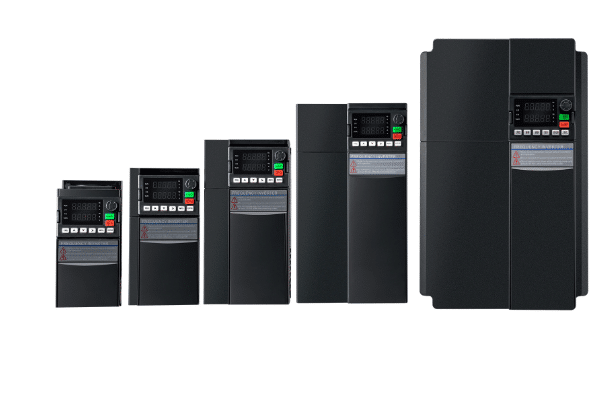
A high-performance 3 Phase VFD featuring a compact design and an intuitive dual display. It offers rich functionality, including advanced vector and standard V/F control, making it a versatile and cost-effective solution for various industrial applications that require precise three-phase motor control.
Key Parameters:

A universal, general-purpose 3 Phase Variable Frequency Drive with superior performance and a modern, compact design. Engineered for excellent heat dissipation and versatile configuration, it is an ideal and highly adaptable drive for a broad array of standard three-phase motor applications.
Key Parameters:

Our premier heavy-duty 3 Phase Variable Frequency Drive, engineered for applications demanding high torque at low speeds. It delivers exceptional dynamic response and superior overload capacity for three-phase motors, making it perfect for the most challenging industrial automation tasks.
Key Parameters:
Our 3-phase VFDs are engineered for flexibility, reliability, and advanced performance. Main technical features include:
| Parameter | Description/Options |
|---|---|
| Input Voltage | 208V / 220V / 380V / 400V / 415V / 440V / 460V / 480V AC, 3-phase (some models support 1-phase) |
| Output Voltage | 0 to rated input voltage, fully adjustable |
| Power Range | 0.75 kW (1 HP) up to 500 kW (670 HP), custom ranges available |
| Output Frequency | 0.1 – 400 Hz (standard), configurable by model |
| Control Modes | V/F (voltage/frequency), Sensorless Vector Control |
| Protection Features | Overcurrent, overvoltage, undervoltage, overload, short-circuit, phase loss, ground fault, overheat |
Selecting the optimal VFD requires careful consideration of your motor specifications, application requirements, environmental conditions, and performance objectives. Our technical team provides comprehensive support throughout the selection and implementation process.
We assist with:
It works in three main stages. First, a rectifier converts the incoming AC power to DC power. Second, the DC bus smooths and stores this power in capacitors. Finally, an inverter takes the DC power and synthesizes a new, adjustable-frequency AC output to send to the motor, which directly controls its speed.
Yes, this is a very common and valuable application. Many 3 Phase VFDs are specifically designed with phase conversion capabilities. They can accept a single-phase input and generate a balanced, three-phase output, allowing you to run powerful and efficient three-phase motors in locations where only single-phase power is available.
3 Phase VFDs are used in a vast range of industrial and commercial applications, including:
Pumps, fans, and blowers in HVAC and water treatment systems.
Conveyor belts in manufacturing and logistics.
Machine tools like lathes, mills, and grinders.
Mixers, agitators, and extruders in processing plants.
Overload capacity (e.g., “150% for 60 seconds”) indicates the drive’s ability to provide extra current for a short period. This is crucial for starting heavy or high-inertia loads that require a temporary boost in torque to get moving.
The main difference is the power they are designed to handle. A single-phase VFD is designed to control a single-phase motor. A three-phase VFD is designed to control a three-phase motor. While a three-phase VFD can often run on single-phase power (phase conversion), its output is always three-phase.
While a VFD can run most standard three-phase motors, it is highly recommended to use an inverter-duty motor. These motors are specifically designed with better insulation and construction to withstand the unique electrical stresses created by a VFD, which helps ensure a longer and more reliable motor lifespan.